
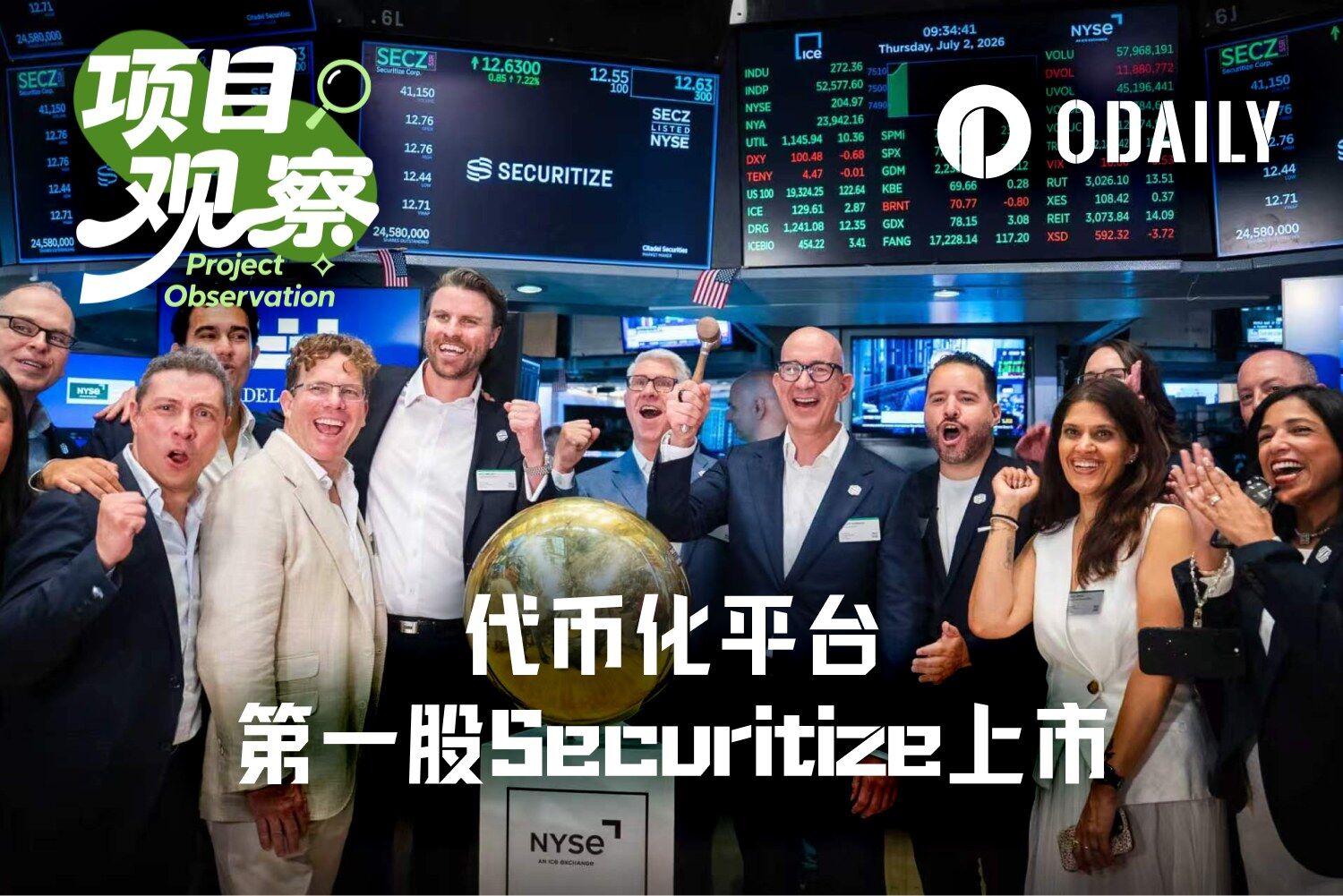
Securitize starts trading on the NYSE as SECZ
On July 2, Securitize officially began trading on the New York Stock Exchange after completing its business combination with special purpose acquisition company Cantor Equity Partners II. The company now trades under the ticker SECZ. On its first day in the public market, SECZ opened at $12.45, climbed as high as $13.70 during midday trading, and eventually closed at $12.3. Based on market estimates, that placed Securitize’s first-day valuation at roughly $1.96 billion, with the intraday peak approaching $2.2 billion.

The public listing is notable not only because Securitize has entered the traditional equity market, but because it simultaneously pushed its own common shares on-chain. At launch, the company tokenized SECZ and made the tokenized shares available to eligible U.S. investors through its regulated platform on Avalanche and Solana. According to RWA.xyz, SECZ immediately became the largest tokenized stock globally by on-chain value, exceeding $295 million on its first day.
That combination of a traditional NYSE listing and an on-chain securities launch makes Securitize the first company to be listed both in conventional public markets and on-chain at the same time. In practical terms, SECZ is more than just a newly public stock. It is also Securitize’s clearest statement yet that the company intends to compete directly in tokenized equities, not just in the broader institutional RWA market where it has already built scale.
From institutional RWA leader to a more direct push into tokenized equities
By DeFiLlama’s measure, Securitize currently leads the RWA sector with more than $4.4 billion in on-chain issued real-world assets, excluding stablecoins such as USDT and USDC. On that basis, it ranks ahead of Circle, Tether, Ondo, and other major names in the space. Yet despite that leadership, Securitize has historically been less visible to retail crypto users than platforms such as Ondo, xStocks, or Binance’s bStocks.

The reason is largely structural. Securitize’s product suite has mostly been built for institutions rather than retail traders. Its 24 on-chain tokenized products, representing more than $4 billion in assets, have mainly focused on bonds, private credit, and money market funds. Prior to SECZ, it had only one tokenized single-stock product, CURR, and that product had seen minimal trading activity. In other words, Securitize has been a dominant issuer in RWA, but not a household name in the tokenized stock narrative that tends to attract retail attention.
Its most representative product to date is BUIDL, the tokenized money market fund issued for BlackRock. That fund has already grown beyond $2.2 billion, making it the second-largest tokenized money market fund in the current RWA market, behind Circle’s USYC. Against that backdrop, using SECZ as its first major tokenized stock signals a meaningful widening of strategic focus. It suggests that Securitize is no longer content to dominate only the institutional side of tokenized assets and is now moving into a segment with a very different user base and competitive dynamic.
“Own the real thing”: how Securitize differs from most tokenized stock platforms
Securitize’s website summarizes its positioning with a simple slogan: “OWN THE REAL THING, NOT A SYNTHETIC VERSION.” That line captures the main distinction the company wants to draw against much of the existing tokenized stock market. According to Securitize, each tokenized stock on its platform represents direct ownership of actual underlying shares, carrying the same legal and economic rights as a conventional shareholder, including dividends, voting rights, and related entitlements.

That is materially different from many tokenized stock products already circulating in the market. A large number of them function more as wrappers, economic claims, or synthetic exposure instruments. In those models, investors may receive stock-price exposure and in some cases dividend-like economics, but they do not necessarily receive direct legal ownership of the underlying equity or the full regulatory protections associated with registered securities. The article specifically points to offerings from Ondo, xStocks, Binance’s bStocks, and products associated with Bitget and Reality as examples closer to that model.
Seen from a market-structure perspective, Securitize is trying to fuse on-chain transferability with traditional securities ownership. That is a heavier and more compliance-intensive path, but it also aligns with the company’s long-standing strength in regulated issuance infrastructure. Securitize is not approaching tokenized equities simply as a way to create tradable digital proxies. It is attempting to move actual share ownership onto blockchain rails.
The cost of authenticity is a much narrower market
The problem is that “real” ownership comes with meaningful access restrictions. To buy SECZ, an investor must complete KYC, pass KYC/AML review, satisfy jurisdictional requirements, and comply with applicable securities laws. If an investor lacks U.S. status, even passing the onboarding process can be difficult. Securitize then whitelists approved wallet addresses, and only those whitelisted wallets are allowed to hold and trade tokenized SECZ.

This creates a sharp contradiction. SECZ exists on Avalanche and Solana, and in principle it lives in an on-chain environment associated with decentralization and composability. In practice, however, ordinary users cannot freely access it. The blockchain layer preserves programmability and settlement flexibility, but not open entry. For most global retail participants, Securitize’s tokenized stock product therefore looks more like regulated on-chain securities infrastructure than like a universally accessible crypto-native stock market.
When launching tokenized SECZ, Securitize posted on X that even though U.S. traditional stock markets would be closed on Friday, July 3, for the Independence Day holiday, SECZ would continue trading. The message is striking from a marketing perspective because it highlights the 24/7 promise of blockchain rails. Yet the irony is obvious: the number of investors actually eligible to trade tokenized SECZ remains very small, while retail traders around the world can more easily obtain comparable market exposure through other platforms that do not sell “the real thing.”
Still, the company does not appear to be backing away from this strategy. Securitize president Brett Redfearn said after the IPO that the firm is already discussing the possibility of tokenizing additional IPOs within the next year. That suggests SECZ is intended as the first major step in a broader tokenized-equities rollout rather than a one-off experiment.
How the valuation looks after listing
From an investment standpoint, SECZ closed its first trading day at $12.3, but Securitize has not publicly disclosed its current total share count, so valuation has to be estimated from filings. In its SEC S-4 filing, Securitize assigned itself a valuation of $1.25 billion. The subscription price for the SPAC and PIPE financing was $10 per share, implying about 125 million shares. Adding roughly 30 million outstanding common shares from shell company Cantor Equity Partners II puts the post-merger share count at around 160 million shares.
Using that rough share base, Securitize’s first-day market capitalization comes out to approximately $1.96 billion, with the intraday high approaching $2.2 billion. In April, investment bank Benchmark assigned Securitize a post-listing price target of $16, arguing that the company was well positioned to benefit from the expansion of tokenized assets. Benchmark’s thesis emphasized that Securitize is not just a tokenization platform. It also has a more complete regulatory stack, including broker-dealer, transfer-agent, and trading capabilities, which could allow it to monetize issuance, secondary trading, custody, and other lifecycle services.
According to the company’s S-4 filing, Securitize generated $55.6 million in revenue in the first nine months of 2025. Management did not disclose full-year 2025 results but projected approximately $69 million in revenue for the year. For Q1 2026, the company reported $19.5 million in revenue, up 39% from Q1 2025 and marking the highest quarterly revenue in its history. Management also projected full-year 2026 revenue of about $110 million.

Using management’s 2025 revenue outlook, Securitize is trading at a roughly 28x static price-to-sales multiple for 2025. One public reference point is Figure, another RWA platform focused more heavily on real estate and private credit. Figure’s 2025 static price-to-sales multiple is around 15x. Looking at tokenized AUM, Securitize stands at $4.4 billion while Figure is at $19.4 billion. That implies a market cap-to-AUM ratio of about 0.45 for Securitize versus 0.38 for Figure. On both valuation lenses, Securitize screens somewhat richer than Figure.
That means the stock does not look obviously undervalued based on simple peer comparisons. At the same time, those metrics do not fully capture the breadth of Securitize’s business model, its regulatory positioning, or its status as one of the strongest infrastructure players in the RWA sector. The market appears to be assigning a premium to that combination and to the possibility that tokenized equities become a meaningful additional growth engine.
The deeper paradox of tokenized stocks
There is a broader tension in tokenized equities that Securitize’s debut makes unusually clear. In many cases, investors care most about convenient access to price exposure, longer trading hours, and on-chain transferability. They care far less about shareholder voting, formal registration, or direct legal title to the underlying shares. In that environment, the market often rewards products that are easier to trade rather than products that more faithfully replicate real ownership.

That puts Securitize in a difficult but important position. On one hand, its approach arguably moves tokenized stocks closer to the standards of traditional securities markets by insisting on direct ownership and full rights. On the other hand, that same insistence raises barriers to entry and reduces addressable retail demand. The result is a model that may be more robust in regulatory and legal terms, but less attractive in pure distribution terms.
The final irony is hard to miss. If a retail investor believes in Securitize’s long-term prospects and wants to make a value-oriented bet on SECZ, the official on-chain version may still be inaccessible. In practice, that investor may have to wait for another platform to launch a more easily tradable imitation or exposure product. Securitize is trying to build tokenized securities the “right” way, but the market it is entering still appears more comfortable with simpler, more flexible substitutes.