
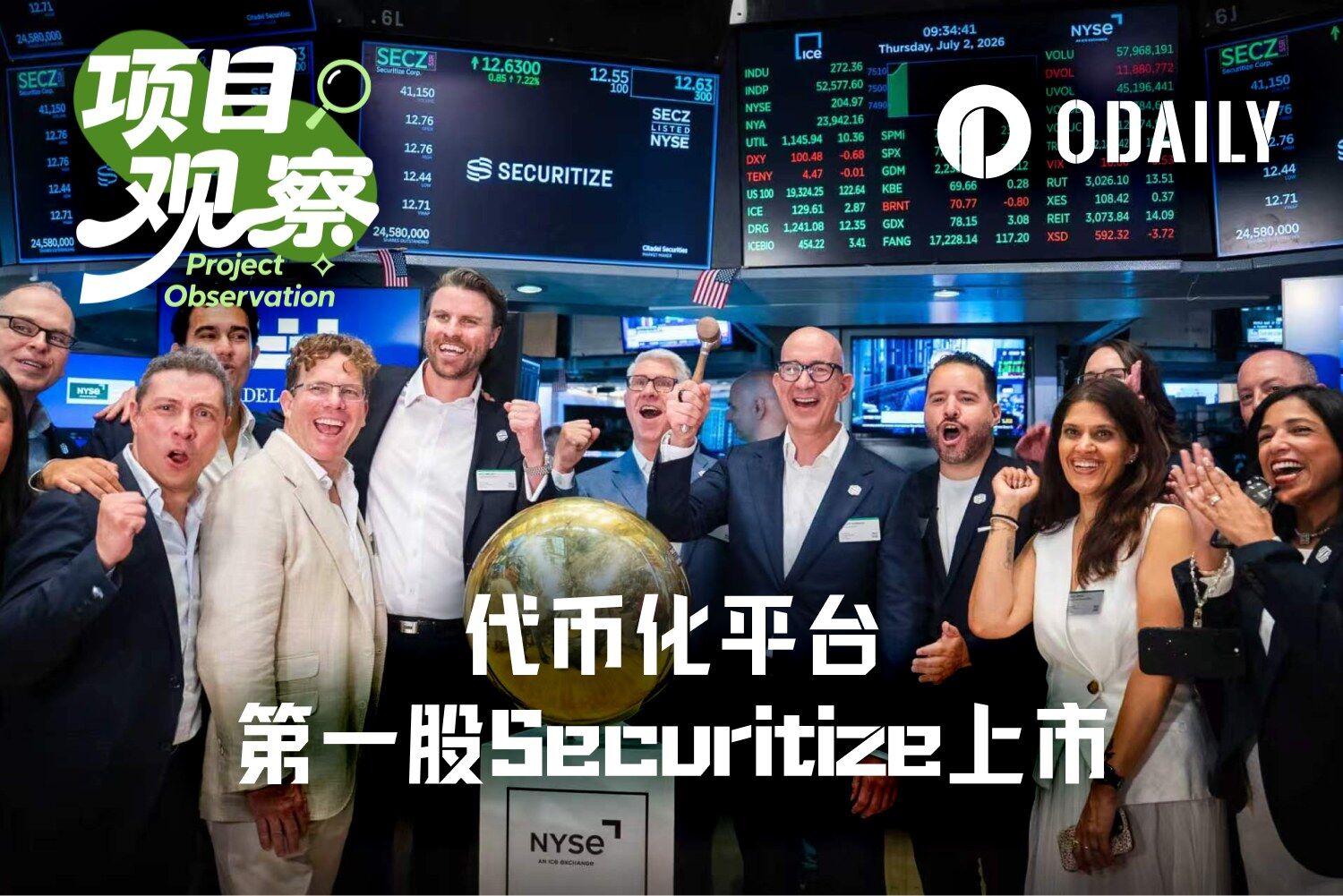
Securitize goes public with SECZ and brings its own equity on-chain
On July 2, Securitize officially began trading on the New York Stock Exchange after completing a business combination with special purpose acquisition company Cantor Equity Partners II. The company now trades under the ticker SECZ. On its first day, the stock opened at $12.45, climbed as high as $13.70 around midday, and eventually closed at $12.3. Based on market estimates derived from public filings and the post-merger share count, that placed the company’s market capitalization near $2 billion, with the intraday peak approaching $2.2 billion.

The listing matters well beyond the equity debut itself. Securitize also tokenized its own common stock from day one, making it available through its regulated platform to eligible U.S. investors on both Avalanche and Solana. According to RWA.xyz, SECZ became the largest tokenized stock globally by on-chain value on its first day of issuance, surpassing $295 million. In practical terms, that makes Securitize the first company to be listed simultaneously on the NYSE and on public blockchains in a regulated tokenized equity format.
That development is especially notable because Securitize has long been viewed as the institutional heavyweight of the RWA segment rather than a retail-facing tokenized stock venue. DeFiLlama data cited in the source shows that Securitize has more than $4.4 billion in on-chain RWA issuance, ranking first ahead of Circle, Tether, Ondo, and other platforms when stablecoins such as USDT and USDC are excluded. Yet despite that leadership, many crypto retail users are more familiar with names like Ondo, xStocks, or Binance’s bStocks than with Securitize.
The reason is straightforward: Securitize historically built its business around institutional products, not mass-market crypto distribution. Its tokenized products are concentrated in bonds, private credit, and money market funds. That strategy gave it scale, regulatory depth, and credibility with asset issuers, but it also left it relatively less visible to users who mainly interact with tokenized equities through exchanges or simplified synthetic wrappers. SECZ changes that perception, because it places Securitize directly into one of the most closely watched subsegments of tokenized finance.
The institutional base behind Securitize’s RWA lead
Securitize currently has 24 on-chain tokenized products and more than $4 billion in total assets represented across them. Most of these products sit firmly in institution-oriented categories such as debt instruments, private credit, and money market vehicles. Before SECZ, the only tokenized single-name equity on the platform was CURR, and that product had little meaningful trading activity. In other words, tokenized stocks were not the core of Securitize’s business, even though tokenization itself clearly was.

The company’s flagship example remains BUIDL, the tokenized money market fund built for BlackRock. As cited in the source material, BUIDL has already exceeded $2.2 billion in size, making it the second-largest tokenized money market fund in the RWA market. The article also notes that the largest is Circle’s USYC. BUIDL is important not just because of its scale, but because it shows where Securitize has been strongest: regulated issuance infrastructure for blue-chip financial institutions that want compliant access to blockchain rails.
This institutional orientation is what makes SECZ a strategic turning point. It is not Securitize’s first tokenized stock in an absolute sense, but it is the company’s first major one and, more importantly, its own equity. That signals a move from using tokenization primarily for institutional fixed-income and cash-management products toward applying the same compliance-heavy architecture to listed equities. For the broader market, it suggests that the dominant RWA platform is now stepping directly into the tokenized stock battlefield.
That battlefield is commercially attractive but structurally difficult. Tokenized stocks attract far more public attention than tokenized credit or money market funds because they speak directly to price discovery, market access, and trading narratives. At the same time, they raise more complicated questions around ownership, shareholder rights, secondary trading restrictions, transfer control, and securities law. Securitize is entering this category from a position of regulatory strength, but also into a segment where competitors have often grown faster by taking looser approaches to legal structure.
Why SECZ is different from most tokenized stocks on the market
Securitize’s own slogan captures the distinction succinctly: “OWN THE REAL THING, NOT A SYNTHETIC VERSION.” That line is not merely marketing. According to the source, each tokenized stock issued through Securitize represents direct ownership of actual shares and comes with the same legal and economic rights as a traditional shareholder, including dividends, voting rights, and other associated entitlements. In that sense, the token is intended to be a compliant digital representation of real equity ownership rather than a derivative claim or price mirror.

This stands in sharp contrast to many products commonly described as tokenized stocks elsewhere in the market. In many competing structures, investors receive economic exposure to an underlying stock, including price participation or potentially dividend-linked value, but they do not necessarily obtain direct ownership of the real shares, a full legal shareholder relationship, or the same level of regulatory protection. The original article specifically groups products from Ondo, xStocks, Binance’s bStocks, and Bitget’s Reality into that broader category of exposure-based tokenized stock products.
The difference matters because it changes the legal and economic meaning of the token. If a token only tracks or references the value of a stock, then it functions closer to a packaged exposure instrument. If it represents actual common shares, then the token becomes part of a securities framework with direct implications for transfer restrictions, rights enforcement, onboarding, custody, and investor eligibility. Securitize is explicitly pursuing the second path, which is far more demanding operationally but also much closer to the idea of genuine securities tokenization.
This is one reason SECZ is important for the RWA narrative. Much of the industry has used the term “tokenized stock” quite loosely, often to describe products that optimize access and trading convenience rather than ownership authenticity. Securitize is trying to anchor the category in actual share ownership and regulated infrastructure. Whether that model scales faster or slower than more synthetic alternatives is a separate question, but the legal distinction is fundamental and should not be blurred.
Compliance requirements make SECZ far less accessible to retail traders
The tradeoff for selling the “real thing” is a much narrower user base. To purchase SECZ through Securitize, investors must complete KYC, pass KYC/AML reviews, satisfy jurisdictional requirements, and comply with applicable securities law restrictions. The source notes that if an investor does not have U.S. identity credentials, even passing the initial KYC process may be impossible. Securitize then whitelists eligible wallet addresses, and only those approved wallets are allowed to hold and trade tokenized SECZ.

That means the token may exist on-chain, but it is not open-access in the way many crypto-native users might assume. Even if SECZ is technically tradable in decentralized environments, ordinary users cannot simply connect a wallet and buy it unless their address has been approved within the regulated framework. In effect, blockchain settlement does not eliminate investor qualification rules; it simply changes the medium through which eligible securities are held and transferred.
Securitize highlighted one of the advantages of this structure in a post on X, saying that although the U.S. stock market would be closed on Friday, July 3, for Independence Day, SECZ would continue trading. From a technical and market-structure perspective, that demonstrates how tokenized securities can extend trading availability beyond traditional exchange hours. But as the source article points out, there is an irony here: the actual number of investors globally who are eligible to trade SECZ remains very small.
That irony cuts to the heart of the current tokenized stock market. Many investors mainly want easy stock exposure, not necessarily shareholder voting rights or direct legal title. For that audience, products that deliver economic exposure without full ownership may be “good enough,” especially if they are easier to access globally and involve fewer compliance hurdles. As a result, platforms offering exposure-based products can often reach a much larger audience than a platform like Securitize, whose stronger legal footing comes with higher friction.
Still, the company does not appear to be backing away from this path. After the IPO, Securitize president Brett Redfearn said the company is discussing the possibility of tokenizing other IPOs within the next year. That is a notable statement because it implies SECZ is not a symbolic one-off. Instead, Securitize may be building a repeatable model for bringing additional public equities on-chain under the same regulated ownership framework.
How the market may value Securitize after the listing
Assessing valuation requires some estimation because Securitize has not publicly disclosed its exact current fully diluted share count post-listing. The source uses the company’s SEC S-4 filing as a reference point. In that filing, Securitize assigned itself a valuation of $1.25 billion. The subscription price for the SPAC and PIPE financing was $10 per share, implying roughly 125 million shares attributable on that basis. Adding approximately 30 million ordinary shares outstanding at the shell company Cantor Equity Partners II suggests a post-merger total share count around 160 million.
Using that estimated share count, a closing price of $12.3 implies a market capitalization of roughly $1.96 billion on the first trading day. At the intraday high, the market cap would have come close to $2.2 billion. That is well above the valuation reference used in the merger documentation, but newly public companies in emerging sectors are often judged on forward expectations rather than static filing benchmarks alone.
In April of this year, investment bank Benchmark assigned Securitize a post-listing target price of $16. Benchmark’s thesis was that the company is well positioned to benefit from the tokenized asset wave because it is not merely a tokenization front end. It also holds what the article describes as a more complete regulatory stack, covering broker-dealer, transfer agent, and trading functionality. That means Securitize can potentially monetize multiple layers of the asset lifecycle, from issuance to secondary trading to custody-related services.
The company’s revenue profile in the filing also provides some context. According to the S-4, Securitize generated $55.6 million of revenue in the first nine months of 2025. While it had not disclosed full-year 2025 results at the time referenced in the article, management projected approximately $69 million in revenue for the full year. For the first quarter of 2026, the company reported revenue of $19.5 million, up 39% from the first quarter of 2025 and marking the highest single-quarter revenue in its history. Management projected roughly $110 million in revenue for full-year 2026.

Based on management’s 2025 revenue expectation, the article estimates Securitize’s 2025 static price-to-sales ratio at around 28x. As a listed comparison point, it cites Figure, another RWA-focused platform with major exposure to real estate and private credit. Figure’s 2025 static price-to-sales multiple is cited at about 15x. On tokenized assets under management, Securitize stands at $4.4 billion while Figure is at $19.4 billion. That implies a market cap-to-AUM ratio of approximately 0.45 for Securitize versus 0.38 for Figure.
On those comparative metrics, Securitize does not obviously look cheap. It trades at a premium both on a price-to-sales basis and on a market-cap-to-AUM basis. The article therefore argues that the stock does not appear meaningfully undervalued at current levels. However, that conclusion comes with an important caveat: Securitize may deserve some premium because its business mix is broader, its regulatory capabilities are deeper, and its leadership position in tokenized RWAs is stronger than many peers.
Ultimately, the market appears to be paying not just for current issuance volume, but for optionality. Investors are likely pricing in the possibility that Securitize can extend its infrastructure from institution-focused RWA products into tokenized public equities, and perhaps become a primary gateway for compliant on-chain securities issuance. Whether that premium can be sustained will depend on execution, revenue growth, and adoption of its tokenized stock model rather than on narrative alone.
The broader market tension: authenticity versus accessibility
The article closes on a tension that may define the tokenized stock sector for some time. In theory, direct ownership, dividend rights, and voting rights should be the gold standard. In practice, many market participants are primarily interested in tradable exposure to equity prices. If most users care more about access and convenience than about the full legal bundle of shareholder rights, then platforms selling “less authentic” tokenized stock products may continue to win on reach and liquidity.
That creates a classic market mismatch. The legally stronger structure may not be the most commercially scalable one in the early stages, especially if global retail users cannot easily pass the onboarding filters required by securities regulation. Securitize therefore enters tokenized stocks with a product that is arguably more faithful to the idea of ownership, yet potentially less attractive to the mass market than easier-to-access alternatives.
For crypto professionals, this makes SECZ a useful case study in the future of tokenized securities. It shows that the industry is no longer only experimenting with treasury products, credit instruments, and money market funds. It is now testing whether public equities can be brought on-chain in a legally robust form. But it also shows that technical availability alone does not equal open access, and that compliance architecture can shape liquidity just as much as blockchain infrastructure does.
In that sense, Securitize’s public debut is both a milestone and a stress test. It validates that a major RWA issuer can list publicly, tokenize its own shares, and anchor those shares to real ownership rights. At the same time, it forces the market to confront a harder question: in tokenized equities, will investors ultimately prefer the authenticity of real ownership or the convenience of looser exposure products? Securitize has made its choice clear. The market will determine how much that choice is worth.