
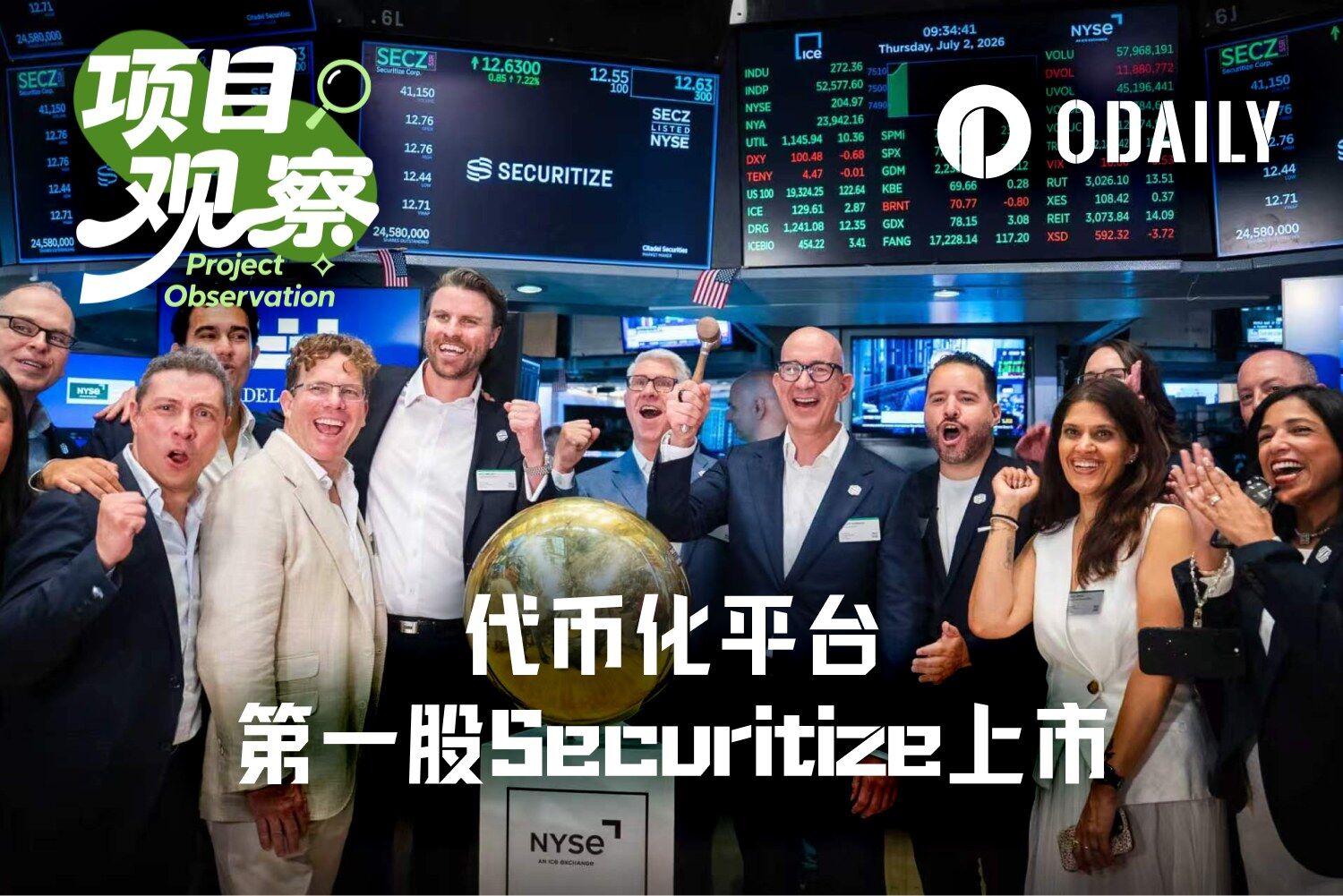
Securitize goes public as SECZ starts trading on the NYSE
On July 2, Securitize officially entered the public market by completing a business combination with special purpose acquisition company Cantor Equity Partners II. The merged entity began trading on the New York Stock Exchange under the ticker SECZ. On its first trading day, SECZ opened at $12.45, climbed to an intraday high of $13.70, and ultimately closed at $12.3. Based on public filing assumptions and market pricing, the company’s valuation on day one was roughly $1.96 billion, with the intraday peak approaching $2.2 billion.

The listing would already be notable on its own, but Securitize added a second layer of significance by tokenizing its own common stock at launch. Eligible U.S. investors can buy tokenized SECZ through Securitize’s regulated platform on both Avalanche and Solana. According to data cited from RWA.xyz, SECZ became the largest tokenized stock in the world on its first day of issuance, with more than $295 million in on-chain value. That makes Securitize the first company to debut simultaneously on the NYSE and on public blockchains in a meaningful way.
This move is important because it marks more than a branding exercise. For years, Securitize has been one of the most influential infrastructure providers in the RWA segment, but its product footprint was concentrated in tokenized funds, debt, and private credit rather than in equities aimed at a broader crypto audience. By placing its own stock on-chain as its first major tokenized equity, the company is signaling that tokenized stocks are now becoming a strategic growth area rather than a side experiment.
Why the RWA leader remained relatively unfamiliar to retail crypto users
Measured by on-chain scale, Securitize has long ranked at the top of the RWA stack. DeFiLlama data cited in the source indicates that the company has issued more than $4.4 billion in on-chain real-world assets, ahead of Circle, Tether, Ondo, and other platforms when stablecoins such as USDT and USDC are excluded from the comparison. Yet despite that leadership position, many retail crypto participants remain more familiar with names like Ondo, xStocks, or Binance’s bStocks than with Securitize itself.

The reason is structural rather than accidental. Securitize has never primarily built for mass retail order flow. Its customer base and operating model have been centered on institutions. Of its 24 on-chain tokenized products and more than $4 billion in assets, most consist of bonds, private credit, and money-market products. It has only one tokenized single-stock product mentioned in the article, CURR, and that instrument has seen essentially no trading activity. In other words, Securitize became the largest player in the category without relying on the types of products that usually generate retail attention.
The company’s most representative product is the tokenized money-market fund BUIDL, built for BlackRock. That fund has already exceeded $2.2 billion in size, making it the second-largest tokenized money-market product in the current RWA market, behind Circle’s USYC. This track record helps explain why Securitize is seen less as a consumer-facing crypto brand and more as a highly regulated issuance and transfer infrastructure provider with deep institutional credibility.
SECZ is designed as a tokenized real share, not a synthetic stock wrapper
Securitize is trying to differentiate itself sharply from the broader tokenized equity market. Its slogan captures the strategy clearly: “OWN THE REAL THING, NOT A SYNTHETIC VERSION.” In practical terms, Securitize says each tokenized stock on its platform represents direct ownership of actual shares, with the same legal and economic rights held by any traditional shareholder. Those rights include dividends, voting rights, and other shareholder entitlements attached to the underlying equity.

That stands in contrast to many products currently marketed as tokenized stocks. Across the market, these instruments often function more like contractual claims, economic exposure certificates, or synthetic wrappers. Investors may receive some of the economic upside, such as dividend-linked returns, but they do not necessarily receive actual ownership of the underlying share, nor the same regulatory protections attached to direct shareholding. The source article explicitly places tokenized stock products from Ondo, xStocks, Binance bStocks, and Bitget Reality in this broader category.
From a market design perspective, Securitize is choosing authenticity and legal clarity over open accessibility. The benefit is that the product is far closer to traditional securities law and actual shareholder structure. The cost is that participation cannot be permissionless in the way many crypto-native markets are. That tradeoff may define both the strengths and the limitations of SECZ as a new type of blockchain-based equity instrument.
Access is tightly restricted, leaving most retail investors shut out
The insistence on offering “real shares” comes with a very high compliance threshold. To purchase tokenized SECZ today, an investor must complete KYC and AML checks, satisfy jurisdiction-specific requirements, and comply with applicable securities laws before gaining access. According to the source, investors without U.S. identity credentials may not even pass the initial KYC stage. Securitize also uses wallet whitelisting, meaning only approved addresses can trade tokenized SECZ.
This detail matters because it changes what “on-chain availability” really means. Even if SECZ exists on Avalanche and Solana, and even if those chains support broader decentralized market infrastructure, the token itself is not open to unrestricted global trading. If a wallet is not whitelisted, the holder cannot participate. As a result, ordinary retail users are effectively excluded even in an on-chain environment that would normally be associated with broader access and fewer gatekeepers.
Securitize highlighted one advantage of the model in a post on X, noting that SECZ would continue trading even while the traditional U.S. stock market would be closed on Friday, July 3, for the Independence Day holiday. The statement underscores the time-zone and market-hours flexibility enabled by tokenization. At the same time, it also reveals the core paradox: the product may be technically live beyond Wall Street trading hours, but the set of people actually allowed to trade it remains very small on a global basis.
Despite those restrictions, Securitize appears committed to scaling the tokenized equity business. Company president Brett Redfearn said after the IPO that Securitize is discussing the possibility of tokenizing other IPOs within the next year. That suggests SECZ is meant to serve as the first major proof point in a broader strategy rather than a one-off showcase tied only to its own listing.
Valuation metrics suggest no obvious discount, but investors may be paying for strategic positioning
Whether SECZ is cheap after listing is harder to answer because the company has not publicly disclosed a definitive current share count. The article therefore relies on estimates from S-4 filing information. In those SEC documents, Securitize assigned itself a valuation of $1.25 billion. The SPAC and PIPE subscription price was $10 per share, implying roughly 125 million shares. Adding the approximately 30 million common shares outstanding at shell company Cantor Equity Partners II suggests the post-merger total share count is likely around 160 million.
Using that assumption, Securitize’s first-day closing price of $12.3 implies a market capitalization near $1.96 billion. Earlier, in April, investment bank Benchmark had assigned a post-listing price target of $16, arguing that Securitize was positioned to benefit materially from the growth of tokenized assets. Benchmark also emphasized that Securitize is more than a tokenization front end. The firm operates with what it described as a full regulatory stack, including broker-dealer, transfer agent, and trading capabilities, giving it multiple ways to monetize the life cycle of digital securities through issuance, secondary trading, and custody-related services.
Revenue figures included in the S-4 filing add more context. For the first nine months of 2025, Securitize generated $55.6 million in revenue, though it did not disclose the full-year 2025 figure. Management projected approximately $69 million for full-year 2025. The company also reported $19.5 million in revenue for the first quarter of 2026, up 39% from the first quarter of 2025 and representing its strongest quarter on record. Management’s forecast for full-year 2026 was about $110 million.

Based on management’s 2025 revenue outlook, Securitize trades at roughly 28 times price-to-sales on a static basis. One listed comparison mentioned in the source is Figure, another RWA platform with a stronger orientation toward real estate and private credit. Figure’s 2025 static price-to-sales multiple is cited at around 15 times. On that measure, Securitize already looks meaningfully more expensive. If compared on tokenized AUM, Securitize stands at $4.4 billion while Figure is at $19.4 billion. Securitize’s market cap to AUM ratio is about 0.45, versus 0.38 for Figure, again suggesting Securitize carries a richer valuation.
That said, the article does not conclude that the company is wildly overvalued. Instead, it argues that the premium may reflect the diversity of Securitize’s business model and its leadership position in the RWA sector. Investors are not simply paying for today’s revenue. They are also paying for regulatory licenses, enterprise relationships, issuance infrastructure, and the possibility that tokenized equities become a meaningful future category where Securitize can establish early dominance.
The broader market problem: real ownership may be less attractive than easy exposure
SECZ also highlights a more uncomfortable truth about the tokenized stock market. Most investors, especially in crypto, are not necessarily seeking full shareholder rights. In many cases, they simply want price exposure to a familiar public equity, tradable with low friction, broad availability, and round-the-clock market access. Dividends, voting rights, and direct legal ownership are valuable in principle, but they may not be the primary product attributes driving demand in crypto-native trading environments.
That creates a difficult competitive setup for Securitize. The company’s model arguably offers the cleaner, more legitimate, and more regulatorily robust version of tokenized equities. Yet because it comes with stricter investor verification, geographic restrictions, and wallet whitelisting, it is less accessible to the very global user base that has made crypto markets liquid and fast-growing. By contrast, platforms offering synthetic or exposure-only stock tokens may be commercially advantaged precisely because they remove those barriers, even if they provide less legal substance.
This is why the article frames the sector as a market where inferior structures can crowd out better ones. Securitize is trying to bring actual securities onto public blockchains, but most retail demand may still flow toward easier-to-access products that only mimic stock ownership. For ordinary investors, the irony is sharp: someone may believe Securitize has strong long-term upside as the leading RWA platform and want to invest in SECZ, yet still be unable to buy the tokenized real-share version. In practice, they may end up waiting for another platform to list a synthetic or mirrored version instead.