
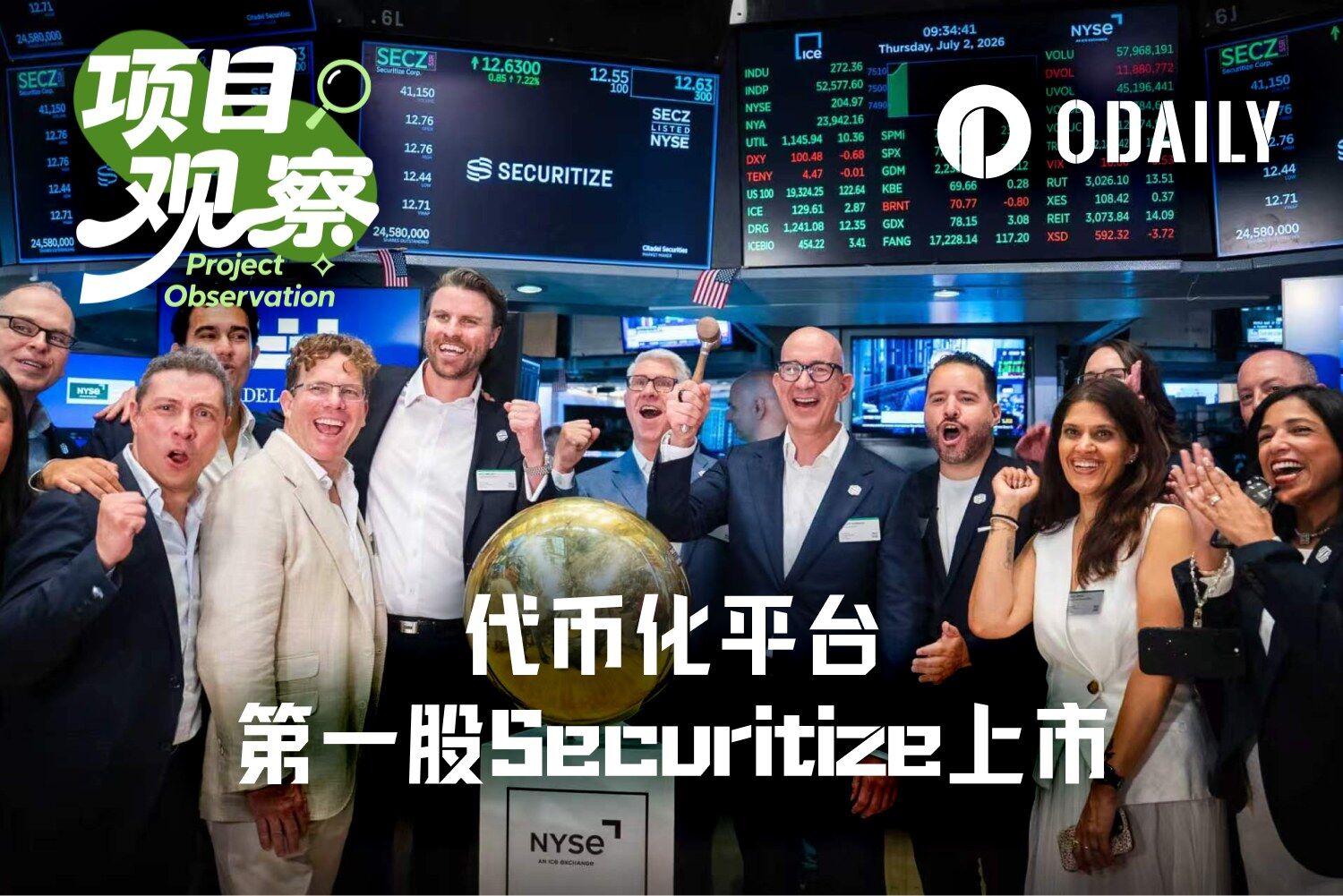
Securitize starts trading on the NYSE while launching SECZ on-chain
On July 2, Securitize officially began trading on the New York Stock Exchange after completing a business combination with special purpose acquisition company Cantor Equity Partners II. The company now trades under the ticker SECZ. In its first session, SECZ opened at $12.45, rose to an intraday high of $13.70, and closed at $12.3. Based on public estimates, that placed the company’s market capitalization near $2 billion by the end of the day.

The listing stood out for more than its public-market debut. Securitize also tokenized its own common stock at launch, making it the first company to be listed both on the NYSE and directly on public blockchains at the same time. Eligible U.S. investors can purchase tokenized SECZ through Securitize’s regulated platform on Avalanche and Solana, giving the company an immediate presence in both traditional capital markets and on-chain financial infrastructure.
According to RWA.xyz, SECZ became the largest tokenized stock in the world on its first day of issuance, with on-chain value exceeding $295 million. That scale is notable not only because of the size of the issuance, but because it signals that Securitize is no longer limiting itself to institutional tokenized credit and fund products. It is now making a clear move into the tokenized equity segment, a market where demand has often been driven by access and trading convenience rather than strict legal ownership.
From institutional RWA leader to a more direct equity tokenization push
By most on-chain metrics, Securitize already occupies a leading position in the RWA sector. DeFiLlama data cited in the original report shows that the platform’s issued on-chain RWA products have a combined market value of more than $4.4 billion, well ahead of peers such as Circle, Tether, and Ondo when stablecoins like USDT and USDC are excluded from the comparison.

Despite that scale, Securitize remains far less familiar to retail traders than platforms focused on more accessible tokenized stock exposure. The reason is structural rather than promotional. Securitize’s product lineup has historically been built for institutions. Its 24 on-chain tokenized products, representing more than $4 billion in assets, are primarily tied to bonds, private credit, and money market funds. Before SECZ, the company had only one tokenized single-stock product, CURR, and that product saw almost no meaningful trading activity.
Its best-known product is BUIDL, the tokenized money market fund launched for BlackRock. That fund has already grown to more than $2.2 billion in size, making it the second-largest tokenized money market fund in the RWA market, behind Circle’s USYC. In that context, the launch of tokenized SECZ is more than a branding event. It suggests that Securitize is actively broadening its business from institutional asset tokenization into the more visible and contested tokenized stock market.
The public listing therefore matters on two levels. First, it gives Securitize a tradable public equity story tied directly to the growth of tokenized finance. Second, it creates a test case for how a heavily regulated RWA platform can structure tokenized equity ownership in a way that aligns with traditional shareholder rights. That could prove important if the company follows through on its plan to tokenize additional IPOs over the next year.

“Own the real thing”: how Securitize differs from most tokenized stock platforms
Securitize summarizes its positioning with the slogan “OWN THE REAL THING, NOT A SYNTHETIC VERSION.” That phrase captures the company’s key distinction in the tokenized stock market. On Securitize, each tokenized share is designed to represent direct ownership of an actual underlying share. Holders are meant to receive the same legal and economic rights as traditional shareholders, including dividends, voting rights, and other shareholder protections.
This is fundamentally different from many tokenized stock products currently circulating in crypto markets. In many competing models, investors are not acquiring direct equity ownership. Instead, they are buying instruments that provide economic exposure to the stock, such as price participation or dividend-linked benefits, without transferring the full bundle of legal ownership rights or offering the same regulatory safeguards. The article identifies Ondo, xStocks, Binance’s bStocks, and Bitget and Reality’s tokenized stock offerings as examples of this broader category.
That difference matters because tokenized equities have often been marketed under a single label while actually representing very different legal structures. Securitize is trying to anchor tokenized stock issuance in regulated securities ownership rather than synthetic replication. For institutions and compliance-oriented market participants, that creates a stronger legal foundation. But it also introduces additional frictions that many crypto-native products are designed to avoid.
Real ownership comes with a high access barrier
The practical downside of Securitize’s model is that access is narrow. To buy tokenized SECZ today, investors must complete KYC and KYC/AML checks, satisfy jurisdiction-specific requirements, and meet applicable securities-law standards. If an investor lacks U.S. status, even passing the initial onboarding process may not be possible. In other words, this is a public blockchain product, but not an open-access one.
Securitize places eligible investors’ wallet addresses on a whitelist, and only whitelisted wallets can trade tokenized SECZ. That means ordinary users cannot simply go to a DEX and purchase the asset the way they would buy a standard crypto token. The token may exist on-chain, but transferability and participation remain gated by the issuer’s compliance framework. This sharply distinguishes regulated tokenized securities from unrestricted digital assets.
When announcing tokenized SECZ on X, Securitize highlighted that the token would continue trading even while U.S. equity markets were closed on Friday, July 3, for the Independence Day holiday. That messaging underscores one of the most commonly cited benefits of blockchain-based securities: potentially continuous market access. Yet the statement also contains an irony. The number of investors globally who are actually eligible to trade SECZ is very small, while much broader retail audiences can access synthetic tokenized stock products elsewhere with far fewer restrictions.
Still, the company appears committed to expanding this line of business. After the IPO, Securitize president Brett Redfearn said the company is discussing the possibility of tokenizing other IPOs within the next year. That suggests SECZ is not a one-off experiment, but rather the opening step in a broader push to establish a regulated tokenized equity franchise.

Valuation: premium to Figure, but the market is paying for positioning
Whether SECZ is undervalued at current levels is difficult to answer conclusively because the company has not disclosed a definitive current share count. The original report therefore estimates valuation based on public filings. In Securitize’s SEC S-4 filing, the company was valued at $1.25 billion. The SPAC and PIPE subscription price was set at $10 per share, implying about 125 million shares, and Cantor Equity Partners II had roughly 30 million common shares outstanding. On that basis, the post-merger share count is likely around 160 million shares.
Using that estimate, a closing price of $12.3 implies a market capitalization of approximately $1.96 billion. At the intraday high of $13.70, the company’s valuation would have approached $2.2 billion. In April, investment bank Benchmark assigned Securitize a post-listing target price of $16, arguing that the company is well positioned to benefit from the broader tokenization wave. Benchmark emphasized that Securitize is more than a tokenization platform. It also has a more complete regulatory stack, including broker-dealer, transfer agent, and trading capabilities, which could allow it to monetize issuance, secondary trading, and custody-related services across the asset lifecycle.
Financially, Securitize’s S-4 filing shows revenue of $55.6 million for the first nine months of 2025, though full-year 2025 revenue had not yet been formally reported. Management projected approximately $69 million in revenue for full-year 2025. For Q1 2026, revenue reached $19.5 million, up 39% from Q1 2025 and marking the highest quarterly revenue in the company’s history. Management projects approximately $110 million in revenue for full-year 2026.
Based on the 2025 management forecast, Securitize trades at roughly 28x static price-to-sales. The article uses publicly listed RWA platform Figure as a comparison. Figure, whose business is more concentrated in real estate and private credit, trades at roughly 15x 2025 static price-to-sales. On a tokenized AUM basis, Securitize stands at about $4.4 billion while Figure is around $19.4 billion. Securitize’s market cap to AUM ratio is therefore about 0.45, versus 0.38 for Figure. On both metrics, Securitize screens as the richer valuation.
That does not necessarily mean the stock is obviously overpriced. Investors may be assigning a premium for business breadth, regulatory infrastructure, and category leadership in RWA. But it does suggest that the market has already priced in a significant part of the company’s tokenization narrative, especially if tokenized equities become a meaningful new revenue pillar.
The core tension in tokenized stocks: legal purity versus market access
The article’s broader point is that tokenized stocks may be a market where product quality, in a legal sense, does not automatically translate into distribution success. Many investors mainly want exposure to stock price movement. They care less about formal shareholder rights such as voting or direct registration, and more about whether they can access the asset easily, trade it efficiently, and use it globally without extensive compliance hurdles.

That creates a structural challenge for Securitize. Its “real thing” model offers stronger legal certainty and a more authentic ownership structure, but it also narrows the potential user base. For institutional capital, that may be a feature. For retail demand, it is clearly a constraint. By contrast, synthetic or exposure-based tokenized stock platforms may offer a less legally robust product, but they can scale distribution much faster because they remove many of the barriers that regulated securities tokenization necessarily imposes.
The irony is difficult to miss. A retail investor may believe in Securitize’s business, may want long-term exposure to SECZ, and may prefer a regulated tokenized ownership model. Yet that same investor may still be unable to buy the tokenized shares directly. In practice, they may end up waiting for another platform to list a synthetic or indirect version instead. That contradiction captures the current state of the tokenized stock market: the legally cleanest model is not always the most accessible one.
Securitize’s public listing and the simultaneous on-chain launch of SECZ bring that divide into sharper focus than before. One path prioritizes compliance, direct ownership, and securities-law alignment. The other prioritizes broad user access and crypto-native market reach. SECZ has now become one of the clearest real-world tests of whether the “authentic ownership” model can gain traction beyond institutions.