
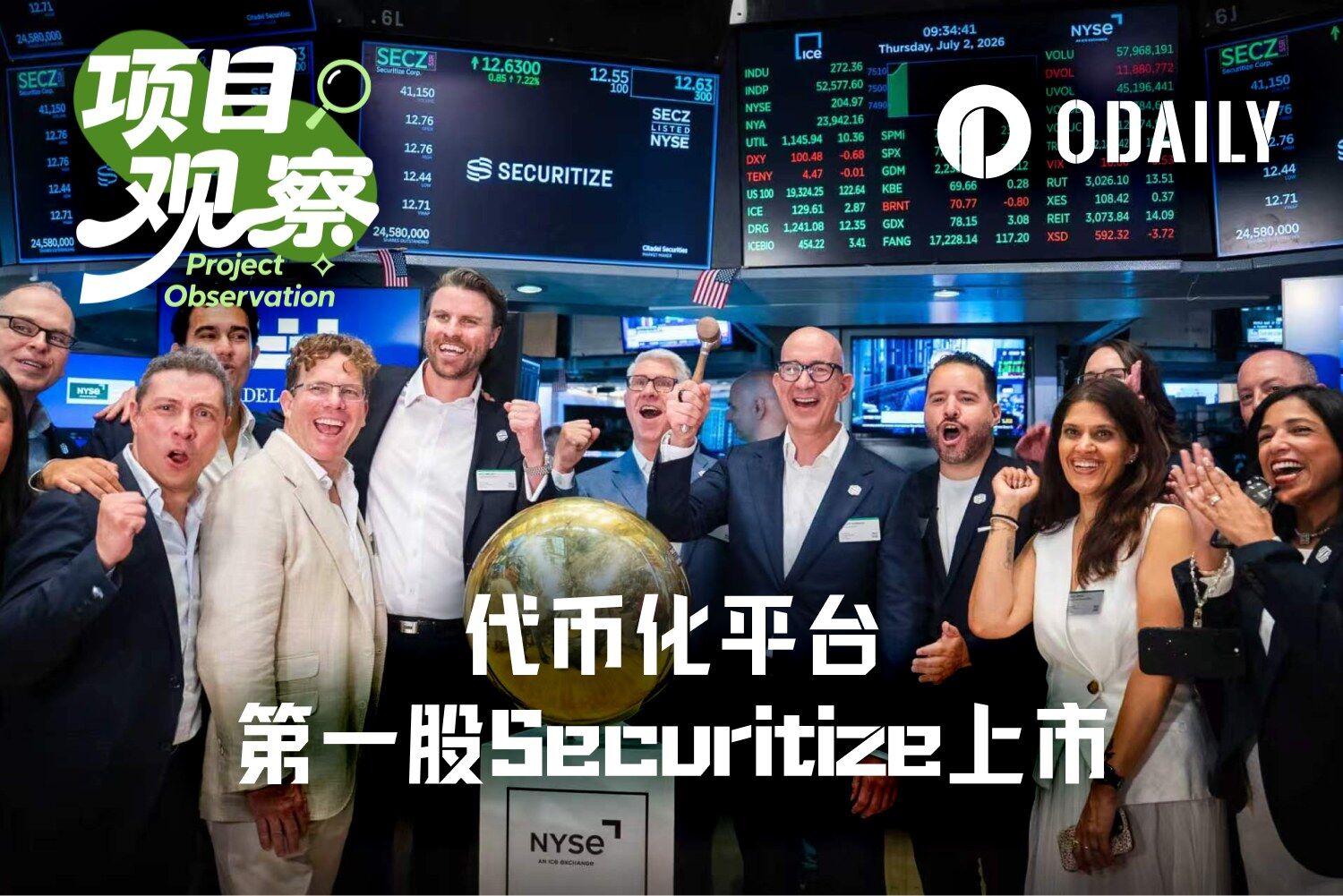
Securitize starts trading as SECZ and simultaneously brings its own stock on-chain
On July 2, Securitize officially began trading on the New York Stock Exchange after completing a business combination with special purpose acquisition company Cantor Equity Partners II. The company now trades under the ticker SECZ. On its first day, the stock opened at $12.45, rose to an intraday high of $13.70, and finished the session at $12.3. Based on market estimates, that closing level implies a market capitalization of roughly $1.96 billion, while the intraday peak pushed valuation close to $2.2 billion.

The listing is significant not merely because Securitize has become the first major tokenization platform of its kind to reach the public market. The more important point is that it launched as both a listed company and an on-chain security issuer at the same time. At the start of trading, Securitize tokenized its own common stock and made it available, through its regulated platform, to eligible U.S. investors on Avalanche and Solana. According to RWA.xyz, tokenized SECZ became the largest tokenized stock in the world on its first day, with on-chain value exceeding $295 million.
That move matters because SECZ is also Securitize’s first major tokenized equity product on-chain. For years, the company has dominated the real-world asset segment from an infrastructure and issuance perspective, but it has not been a high-profile player in retail-facing tokenized stocks. By bringing its own public equity to blockchain rails on day one, Securitize signaled that tokenized equities may now become a more central part of its next phase of growth.
An RWA leader with institutional roots is now expanding into tokenized equities
Measured by on-chain issuance, Securitize is already one of the clearest leaders in the RWA market. Data cited from DeFiLlama shows that the platform has issued more than $4.4 billion in tokenized real-world assets on-chain, ahead of Circle, Tether, Ondo, and other platforms when stablecoins such as USDT and USDC are excluded. Yet despite that scale, Securitize is less familiar to many retail traders than names such as Ondo, xStocks, or Binance’s bStocks.

The reason is structural rather than accidental. Securitize has historically catered to institutions. Its portfolio of 24 on-chain tokenized products, representing more than $4 billion in assets, is concentrated in bonds, private credit, and money market funds. Prior to SECZ, it had only one tokenized single-stock product, CURR, and that instrument reportedly saw minimal trading activity. The company’s most recognizable on-chain product remains BUIDL, BlackRock’s tokenized money market fund serviced by Securitize. That fund has now surpassed $2.2 billion in size, making it the second-largest tokenized money market product in the RWA market, behind Circle’s USYC.
Seen in that context, SECZ is not just another product launch. It suggests a meaningful change in business direction. Securitize is no longer only an institutional tokenization stack for relatively low-volatility yield products. It is beginning to push into tokenized equities, an asset class with far greater visibility, greater retail demand, and a much sharper debate around ownership, compliance, and market access.
“Own the real thing”: how Securitize differs from most tokenized stock offerings
Securitize’s website uses a concise slogan to define its approach: “OWN THE REAL THING, NOT A SYNTHETIC VERSION.” That phrase captures the company’s central distinction from most tokenized stock products currently circulating in the market. On Securitize, each tokenized stock is designed to represent direct ownership of actual shares, with the same legal and economic rights that a traditional shareholder would enjoy, including dividend rights, voting rights, and other shareholder protections.
That is materially different from many existing tokenized equity products, which are better described as economic wrappers, exposure certificates, or synthetic instruments. Those products may track price performance or pass through some economic benefits such as dividends, but they generally do not transfer direct ownership of the underlying shares, nor do they necessarily provide the same regulatory protections as conventional securities ownership. The original report groups offerings from Ondo, xStocks, Binance’s bStocks, and Bitget’s Reality-issued tokenized stocks into that broader category.
In practical terms, Securitize is trying to put actual equity ownership on-chain rather than merely placing stock-like exposure on blockchain infrastructure. That model may be more robust from a legal and rights perspective, and it may better align with the long-term promise of tokenized securities. But it also imposes a much heavier compliance burden than the models adopted by platforms that primarily optimize for retail accessibility and global distribution.
Strict compliance means most retail investors still cannot access tokenized SECZ
The cost of selling the “real thing” is clear in the onboarding process. To purchase tokenized SECZ, investors must complete KYC and KYC/AML procedures, satisfy jurisdiction-specific requirements, and comply with applicable securities laws before being granted access. If an investor lacks U.S. status, even passing the basic onboarding process may be impossible. Securitize also whitelists wallet addresses, which means only approved addresses can hold and trade tokenized SECZ.
As a result, even though the security exists on-chain and may theoretically appear in decentralized trading environments, ordinary users still cannot simply buy it in the way they can access many other crypto-native assets. When introducing tokenized SECZ on X, Securitize noted that the tokenized version could continue trading even while U.S. equity markets were closed on July 3 for the Independence Day holiday. The statement highlighted the 24/7 potential of blockchain-based securities. At the same time, it underscored a contradiction: the number of people actually eligible to trade this “real-share” product remains very small, while retail users globally can more easily access other tokenized stock platforms that do not offer true legal ownership.
Even so, the company appears committed to pushing further into tokenized equities. After the IPO, Securitize President Brett Redfearn said the firm is discussing the possibility of tokenizing other IPOs over the coming year. That suggests SECZ is not a one-off demonstration. Instead, it may serve as a model for how Securitize intends to extend its regulated tokenization framework into additional public equities.
Valuation after listing: revenue outlook, implied share count, and peer comparison
Whether SECZ is undervalued at current levels remains an open question. The company has not yet disclosed a definitive fully diluted share count post-listing, so observers must estimate market capitalization using available filings. In its S-4 filed with the U.S. Securities and Exchange Commission, Securitize assigned itself a valuation of $1.25 billion. The subscription price for the SPAC and PIPE financing was $10 per share, implying roughly 125 million shares. Adding the approximately 30 million outstanding common shares of shell company Cantor Equity Partners II suggests the merged entity likely has total shares outstanding of around 160 million.
Using that estimate, SECZ’s closing price of $12.3 implies a market capitalization of about $1.96 billion on its first trading day. Earlier this year in April, investment bank Benchmark assigned Securitize a post-listing target price of $16, arguing that the company was well positioned to benefit from the rise of tokenized assets. Benchmark emphasized that Securitize is not just a tokenization platform in the narrow sense. It also possesses what the firm described as a full regulatory qualification stack, including broker-dealer, transfer-agent, and trading capabilities, which could allow it to generate revenue across issuance, secondary trading, and custody services.
Revenue disclosures in the S-4 offer a partial picture. The filing shows that Securitize generated $55.6 million in revenue during the first nine months of 2025, but it did not disclose full-year 2025 revenue. Management instead projected approximately $69 million for the full year. For 2026 Q1, revenue came in at $19.5 million, up 39% year over year and marking the highest quarterly revenue in company history. Management projected approximately $110 million in revenue for full-year 2026.
Based on the 2025 revenue outlook of about $69 million and an implied market capitalization of roughly $1.96 billion, Securitize trades at around 28x static price-to-sales for 2025. A relevant listed comparison is Figure, another RWA-related platform focused mainly on real estate and private credit. Figure’s 2025 static price-to-sales ratio is about 15x. On that basis, Securitize screens as more expensive.

The same pattern appears when looking at tokenized AUM. Securitize has around $4.4 billion in tokenized AUM, while Figure has about $19.4 billion. That implies a market-cap-to-AUM ratio of approximately 0.45 for Securitize versus 0.38 for Figure. Again, Securitize sits somewhat higher. So if the analysis is limited to those two metrics alone, the stock does not look obviously cheap. However, proponents would argue that Securitize deserves some premium for the breadth of its regulated business model, the depth of its compliance stack, and its leading strategic position in the RWA segment.
What the listing reveals about the tokenized stock market
The SECZ listing throws one of the tokenized equity market’s core tensions into sharp relief: do investors actually want legal ownership, or do they mainly want convenient price exposure? Securitize is clearly betting that fully compliant, rights-bearing, on-chain securities will matter over time. Its model offers something closer to the ideal version of tokenized equities, where blockchain rails are used to represent genuine shareholder ownership rather than just synthetic access to market movements.
But the market reality is more complicated. Many investors care less about voting rights, formal title, or legal protections than about 24/7 trading, broad availability, and low onboarding friction. In that environment, products that offer only economic exposure can spread much faster than products that insist on full compliance and strict investor qualification. That helps explain why the tokenized stock market is often described as one where inferior structures can outcompete superior ones in distribution.
For Securitize, the challenge is therefore strategic as much as legal. By insisting on real ownership and regulated access, the company may build the most defensible long-term model. Yet in the near term, it risks ceding mindshare and volume to platforms offering easier but less robust alternatives. The irony is obvious: many investors who may genuinely want long-term exposure to Securitize itself still cannot buy tokenized SECZ directly. For most global retail participants, any eventual access may come not through Securitize’s own on-chain stock, but through some future wrapped, mirrored, or synthetic version listed elsewhere.
That contradiction may be the most important takeaway from this listing. SECZ is not only a public debut. It is also a live test of whether the market is ready to reward authentic tokenized ownership, even when authenticity comes with friction.