
Securitize listed on the NYSE and put its stock on-chain the same day
Securitize, a company focused on tokenization infrastructure for public companies, private funds, and asset managers, used its own listing to make the case for on-chain equities.
On July 2, 2026, co-founder and CEO Carlos Domingo rang the opening bell at the New York Stock Exchange as the company went public. That same morning, its stock also launched in tokenized form on Solana and Avalanche. The article says this was not a wrapped derivative structure. Ownership of the equity itself was recorded on-chain rather than through a traditional centralized registry. About $270 million in common shares were registered on-chain on the first day.
That choice carried clear regulatory exposure. Most newly public companies would avoid adding an extra layer of scrutiny at listing. Securitize did the opposite.
A term sheet has long sold founders a bundled service package
The article uses that listing to frame a broader question: if a public company can issue tokenized stock at the moment it lists, why could a private startup not eventually use a similar structure in a Series A round?
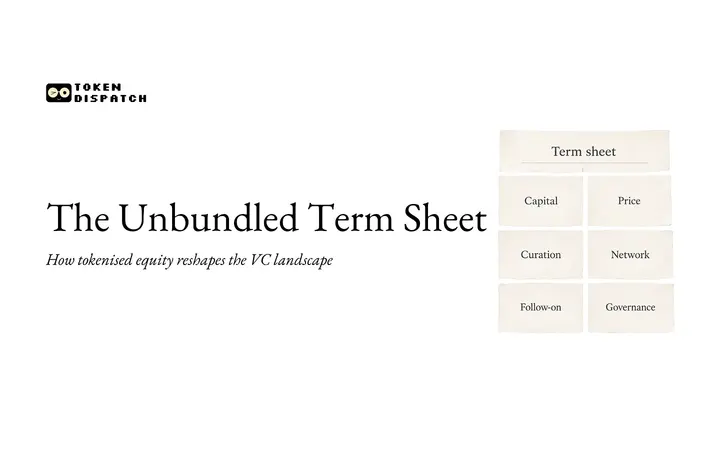
Its answer starts with what venture capital actually sells. A VC term sheet is not just capital. It usually combines several functions at once: funding, valuation setting led by the lead investor, signaling through the investor’s name on the cap table, access to customers and talent, an expectation of follow-on support, and governance rights such as board seats, information rights, protective provisions, and transfer restrictions.
That package held together for years because private equity remained closed to ordinary investors. Without broad market access, founders had limited ways to separate pricing, capital, governance, and distribution into different providers.
Why Securitize’s case does not map cleanly onto early-stage startups
The piece also draws a sharp line between a mature company and a young startup. Securitize had been operating for 10 years when it pursued tokenized stock. It had audited financial statements, disclosable cash flows, and more than $4 billion in tokenized assets on its platform. The market had enough information to form a valuation.
A Series A startup usually does not. Investors often rely on a founder’s track record, reputation, and the business idea itself. In that setting, the article argues, curation is not just a logo effect. A VC is underwriting credibility for a company that lacks public operating data.
It says later-stage private names such as SpaceX and OpenAI are better candidates for tokenized equity because they already have price references before an IPO, including secondary trading, tender offers, perpetual contracts, and broker research.
Native on-chain equity is different from wrapped stock tokens
Securitize was not the first company to put listed stock on a blockchain. The article notes that Exodus did so on Algorand in 2021, and Galaxy Digital also issued on-chain equity. What makes Securitize notable, it says, is that it became the first company to issue native on-chain equity on the first day of its public listing.
According to the article, the tokens trading on Solana and Avalanche carry the same legal force as the stock circulating on the NYSE. Each token comes with full voting rights, dividend rights, and residual claims. It is not a synthetic instrument tracking price, and it is not a claim issued through an offshore special purpose vehicle. Securitize’s tokenized common stock is presented as economically and legally equivalent to the offline common stock, SECZ.
The article cites Vaidik’s framework for two broad categories of stock tokens. One is issuer-native, where the token itself represents equity, as in SECZ and Exodus. The other is a custody-and-wrapper model, such as xStocks and Robinhood stock tokens, where an SPV holds the real shares and investors hold a claim on proceeds. Only the first model carries full shareholder rights.
The VC bundle starts to come apart
The central argument is that once equity can be priced on an ongoing basis and transferred more freely, many of the functions inside a term sheet no longer need to be sold together.
For more mature companies with enough information for valuation, fundraising and price discovery can move toward market infrastructure. The article points to more than $1 billion in tokenized equity total value locked on Ondo Global Markets. It also says the pre-IPO perpetual price of Cerebras on Hyperliquid differed from its Nasdaq opening price by only 1.3%.
Signaling and network access still need anchor investors, but lead capital and brand value no longer have to come only from a full-service institution such as Sequoia or Andreessen Horowitz. The article gives Elad Gil as an example, saying his roughly $1.5 billion solo fund can lead deals and provide that branding effect through his personal reputation and rolling fund structure.
Specialized vendors are picking up other parts of the stack. Fairmint and Pulley handle cap-table administration. Coinbase acquired LiquiFi in July 2025 to expand into token exercise tooling, and Echo in October 2025 for fundraising tools. Magna and Sablier manage staged vesting. The article’s point is simple: by 2026, founders can assemble many of the back-office capabilities that once came bundled through a venture firm.
Governance may also become programmable
The article says Fairmint supports continuous fundraising structures similar to SAFEs, with equity conversions executed automatically under preset rules. Vesting cliffs, lockups, and payout conditions can also be enforced in smart contracts rather than left only to legal documents.
As secondary liquidity expands, employees and early investors get more ways to exit. A tokenized private company could give employees and angel investors paths to sell before an IPO rather than waiting for a distant liquidity event.
That changes how equity is viewed inside a startup. If shares can trade at any time, the bargaining logic behind exercise windows and lockup schedules changes too. Employees who once had to wait four years for a tender window may gain access to secondary markets much earlier.
Liquidity solves one problem and creates another
The article does not present this as an uncomplicated gain. It compares the situation to crypto governance tokens such as Arbitrum’s ARB and Optimism’s OP, which could trade immediately after launch. When team unlocks arrived, concentrated selling followed, and prices could drift away from actual network operations. Founders then had to spend time watching the market rather than focusing only on product work.
It also says the comparison has limits. ARB and OP are governance tokens, not corporate equity, and their prices reflect ecosystem activity more than company performance. Still, the incentive conflict is similar enough to matter.
Reg D 506(c) accredited-investor access rules, Rule 144 lockup requirements, and multi-year resale restrictions can soften concentrated selling, the article says, but they do not eliminate it. Tokenized equity opens a new exit channel for insiders and weakens the private-market habit of using time to smooth liquidity pressure.
The hardest function to replace remains follow-on investing. The article says current regulatory frameworks that have moved into implementation, including the SEC-approved DTCC pilot, Nasdaq’s token trading system, and related DTCC services expected in October, are all built for already public companies such as Russell 1000 constituents. There is still no compliant channel for tokenized Series A equity to trade publicly on those systems.
What may stay with VC
To explain what survives, the article compares venture to the music industry after streaming. Distribution became cheap and standardized, but record labels did not disappear. What remained scarce was A&R: deciding which artists were worth backing, shaping their brand, and unlocking industry access that raw data could not provide.
It argues venture is likely to follow the same path. Blockchains can handle standardized processes better than paper term sheets: ownership records, price discovery, share transfers, and scheduled vesting or exercise. What technology cannot replace is the investor whose reputation can help secure the next round, persuade a major customer to switch vendors, or convince senior talent to leave a large company for a startup.
The article adds one more caution. Unbundling waves are often followed by a new round of consolidation, and the consolidators are not always the old incumbents. It cites London’s 1986 Big Bang reforms, which split broker and market-maker functions, only for universal banks to pull those pieces back together within a decade.
For founders, the change is basic but important. They may still need capital, valuation, governance, and signaling, but not from the same provider in one package. The most standardized parts of a term sheet are likely to move on-chain first. Judgment is the last layer, and it may never be fully digitized. A Series A startup may one day tokenize its equity, but someone still has to decide whether that equity should be brought to market in the first place.