
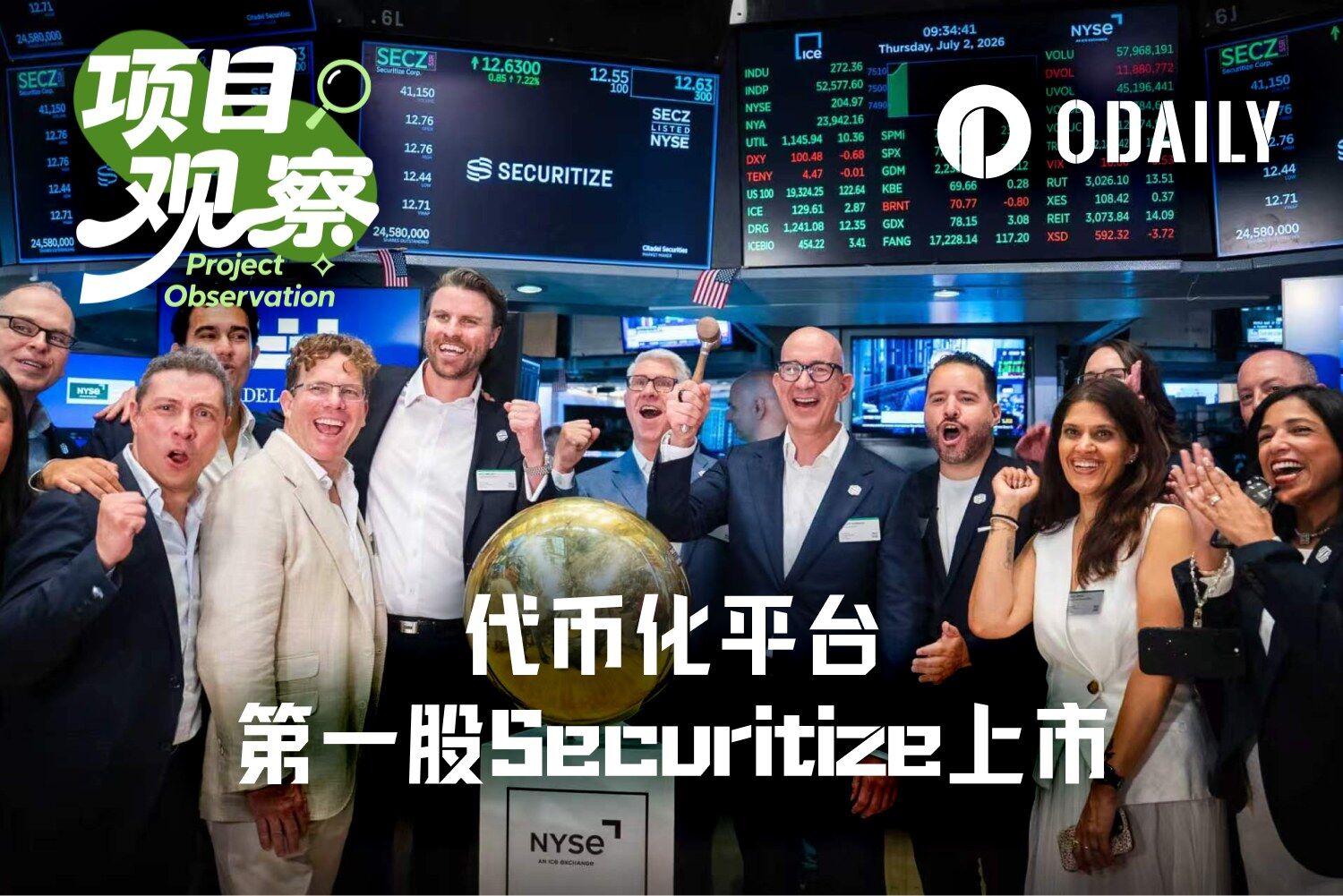
Securitize debuts on the NYSE and brings its own equity on-chain
On July 2, Securitize officially began trading on the New York Stock Exchange after completing its business combination with special purpose acquisition company Cantor Equity Partners II. The company now trades under the ticker SECZ. Shares opened at $12.45, rose to an intraday high of $13.70, and eventually closed at $12.3. Based on public estimates, that puts Securitize’s first-day market capitalization at roughly $1.96 billion, with the intraday peak approaching $2.2 billion.

The listing was notable not only because Securitize became a public company, but because it launched a tokenized version of its own common stock from day one. Eligible U.S. investors can access tokenized SECZ through Securitize’s regulated platform on both Avalanche and Solana. According to RWA.xyz, SECZ became the world’s largest tokenized stock on its first day of issuance, with more than $295 million in on-chain value.
This was also Securitize’s first major tokenized equity product on-chain. That matters strategically. For years, the company has dominated the RWA issuance landscape through money market funds, private credit, and fixed-income style products. By putting its own shares on-chain at listing, Securitize signaled that tokenized equities are no longer a side experiment for the company, but a business line it intends to develop more seriously.
Why the RWA leader remained relatively unfamiliar to retail users
In terms of on-chain asset scale, Securitize has been one of the most important players in the RWA market for some time. DeFiLlama data shows that the company has issued more than $4.4 billion in on-chain RWA assets. Excluding stablecoins such as USDT and USDC, that places Securitize ahead of Circle, Tether, Ondo, and other tokenization platforms.

Yet compared with platforms like Ondo, xStocks, or Binance’s bStocks, Securitize has had a much lower profile among retail crypto investors. The reason is straightforward: its products have largely been built for institutions rather than broad consumer access. Across 24 tokenized products and over $4 billion in assets, the company’s focus has been concentrated in bonds, private credit, and money market funds. Before SECZ, the only tokenized individual stock it offered was CURR, which had almost no trading activity.
Its best-known product remains BUIDL, the tokenized money market fund issued for BlackRock. That product has already grown beyond $2.2 billion in size, making it the second-largest tokenized money market fund in the current RWA market, behind Circle’s USYC. This institutional orientation explains why Securitize became a leading infrastructure provider inside the sector without becoming a familiar retail trading brand.
“Own the real thing”: direct ownership versus synthetic exposure
Securitize summarizes its differentiation with a simple slogan: “OWN THE REAL THING, NOT A SYNTHETIC VERSION.” That phrase captures the central point of its tokenized stock strategy. On Securitize, each tokenized equity is meant to represent direct ownership of actual shares, with the same legal and economic rights associated with traditional stock ownership. That includes dividends, voting rights, and other shareholder entitlements.

This is fundamentally different from many so-called tokenized stocks already available in crypto markets. In many other structures, investors do not actually own the underlying shares. Instead, they hold a claim that mirrors the stock’s economic performance or grants access to cash-settled benefits. Such structures may provide price exposure or dividend-like economics, but they do not necessarily transfer actual ownership or the full set of regulatory protections attached to the underlying security.
The article specifically contrasts Securitize’s model with products offered by Ondo, xStocks, Binance bStocks, and Bitget Reality. Those products generally fall into the “exposure” category rather than the “direct ownership” category. In legal, compliance, and investor-rights terms, that is a major distinction. In commercial terms, however, the market may not always reward that distinction, because many participants are primarily seeking tradable exposure rather than formal shareholder rights.
Strict compliance keeps access limited even on-chain
The trade-off behind Securitize’s model is clear: if tokenized stock is treated as the real security, access must be tightly controlled. To purchase SECZ, investors must complete KYC, pass KYC/AML review, satisfy jurisdictional requirements, and comply with applicable securities laws. If an investor does not have the required U.S. status, even the onboarding process may not be available.

Operationally, Securitize whitelists approved wallet addresses. Only those wallets can hold and trade tokenized SECZ. This means that even if the security is issued on-chain and can technically exist in decentralized environments, access remains permissioned at the compliance layer. In other words, blockchain settlement does not override securities law restrictions; it simply changes the infrastructure used for issuance and transfer.
Securitize highlighted on X that SECZ would continue trading even while U.S. stock markets were closed on July 3 for the Independence Day holiday. That statement emphasizes one of the strongest arguments for on-chain securities: potentially continuous trading outside legacy market hours. At the same time, it also exposes the model’s limitation. The number of people globally who are actually qualified to trade SECZ remains very small, while retail users around the world can more easily access alternative tokenized stock products that do not convey actual ownership.
Still, the company appears committed to expanding this segment. After the IPO, Securitize President Brett Redfearn said the firm is already discussing the possibility of tokenizing other IPOs over the next year. That suggests SECZ is not just a symbolic demonstration, but potentially the first of a broader tokenized equity pipeline.
Valuation: is SECZ underpriced after listing?
Whether SECZ is undervalued is difficult to answer definitively because the company has not yet disclosed a finalized current share count. Based on its SEC S-4 filing, however, analysts can approximate the capital structure. Securitize assigned itself a valuation of $1.25 billion in the filing. The SPAC and PIPE subscription price was $10 per share, implying about 125 million shares. Adding roughly 30 million common shares outstanding from Cantor Equity Partners II suggests that the combined company likely has about 160 million shares outstanding.
Using that estimate, a closing price of $12.3 implies a market capitalization of about $1.96 billion, while the intraday high points to a valuation just below $2.2 billion. In April, investment bank Benchmark gave Securitize a post-listing $16 price target. Its rationale was that the company is positioned to benefit materially from the tokenized asset wave, not just as an issuance venue, but as a firm with a broad regulatory stack that includes broker-dealer, transfer agent, and trading capabilities.
Benchmark’s thesis is important because it treats Securitize less as a single-product issuer and more as full-stack infrastructure. If the company can monetize issuance, secondary trading, servicing, and custody across tokenized assets, its revenue opportunity is broader than the notional size of any one product. That said, investors still need to judge whether the current market value already prices in much of that future optionality.
Revenue growth is solid, but relative metrics do not show obvious cheapness
According to the S-4 filing, Securitize generated $55.6 million in revenue for the first nine months of 2025. Management projected full-year 2025 revenue of approximately $69 million. For the first quarter of 2026, the company reported revenue of $19.5 million, up 39% from the first quarter of 2025 and marking the highest quarterly revenue in its history. Management projected full-year 2026 revenue of about $110 million.

Based on the 2025 revenue forecast, Securitize trades at roughly 28x forward price-to-sales on a static basis. One public comparable mentioned in the article is Figure, another RWA-related platform focused primarily on real estate and private credit. Figure’s 2025 static price-to-sales ratio is around 15x. On that basis alone, Securitize does not look inexpensive.
The comparison is similar when viewed through tokenized AUM. Securitize has around $4.4 billion in tokenized assets under management, while Figure has about $19.4 billion. That implies a market-cap-to-AUM ratio of roughly 0.45 for Securitize versus 0.38 for Figure. Again, Securitize screens somewhat richer.
Even so, the article stops short of calling the stock overvalued. Securitize’s supporters would argue that its business mix is broader, its regulatory footprint is deeper, and its strategic positioning inside the RWA market is stronger than a simple multiple comparison suggests. The market appears to be placing a premium not just on current revenue, but on the company’s ability to become a central venue for compliant tokenized securities over time.
The core tension in tokenized equities is now impossible to ignore
The launch of SECZ exposes a structural contradiction in the tokenized stock market. From a legal and ownership perspective, Securitize’s model is arguably closer to what tokenized equities were originally supposed to become: actual securities represented and transferred on-chain. But from a distribution perspective, that model is harder to scale because compliance requirements limit who can participate.
By contrast, many competing products are easier to distribute because they offer economic exposure without delivering the full legal package of true share ownership. For a large share of the market, that may be good enough. Many traders care more about price access than voting rights, cap-table status, or shareholder governance. As a result, a platform that insists on selling the “real thing” may lose ground to products that are more permissive, even if they are structurally weaker from an ownership standpoint.
That is the irony at the heart of SECZ. If investors believe Securitize is well positioned for the future of tokenized finance and want to build a long-term position, many of them still cannot directly access the tokenized version of the stock. For much of the global retail market, the path to exposure may eventually come not through Securitize’s regulated product, but through a more accessible imitation listed somewhere else in crypto.