
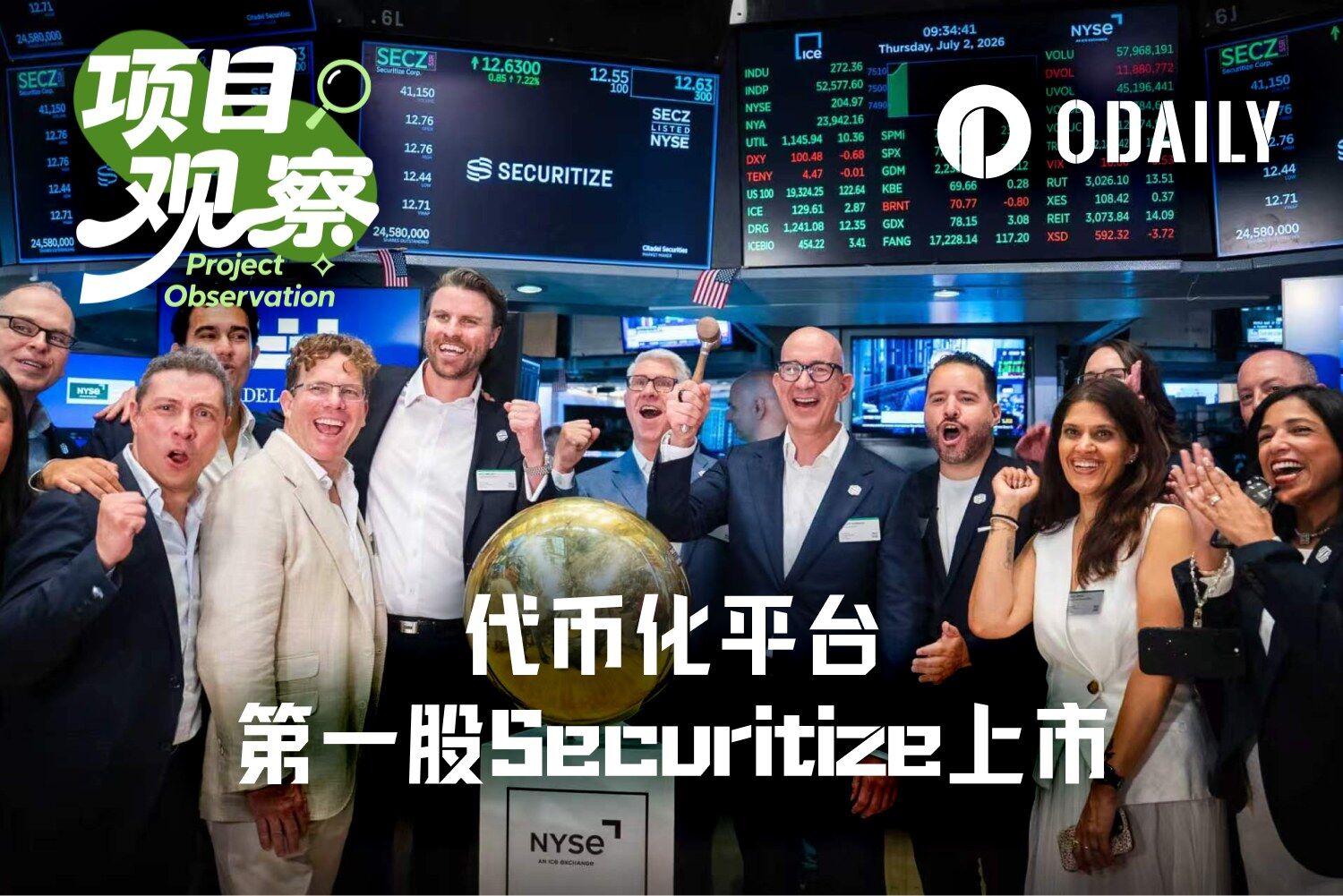
Securitize starts trading on the NYSE while launching SECZ on-chain
On July 2, Securitize completed its business combination with special purpose acquisition company Cantor Equity Partners II and officially began trading on the New York Stock Exchange under the ticker SECZ. The stock opened at $12.45, climbed to an intraday high of $13.70, and ultimately closed at $12.3. Based on the estimates cited in the source article, that closing price implies a market capitalization of roughly $1.96 billion, with the intraday peak bringing the valuation close to $2.2 billion.

The listing matters for more than the SPAC transaction itself. Securitize also tokenized its own common stock from day one, making SECZ available on-chain for eligible U.S. investors through its regulated platform on both Avalanche and Solana. According to data from RWA.xyz, SECZ became the largest tokenized stock in the world on its first day of issuance, with more than $295 million in on-chain value. That combination of a traditional public listing and a parallel blockchain-native share format makes Securitize the first company to launch in both venues simultaneously.
This is also strategically important for the broader tokenization sector. Securitize has long been seen as one of the most established infrastructure providers in the real-world asset market, especially for institutionally oriented issuance. By putting its own stock on-chain as its first major tokenized equity product, the company is signaling that it is ready to compete more directly in the tokenized stock market rather than remaining primarily a platform for tokenized funds, credit products, and fixed-income instruments.
Why the leading RWA platform remained unfamiliar to many retail users
By DeFiLlama’s count, Securitize has more than $4.4 billion in on-chain RWA issuance, ahead of platforms such as Circle, Tether, and Ondo if stablecoins like USDT and USDC are excluded. Despite that leadership, Securitize has been much less visible to retail traders than names like Ondo, xStocks, or Binance’s bStocks. The main reason is straightforward: Securitize’s historical business has not been built around mass-market distribution.

Its product set reflects that positioning. The article notes that Securitize has issued 24 on-chain tokenized products representing over $4 billion in assets, and nearly all of them are concentrated in bonds, private credit, and money market funds. Only one tokenized single-stock product, CURR, existed previously, and it has seen little to no trading activity. The company’s best-known product is BUIDL, the tokenized money market fund launched for BlackRock. That fund has grown beyond $2.2 billion and is currently the second-largest tokenized money market fund in the RWA market, with the article identifying Circle’s USYC as the largest.
In other words, Securitize’s reputation has been built on regulated issuance, servicing, and lifecycle management for institutional assets rather than on retail-friendly tokenized equity access. That is why SECZ stands out. It marks a potential shift from a predominantly institutional RWA issuer and administrator toward a more visible role in one of the most commercially attractive segments of tokenization: publicly traded equities.
Securitize is selling direct equity ownership, not synthetic stock exposure
Securitize summarizes its distinction with a simple slogan on its website: “OWN THE REAL THING, NOT A SYNTHETIC VERSION.” That phrase captures the core difference between its approach and most existing tokenized stock offerings in the market. According to the article, each tokenized stock on Securitize represents direct ownership of actual shares and carries the same legal and economic rights as a traditional shareholder position, including dividends, voting rights, and other shareholder entitlements.

That stands in contrast to many products currently marketed as tokenized stocks. In many cases, those instruments function more like exposure certificates or wrapped economic claims. Investors may receive price exposure or certain economic benefits linked to the stock, but they do not hold the real underlying shares in a way that passes through full legal ownership or equivalent regulatory protection. The article specifically cites tokenized stock products issued by Ondo, xStocks, Binance bStocks, and Bitget’s Reality as examples of this more limited model.
From a compliance and asset-integrity standpoint, Securitize’s structure is much stricter and arguably much closer to the concept of regulated digital securities. It is not merely creating a blockchain-tradable representation of market exposure. Instead, it is attempting to bring the full shareholder relationship on-chain within an existing legal framework. That makes the product structurally stronger for institutions and compliance-focused investors, but it also imposes significant friction compared with lighter-weight, globally distributed tokenized stock alternatives.
Strict investor eligibility means most retail participants are excluded
The trade-off is clear: selling the “real thing” dramatically raises the barrier to entry. To buy SECZ today, investors must complete KYC and KYC/AML reviews, satisfy jurisdictional restrictions, and meet applicable securities-law requirements before they can be considered eligible. The article states that if an investor does not have U.S. status, even the initial KYC process may not be passable.
Securitize also whitelists wallet addresses for approved investors, and only whitelisted addresses can transact in tokenized SECZ. That means the asset may exist on public blockchains and may even appear in decentralized trading environments, but the actual transferability of the security remains tightly permissioned. From a technical perspective it is on-chain; from an access-control perspective it remains firmly gated.
The company highlighted on X that SECZ would continue trading even while U.S. stock markets are closed on Friday, July 3, for Independence Day. That statement underscores one of the strongest arguments for on-chain securities: extended tradability beyond legacy market hours. Yet the article points out the irony. The number of people worldwide who are actually qualified to trade SECZ is extremely small, while retail users around the world can easily gain stock exposure through other tokenized stock venues that do not offer direct ownership of real shares.
This tension goes to the heart of the tokenized equity market. Many investors primarily want price exposure and trading convenience, not voting rights or shareholder formalities. The article therefore describes tokenized stocks as a market where lower-quality structures can displace better-quality ones, because convenience often wins over legal purity. Even so, Securitize appears committed to expanding in this direction. Company president Brett Redfearn said after the IPO that Securitize is discussing the possibility of tokenizing other IPOs over the next year, suggesting SECZ may be just the opening move rather than a one-off experiment.
Valuation: not obviously cheap, but not clearly overextended either
The next question is whether the market is undervaluing or overvaluing SECZ after the listing. Because the company did not disclose its current total share count, the article uses public filings to estimate capitalization. In its SEC S-4 filing, Securitize assigned itself a valuation of $1.25 billion. The subscription price for the SPAC and PIPE financing was $10 per share, implying about 125 million shares. Adding roughly 30 million common shares outstanding at Cantor Equity Partners II suggests a post-merger total share count of around 160 million shares. At a closing price of $12.3, that points to a market capitalization of approximately $1.96 billion.
In April, investment bank Benchmark reportedly assigned Securitize a post-listing price target of $16, arguing that the company stands to benefit significantly from the tokenized asset wave. Benchmark’s view was not based only on token issuance volume. It emphasized that Securitize combines a tokenization platform with a broader regulated operating stack, including broker-dealer, transfer agent, and trading capabilities. That full-spectrum regulatory setup could allow the company to generate diversified revenue across issuance, secondary trading, and custody or servicing functions throughout the lifecycle of tokenized assets.
Financially, the S-4 filing showed revenue of $55.6 million for the first nine months of 2025, while management projected about $69 million for full-year 2025. For the first quarter of 2026, Securitize reported revenue of $19.5 million, up 39% from the first quarter of 2025 and marking the highest quarterly revenue in the company’s history. Management’s forecast for full-year 2026 is about $110 million.

Using management’s 2025 revenue estimate, the article calculates Securitize’s static price-to-sales multiple at roughly 28x. As a listed comparison, it points to Figure, another RWA platform focused mainly on real estate and private credit. Figure’s 2025 static price-to-sales multiple is cited at around 15x. On tokenized AUM, Securitize stands at $4.4 billion while Figure is at $19.4 billion. That implies a market-cap-to-AUM ratio of about 0.45 for Securitize versus 0.38 for Figure. On both measures, Securitize screens richer than Figure, meaning it does not look obviously undervalued.
Still, the source article stops short of calling the company clearly overvalued. Securitize’s broader business mix, deeper regulatory licensing, and leadership position within the RWA sector support a premium relative to simpler peers. More importantly, the market may be assigning option value to the company’s expansion into tokenized equities, a segment where its authenticity-first model could become strategically valuable if regulatory clarity improves and institutional adoption accelerates.
The deeper industry tension: authentic on-chain securities versus accessible trading
SECZ puts the central contradiction of tokenized equities into sharp focus. On one side is a fully compliant model tied to real shares and complete shareholder rights. On the other is a globally accessible market that favors low friction, easy onboarding, and continuous trading. Securitize has clearly chosen the first path. As a result, it offers stronger legal certainty and a much more faithful form of tokenization, but potentially at the cost of lower user reach, less retail participation, and weaker near-term liquidity than synthetic or derivative-like alternatives.
That is why Securitize may represent the “higher-quality” version of tokenized stocks while still being disadvantaged in actual distribution. Most retail investors do not optimize for voting rights or ownership formalities. They optimize for access. The article ends on that irony: even investors who are constructive on Securitize’s future and want to take a long-term position in SECZ may not be able to buy the company’s tokenized shares directly. In practice, they may have to wait until another platform lists a looser, imitation version that offers market exposure without the legal substance.
As an industry signal, Securitize’s listing is significant because it demonstrates that public equities can now bridge traditional capital markets and public blockchains more directly than before. But it also reveals a hard truth. Under current regulatory conditions, putting a real security on-chain does not automatically make it open, borderless, or universally tradable. For now, the sector still has to choose between authenticity and accessibility, and that trade-off remains unresolved.