
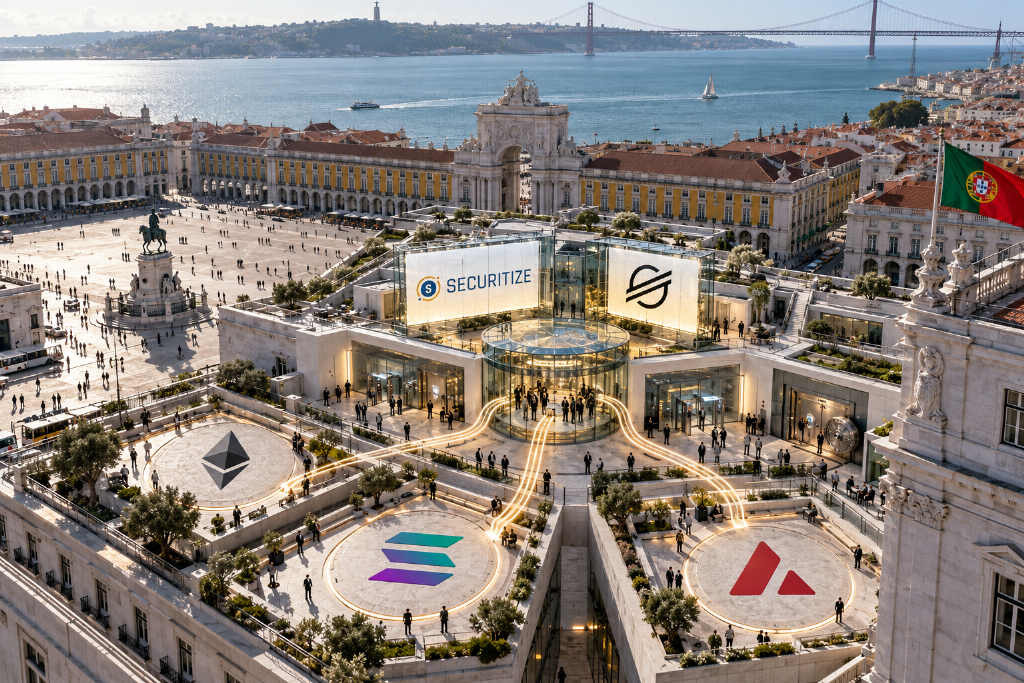
Securitize, the tokenized asset platform listed on the New York Stock Exchange under SECZ, said it plans to integrate with the Stellar network. That pushes the number of supported blockchains to four. The news came out at Stellar’s Meridian 2026 conference, and the Stellar Development Foundation said on Oct. 28 in Lisbon that the tie-up will allow Securitize to issue and manage tokenized financial products on Stellar.
Per the announcement, the arrangement will handle asset issuance, fast settlement, and features built for regulated use cases. Securitize already works with Ethereum, Solana, and Avalanche. Now Stellar is being added to that lineup.
The Stellar Development Foundation said assets on Stellar can be set up with know-your-customer, or KYC, controls, clawback functions, and sanctions compliance features. For institutional products that have to satisfy regulatory standards, those tools can decide whether an asset can go on-chain in the first place.
And Stellar is not starting from zero here. Franklin Templeton has already issued a tokenized money market fund on the network, while MoneyGram uses the chain for daily cross-border fund scheduling.
What the two sides said
Carlos Domingo, Securitize’s co-founder and chief executive officer, said in the release, “The Stellar network has already built the fourth-largest tokenized real-world asset ecosystem, which shows the strength of the network and the rising institutional demand for tokenization.”
He also said Securitize expects to bring its regulated infrastructure into an ecosystem that is already pushing adoption of tokenized financial products.
Denelle Dixon, chief executive officer and executive director of the Stellar Development Foundation, said Securitize is helping turn tokenization into a workable option for large financial institutions. She said the partnership will widen the infrastructure available to asset managers and back the rollout of the next generation of tokenized financial products on Stellar.
A fourth chain in Securitize’s multi-chain strategy
Securitize was founded in 2017. As of Sept. 30, the platform had about $5 billion in tokenized securities, according to the article. Its partners include Apollo, BlackRock, BNY, Hamilton Lane, KKR, and VanEck. The company also manages issuance and administration for BlackRock’s tokenized money market fund, BUIDL.
Securitize listed on the New York Stock Exchange in July under the ticker SECZ. Its intraday high on the first trading day hit $13.70. But the stock closed at $8.16 on Oct. 27.
The article said the point of a multi-chain strategy for issuers is not just spreading activity across more blockchains. It is about letting institutional clients pick the chain that fits how they operate. In that view, asset managers care about settlement speed, compliance tools, and whether a network can link directly to existing payments and custody infrastructure.
Stellar has also pointed to its work with the Depository Trust & Clearing Corporation, or DTCC. According to the article, DTCC said in May that tokenization services under its Depository Trust Company, or DTC, are expected to connect with the Stellar public blockchain in the first half of 2027. If that happens on schedule, assets held in DTC custody could be tokenized on-chain while keeping investor protections aligned with traditional securities.
Stellar ranks fourth in tokenized real-world assets
Data from rwa.xyz cited in the article for Oct. 28 showed Ethereum leading tokenized real-world assets with $15.9 billion. BNB Chain was second with $6.3 billion, Solana was third with $4.9 billion, and Stellar was fourth with $3.77 billion.
So Stellar sits about $1.1 billion behind Solana. The article said Domingo’s description of Stellar as the fourth-largest ecosystem lines up with the data, though the distance from the top three also shows institutional capital is still concentrated on Ethereum.
Why this integration matters
The article cast the integration as a split of responsibilities. Securitize handles the regulated issuance side: product structure, transfer agency work, and regulatory interfaces. The blockchain, meanwhile, acts as the underlying rail. Simple enough. That also explains why the company can support four chains at once: the real switching cost is technical integration, not rebuilding compliance from the ground up.
For Stellar, this move plugs an issuance-side hole. The network already has Franklin Templeton’s fund and MoneyGram’s cross-border fund flows. And if DTCC’s tokenization service connects on time, the on-chain chain from issuance to settlement to custody would look a lot more complete.
What comes next
The article flagged two things to watch. First, the initial products after integration have not been disclosed. Officials said details will come later, and whether the first offerings are stocks, bonds, or funds will shape which slice of the market Stellar can win. Second, Stellar’s ability to pass Solana in tokenized real-world asset rankings is still an open question. The current gap is about $1.1 billion, and the DTC service is expected to go live in the first half of 2027.
The article also said Securitize worked with South Korea’s LG CNS in October to advance tokenized securities in that market. Whether that business line will later expand to Stellar is still unclear.



