
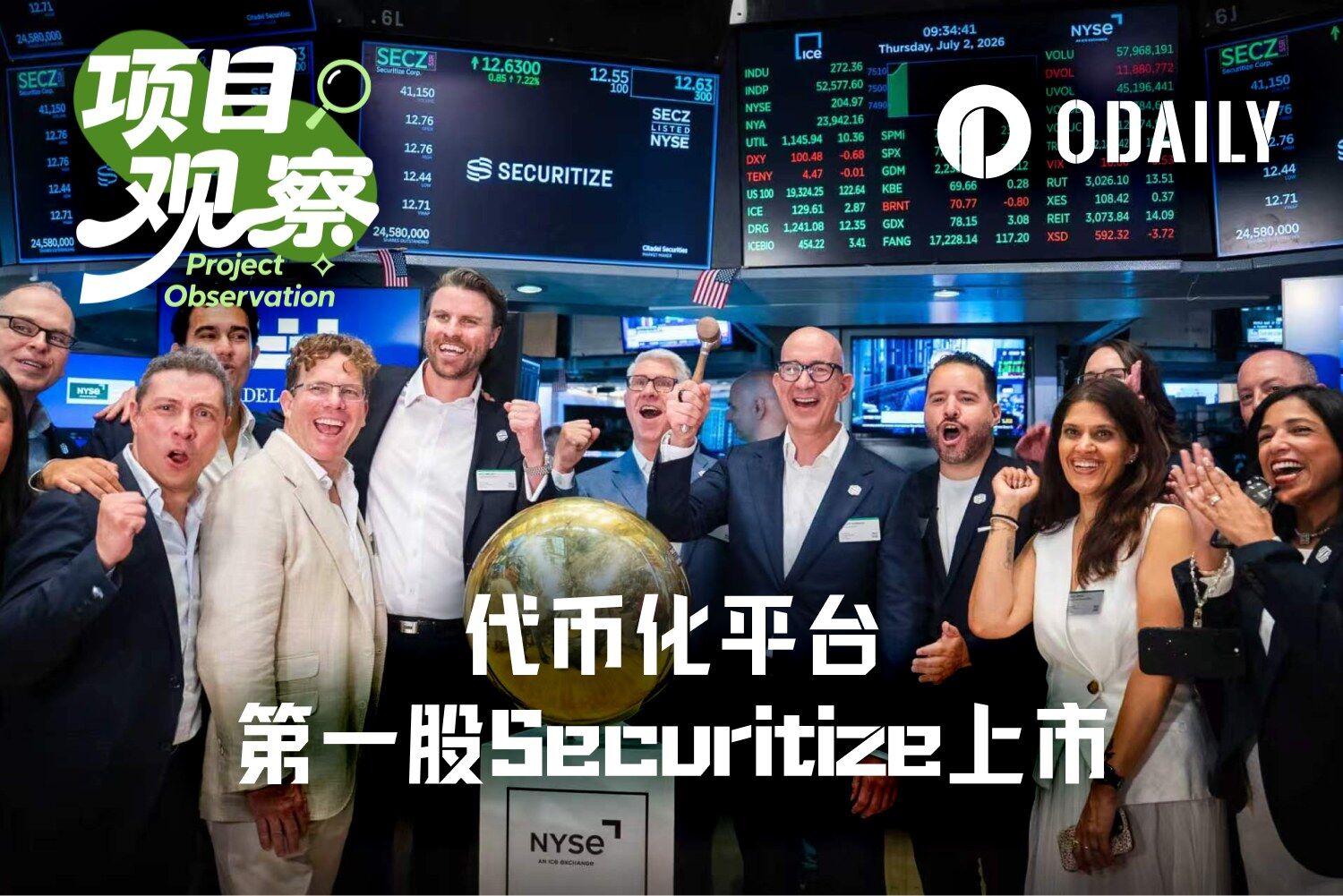
Securitize lists on the NYSE and tokenizes its own shares from day one
Securitize officially entered the public market on July 2 after completing its business combination with special purpose acquisition company Cantor Equity Partners II. The company began trading on the New York Stock Exchange under the ticker SECZ. On its first trading day, the stock opened at $12.45, climbed as high as $13.70 by midday, and eventually closed at $12.3. Based on market estimates, that closing price implied a valuation close to $2 billion, while the intraday peak pushed the company’s market capitalization to nearly $2.2 billion.

The listing mattered for more than just the public-market debut. Securitize also tokenized its own common stock at launch, making it the first company to be listed both on the NYSE and on-chain at the same time. Eligible U.S. investors can purchase tokenized SECZ through Securitize’s regulated platform on Avalanche and Solana. According to data cited from RWA.xyz, SECZ became the largest tokenized stock in the world by on-chain value on its first day of issuance, with more than $295 million represented on-chain.
That makes SECZ more than a headline-friendly IPO. It marks Securitize’s first major tokenized equity product and suggests that one of the dominant players in the RWA market is now moving decisively into tokenized stocks. For a company that has historically been associated with institutional real-world asset issuance rather than retail-facing equity products, the launch signals a meaningful strategic expansion.

A dominant RWA issuer is now moving into tokenized equities
By on-chain scale, Securitize already sits at the center of the RWA sector. DeFiLlama data cited in the source shows that Securitize has issued more than $4.4 billion in on-chain RWAs, ranking ahead of platforms such as Circle, Tether, and Ondo when stablecoins like USDT and USDC are excluded from the comparison. In other words, the company is not a niche infrastructure player experimenting with tokenization at the margins. It is already one of the largest operators in the category.
Yet despite that scale, Securitize has remained far less familiar to retail crypto traders than names like Ondo, xStocks, or Binance’s bStocks. The reason is structural rather than promotional. Most of Securitize’s business has been built around institutional demand, not mass retail distribution. Its 24 on-chain tokenized products, representing more than $4 billion in total assets, are concentrated in bonds, private credit, and money market funds. Until now, it had only one tokenized single-stock product, CURR, and that product carried almost no trading volume.
The company’s best-known product is BUIDL, the tokenized money market fund created for BlackRock. That fund has already grown beyond $2.2 billion in assets and is currently the second-largest tokenized money market fund in the RWA market, behind only Circle’s USYC. Against that background, the decision to place SECZ on-chain as its first major tokenized stock changes the profile of the platform. It suggests that Securitize is no longer content to dominate the infrastructure-heavy institutional segment alone and is beginning to claim ground in the most visible part of the tokenization narrative: publicly traded equities.

“Own the real thing” is the company’s clearest competitive distinction
Securitize’s website sums up its positioning with a direct slogan: “OWN THE REAL THING, NOT A SYNTHETIC VERSION.” That phrase captures the company’s most important difference from many other tokenized stock offerings in the market. On Securitize, each tokenized share is designed to represent direct ownership of an actual share. Holders are meant to receive the same legal and economic rights as traditional shareholders, including dividends, voting rights, and other associated shareholder protections.
That is a fundamentally different model from the one used by many products currently marketed as tokenized stocks. In much of the market, what investors receive is not actual ownership of the underlying shares but an instrument that provides economic exposure. Users may benefit from price movement and, in some structures, dividend-like distributions, but they do not necessarily gain legal title to the stock, the full regulatory protections attached to ownership, or enforceable shareholder rights. The source article identifies Ondo, xStocks, Binance’s bStocks, and products issued by Bitget and Reality as examples that fall into this broader category of synthetic or rights-based exposure rather than true share ownership.
From a legal and regulatory perspective, Securitize’s approach is far closer to bringing actual securities on-chain rather than wrapping equity exposure in a crypto-native shell. That is powerful differentiation in a market where “tokenized stock” often means very different things depending on the issuer. But the same feature that makes the product stronger from a compliance and ownership standpoint also makes it harder to distribute broadly.
Strict compliance sharply limits who can actually buy tokenized SECZ
The clearest trade-off in Securitize’s model is access. Buying tokenized SECZ is not a permissionless retail experience. Investors must complete KYC, pass KYC/AML reviews, satisfy jurisdiction-specific requirements, and comply with applicable securities laws before they can participate. The article notes that if an investor lacks U.S. identity credentials, even clearing the KYC stage may be impossible. Securitize also whitelists eligible wallet addresses, and only those approved addresses can trade tokenized SECZ.
This means that even though the shares exist on-chain, they remain far from open global circulation. Even on a decentralized exchange, ordinary users cannot simply connect a wallet and buy. In practice, the distribution is gated by the same regulatory perimeter that governs traditional securities access. Securitize highlighted on X that SECZ could continue trading on Friday, July 3, even while U.S. equity markets were closed for the Independence Day holiday. The statement underscored one of the strongest theoretical benefits of tokenized securities: they can remain operable outside legacy market hours. But it also exposed the narrowness of the actual user base, since only a small set of qualified investors worldwide can access the product.
That creates an irony at the center of the tokenized stock market. Most investors care primarily about trading access and price exposure, not about legal title, voting rights, or the fine details of shareholder status. As a result, products that offer easier access but weaker legal ownership may attract more activity than products that offer “the real thing” but remain available only to a small, vetted subset of investors. In commercial terms, Securitize may be at a disadvantage precisely because it is trying to do tokenized equities in the most compliant and legally robust way.
Still, the company is clearly committed to the space. After the IPO, Securitize president Brett Redfearn said the firm is discussing the possibility of tokenizing other IPOs within the next year. That comment suggests SECZ is not being treated as a one-off showcase. Instead, it appears to be the opening move in a broader tokenized equity strategy.
Valuation: not obviously cheap, but not easy to dismiss either
The next question is whether the stock looks undervalued after listing. Because Securitize has not yet disclosed a definitive current total share count, outside observers can only estimate the market capitalization from public filings. In its SEC S-4 filing, Securitize assigned itself a valuation of $1.25 billion. The subscription price for the SPAC and PIPE financing was $10 per share, implying roughly 125 million shares. Adding the approximately 30 million publicly outstanding common shares of Cantor Equity Partners II suggests that the combined entity likely has a total share count of around 160 million shares.

Using that estimate, Securitize’s market capitalization would be approximately $1.96 billion based on the first-day closing price of $12.3, and nearly $2.2 billion at the intraday high. Earlier in April, investment bank Benchmark reportedly assigned Securitize a post-listing price target of $16, arguing that the company is well positioned to benefit from the growth of tokenized assets. Benchmark’s argument was not limited to headline tokenization exposure. The firm emphasized that Securitize has a more complete regulated infrastructure stack, including broker-dealer, transfer agent, and trading capabilities, which could allow it to monetize multiple points across the lifecycle of issuance, secondary trading, and custody-related services.
Revenue figures in the S-4 filing also help frame the valuation. Securitize reported $55.6 million in revenue for the first nine months of 2025, though it did not disclose full-year 2025 revenue. Management projected approximately $69 million for all of 2025. For the first quarter of 2026, the company reported revenue of $19.5 million, up 39% from the first quarter of 2025 and marking the highest quarterly revenue in its history. Management also projected around $110 million in revenue for full-year 2026.
On management’s 2025 revenue outlook, Securitize trades at roughly a 28x price-to-sales multiple. A public-market comparison cited in the article is Figure, an RWA platform focused mainly on real estate and private credit. Figure’s 2025 static price-to-sales multiple is around 15x. On that basis, Securitize already screens as more expensive. Looking at tokenized AUM gives a similar result. Securitize has about $4.4 billion in tokenized assets, while Figure stands at roughly $19.4 billion. Securitize’s market cap-to-AUM ratio is around 0.45, versus 0.38 for Figure, again placing Securitize at a premium.

Even so, the stock is not easy to label as plainly overvalued. Securitize combines category leadership in RWA issuance with a broad compliance footprint and a business model that spans issuance, transfer, and trading infrastructure. The market may therefore be willing to pay a higher multiple than it would for a narrower platform. The current numbers do not point to an obvious discount, but they also do not rule out further upside if the company can translate institutional dominance into a meaningful position in tokenized equities and prove that there is durable demand for legally compliant on-chain share ownership.
The broader market tension remains unresolved. Tokenized stocks are still a market where convenience often beats legal purity. Many investors simply want stock exposure in a crypto-native format, while rights such as voting or formal ownership sit far lower on the priority list. That makes Securitize’s product structurally stronger yet commercially harder. For many retail investors, the final irony is clear: even if they believe in Securitize’s long-term prospects and want exposure to SECZ as an investment, the most accessible route may still end up being through other platforms offering a less authentic version of the same idea.