
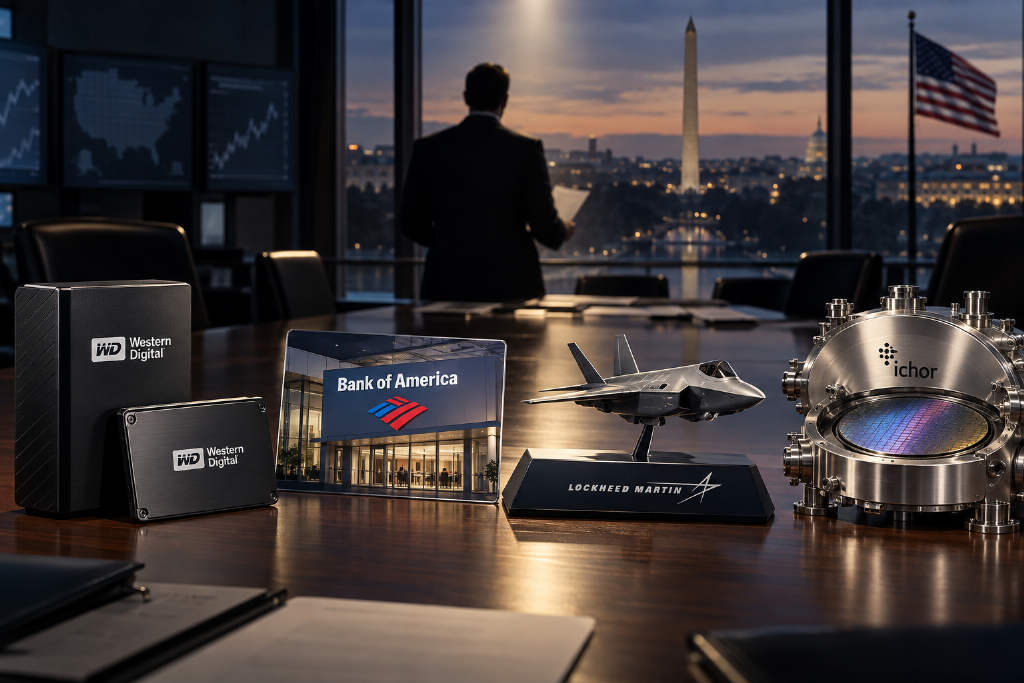
Seeking Alpha Quant strategist Steven Cress said seasonal weakness in September has pushed several fundamentally solid stocks into discount territory, creating what he described as a potential buying window heading into the fourth quarter. Using a screen for stocks rated Quant Strong Buy, trading below their 50-day moving averages, and already down from recent highs, he identified four names: Western Digital (WDC), Bank of America (BAC), Lockheed Martin (LMT), and Ichor Holdings (ICHR).

The article was written by Steven Cress of the Seeking Alpha Quant Team and translated by TechFlow. Cress said September has historically been one of the weakest periods of the year. Looking back across nearly a century, the month has posted an average decline of more than 1%, finished lower in more than half of all years, and seen an average drawdown of about 4.7%.
He added that the pattern has often been sharper in U.S. midterm election years, with market lows frequently arriving near Sept. 30. This year had tracked that pattern at one stage. As of Sept. 16, the Dow Jones Industrial Average, Nasdaq, and S&P 500 were all still negative for the month.
That changed over the following week, when the Nasdaq and the S&P 500 posted a modest rebound and returned to positive territory for the month. Cress wrote that the bounce came slightly earlier than the usual historical rhythm, but that such a shift was not surprising because fourth-quarter reversals in midterm years have often been steep.
Since 1950, October and November have been the two best-performing months in midterm election years, with average gains of 3.0% and 2.7%, according to the article. On that basis, Cress framed the current setup as an unusual entry opportunity, especially in stocks whose declines reflect seasonality rather than worsening business conditions.

The screen and the four selections
Cress said the screen was simple. He used Seeking Alpha’s stock screener to isolate names with a Quant Strong Buy rating, a negative spread versus the 50-day moving average, and a pullback from recent highs. The resulting list covered storage, banking, defense, and semiconductor equipment.
Western Digital: AI storage demand and a reset in valuation
The first stock on the list was Western Digital. The article put its market capitalization at $162.36 billion. It carries a Quant Strong Buy rating and sits in the information technology sector, within technology hardware, storage and peripherals.
Cress described Western Digital as a technology name tied to the broader AI chain and one that could recover over the final months of the year. The company develops and manufactures data storage devices and solutions, serving global hyperscale cloud customers. The article said Western Digital remains well positioned among leading HDD suppliers, with long-term supply agreements extending through 2031, giving it strong visibility on demand.
Its most recent quarter beat expectations on both revenue and profit. Management identified the ramp of 40TB ePMR capacity and a target to move toward 44TB HAMR shipments in the first half of 2027 as key catalysts. Revenue guidance for the first quarter of fiscal 2027 was set at $4.1 billion.

Western Digital’s Quant Strong Buy score stood at 4.95. Profitability was rated A+ and growth A. The article linked margin expansion and strong cash generation to AI-driven demand for data center storage. Revenue growth was listed at 35.70%, nearly three times the sector median of 12.74%.
After a drawdown of about 11% over the past month, the stock’s valuation grade improved from F to B-. The piece also said its forward PEG ratio was just 0.32, representing a discount of about 74% to peers, while its price-to-earnings multiple had moved back toward sector-relative levels.
Bank of America: pullback meets earnings growth and shareholder returns
The second stock was Bank of America. The article listed its market capitalization at $391.80 billion. It was rated Quant Strong Buy, classified in the financial sector and diversified banks industry, and carried a forward dividend yield of 2.28%.
Bank of America has pulled back about 13% from its August record high, according to the piece. Even so, its second-quarter results came in ahead of expectations across the board. Revenue rose 15% year over year to $31.6 billion, net income increased 27% to $9.1 billion, and earnings per share climbed 34% to $1.21. Average loans grew 8% to $1.22 trillion, while average deposits rose 2% to $2.02 trillion.
Net interest income increased 9% in the second quarter to $16.0 billion, helped by expansion in lending and deposits. The article also noted that the Federal Open Market Committee’s latest 25-basis-point rate hike had opened a new phase of tightening, and that further asset repricing at higher rates could leave room for net interest margin improvement.

Bank of America received a Quant Strong Buy rating and ranked second among peers. Profitability was graded A+ and growth B+. Its net margin was reported at 29.52%, roughly 16% above the sector median, while its efficiency ratio improved to 59%.
On valuation, the bank carried a C+ score. Cress said the absolute rating looked only modestly above average, but the pace of improvement across recent quarters stood out. The stock’s forward PEG ratio was 0.78, a discount of about 24% to the sector median.
The article also pointed to shareholder returns. Bank of America had a dividend safety score of B, had raised its dividend for 12 straight years, and offered a forward yield of 2.28%. It also repurchased $6 billion of stock in the second quarter, with a payout ratio of about 25.69%.
Lockheed Martin: backlog, demand pipeline and dividend support
The third selection was Lockheed Martin. The article gave it a market capitalization of $120.87 billion. It was rated Quant Strong Buy, placed in the industrial sector and aerospace and defense industry, and had a forward dividend yield of 2.64%.

Shares have fallen about 14% over the past six weeks, but Quant still rates the stock a Strong Buy. Cress described Lockheed Martin as a defense giant with a deep global contract footprint. As demand accelerated, the company’s backlog reached a record $230 billion. Recent awards cited in the article included a $1.2 billion U.S. Army missile contract and a $24.3 billion F-35 order for Saudi Arabia.
The article tied that demand backdrop to rising defense spending in Europe and among NATO countries during the Russia-Ukraine war and a broader diplomatic standoff. In the Middle East, it said fighting related to Iran had lasted about half a year and had driven heavy U.S. munitions usage. Restocking abroad and at home was described as creating a multiyear demand pipeline for Lockheed Martin.
Its Quant Strong Buy call was driven mainly by A+ grades in profitability and revisions. The article said analysts were raising expectations for stronger demand tied to global conflicts and a favorable U.S. domestic budget backdrop.
Although Lockheed Martin’s valuation grade was only C+, Cress said that score understated the size of the discount when judged against expected profits and growth. The company’s forward PEG ratio was nearly 40% below the sector level and about 71% below its own five-year average.
For income-focused investors, the article highlighted more than 20 years of dividend increases and a forward dividend yield of 2.64%. It said the company’s dividend metrics remained strong and that its cash position supported continued shareholder returns.

Ichor Holdings: a differentiated semiconductor equipment bet
The fourth stock was Ichor Holdings. The article listed its market capitalization at $2.12 billion. It held a Quant Strong Buy rating and was grouped in the information technology sector under semiconductor materials and equipment.
Cress wrote that Ichor had not been hit as directly by September seasonality, but the stock had still fallen sharply from its July high. He said Ichor, a leading manufacturer of semiconductor production components, was trading close to half of its 52-week high of $113.58, making the setup worth examining.
Ichor’s Quant report card was described as especially strong in valuation and growth, both of which were rated A+. The company has shifted strategically toward expanding content per system, and the article said its quarterly revenue capacity can now move above $500 million, with a long-term goal of reaching a $3 billion annualized run rate.
The article quoted CEO Philip Barros from the company’s second-quarter earnings call: “We are more confident today than ever in the magnitude and duration of this growth cycle.”

Ichor’s forward PEG ratio was listed at 0.51, nearly 60% below the sector median. Its long-term forward EPS growth rate was put at 70%, which the article said was 254% above the sector median and 24% above its own five-year average. The revisions grade was A-, with analysts having raised earnings and revenue estimates almost across the board in the past 90 days.
The article also noted a weaker point. Ichor’s profitability grade was only D+. Even so, Cress said the direction of margins and profitability was improving, and that healthy liquidity, a growing order pipeline, and a more attractive share price made it a differentiated semiconductor pick for the fourth quarter.
Cress’s conclusion
Cress closed by arguing that September seasonality has once again pushed a batch of good stocks into discounted territory. In his view, these names have already shown that over longer periods, strong fundamentals can outweigh short-term noise. He reiterated that market lows in midterm election years often arrive around Sept. 30, while October and November have historically delivered the strongest returns in the same cycle.
On that basis, he said he still sees room for a year-end recovery led by companies with the strongest business fundamentals. Of the four names highlighted, Western Digital and Ichor sit more directly in the AI storage and semiconductor equipment chains, while Bank of America represents financials and Lockheed Martin stands in for defense.
