

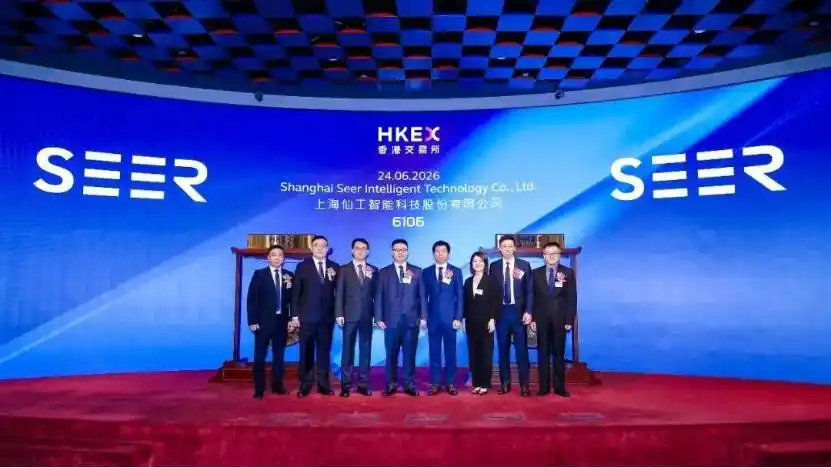
Shanghai SEER Intelligent Technology Co., Ltd. listed on the Hong Kong Stock Exchange in June 2026, with its market capitalization at one point topping HK$11 billion.
Behind that IPO, however, sits an older dispute tied to a predecessor business and an earlier founding team. According to a report by Phoenix Finance’s Storm Eye, just one month before SEER was set up, Shanghai Xianzhi Robot Technology Co., Ltd. — a robotics company founded by nearly the same core founders years earlier — passed a shareholder resolution to enter liquidation. As Xianzhi, once valued at close to RMB 300 million, was dismantled, its second-largest shareholder and co-founder Feng Yuan was left out entirely.
Xianzhi’s early ownership and the dispute over dilution
The report says Feng Yuan, Zhao Yue, Wang Qun, Ye Yangsheng and Dai Xiaohe founded Xianzhi in 2015. Materials provided by Feng showed Zhao as CEO, Feng as COO, Dai as CTO, and Wang and Ye in charge of hardware and software. The original cap table followed a 40-30-10-10-10 split: Zhao held 40%, Feng 30%, and Wang, Dai and Ye 10% each.
Feng told Storm Eye that tensions among the co-founders grew as the company developed. In early 2018, Ecovacs Robotics (Suzhou) Co., Ltd. and Pingtan Huiyin Equity Investment Partnership (Limited Partnership) joined Xianzhi’s Pre-A financing round, putting the company’s post-money valuation at RMB 115 million.
According to Feng, Zhao later approached him and said the other founders had begun comparing themselves with classmates who had joined internet companies on annual pay packages of RMB 400,000 to RMB 500,000, while they were earning a little over RMB 10,000 a month at the startup and holding smaller stakes. Feng said he initially treated that as a normal adjustment in a startup team.
He said the real clash emerged during a key 2019 financing round. Xianzhi was then seeking RMB 50 million at a pre-money valuation of RMB 280 million, which would have taken the post-money valuation to RMB 330 million if completed. Feng said that round instead became the starting point of an effort to remove him.
By his account, Zhao told him several times that new investors believed his stake was too large and that other smaller shareholders felt the same, and that he should sell out entirely.
In a recorded call provided by Feng between his lawyer and Zhao, Zhao said: “What I can guarantee is that the people who can play a bigger role in the company in the future, at least their equity should not be too low.” He also said the other three co-founders were deeply focused on the technical side and added, “To put it plainly, why is Xianzhi valuable? At its core, it’s the technology. That’s first of all my own view. If these three people leave because of this, that’s not a situation I want to see.”
Feng also said even the financial advisor handling the fundraising suggested he should step aside. “They had capital and resources. I couldn’t afford to keep fighting,” he said. After repeated pressure, he said he began to consider leaving in exchange for a payout.
An exit framework agreed in April 2019 collapsed three months later
On April 17, 2019, the five founders met to discuss how Feng would reduce his position. After dilution from the first two funding rounds, his direct holding had fallen from 30% to about 18.26%, but he remained Xianzhi’s second-largest shareholder.
The parties signed meeting minutes laying out a phased exit. Under that plan, 9% of the company would be transferred based on the prior round’s RMB 120 million valuation, implying consideration of about RMB 10.8 million. The remaining 9% would be sold in stages: 3% after the new financing round closed, another 3% a year later, and the final 3% would stay with Feng. The company was supposed to coordinate a transferee within three months.
That arrangement lasted only three months. On July 15, 2019, Feng received an offer letter from Xianzhi saying the company intended to acquire all of his equity for a total of RMB 2 million. That included his directly held 18.26% stake and an additional 13.03% held indirectly through Shanghai Xianban Enterprise Management Partnership (Limited Partnership), the company’s employee option pool vehicle.
Zhao and others told Feng that the plan had changed because no outside buyer had been found and the company’s actual equity value was far below earlier expectations. Feng then proposed looking for a transferee himself, and the two sides agreed. They also signed an attendance arrangement stating that from Aug. 1 to Sept. 30, 2019, Feng would not need to report to the office.
On July 29, Xianzhi held a shareholder meeting. Pingtan Huiyin, one of the investors, demanded that Feng’s share transfer be resolved within 30 days or it would trigger the founders’ repurchase obligation.
A resolution passed that day said that if Feng failed, by Aug. 28, 2019, to give Shanghai Yousu Investment Management Co., Ltd., Pingtan Huiyin and Ecovacs written confirmation of all terms of an external share transfer — including the amount and price — the three investors would have the right to activate the founders’ repurchase obligation.
Feng said he did find a new buyer within the period. According to a letter of intent he provided to Storm Eye, a company was willing to acquire 9% of Xianzhi from him for RMB 10.8 million. On Aug. 27, he formally informed Xianzhi and all shareholders of the proposed transfer and price.
But on Sept. 25, Ecovacs and Pingtan Huiyin formally notified Feng that they rejected the transfer arrangement with the proposed buyer. They gave two reasons. First, Article 2.1 of the shareholders’ agreement said founding shareholders could not transfer shares without prior joint written consent from investors. Second, Article 11 of the company’s articles required approval by shareholders representing more than two-thirds of voting rights, along with the consent of the three investors. Both companies also said in their reply letters that, from a corporate governance perspective, any transfer arrangement Feng reached with a third party would still require a valid shareholder resolution.
That left Feng with little room to sell to an outside party.
Work access was gradually removed before his employment was terminated
While Feng was still trying to arrange a share transfer, Xianzhi had already begun cutting off his access at work. According to judicial rulings cited in the report, the company had removed his workstation as early as Aug. 8, while he was still handling discussions with a potential transferee.
On Sept. 9, he was removed from daily work chat groups. On Sept. 19, without prior notice, his account was deleted from DingTalk work groups, and his access card was demagnetized at about the same time. After October, he could no longer enter the office. On Oct. 28, he lost access to his company email.
By early 2020, Feng received a text message saying his housing provident fund account had been frozen, with contributions only paid through the end of November 2019. Social insurance payments were formally stopped in February 2020. On Feb. 27, 2020, the company officially informed him that his labor contract was being terminated on the ground that he had failed to clock in and work on site after Oct. 1, 2019.
The old company was dissolved while the new one was already in place
Feng’s removal was only the first step. The company moved quickly toward dissolution. The report says that one day before Xianzhi terminated his labor contract, Zhao had already proposed that the board convene an extraordinary shareholder meeting with a single agenda item: dissolving the company.
That meeting took place on March 25, 2020. The other attending shareholders controlled 81.74% of the voting rights. Because Xianzhi operated under a one-share-one-vote structure, that stake was enough to determine the outcome. The meeting resolved to dissolve the company and establish a liquidation group, with Zhao acting as its head.
On May 31, 2020, another shareholder meeting was held, attended by all shareholders including Feng. The liquidation plan drafted by the liquidation group was approved by a vote of 81.74% in favor and 18.26% against, with the only opposing vote coming from Feng. The plan said inventory could be used to continue performing existing contracts if the liquidation group chose to do so, while the remaining movable assets could be sold for cash. Equity investments held by the company could also be disposed of.
At almost the same time, the new operating entity had already been incorporated. On April 22, 2020, Shanghai SEER Intelligent Technology Co., Ltd. was registered — later referred to in the report as Xiangong Keji, the predecessor of the listed SEER entity. Its investors included Shanghai Xianban and all the key founders: Zhao Yue, Dai Xiaohe, Ye Yangsheng and Wang Qun. Feng’s name was no longer on the shareholder list.
Four days later, old investors including Ecovacs and Pingtan Huiyin, together with three new investors — Zhuhai Yinshan Capital, Huachuang Capital and Suzhou Hanchuan — injected RMB 50.9 million into SEER in the form of convertible debt. Of that amount, RMB 35.6 million was then lent to Shanghai Xianban to repurchase the stakes held by Ecovacs, Pingtan Huiyin and Yousu Investment in the old company.
By November that year, the new investors paid RMB 65.59 million to acquire old shares in Xiangong Keji from Shanghai Xianban. Shanghai Xianban used the proceeds to pay the remaining RMB 23.43 million in repurchase consideration and to repay the earlier loan.
According to due diligence materials obtained by Storm Eye, after the repurchase was launched, Ecovacs received RMB 11.85 million, Pingtan Huiyin received RMB 21.58 million, and Yousu Investment received RMB 25.61 million.
After the full series of transactions, Yousu Investment exited. Pingtan Huiyin rolled RMB 11.59 million into Xiangong Keji through its Series A financing and remained a shareholder. Ecovacs also continued as a shareholder by putting in RMB 24 million through the Series A. Feng’s Xianzhi stake alone was left inside the liquidation process.
Assets were moved through a wholly owned subsidiary into the new entity
As investors shifted at the equity level, Xianzhi’s assets were also transferred.
On May 14, 2020, Shanghai Dongzhou Assets Appraisal Co., Ltd. issued an appraisal report using March 31, 2020 as the base date and the asset-based approach. It assessed the total equity value of Xianzhi at about RMB 10.492 million.
Xianzhi then signed four transfer agreements with its wholly owned subsidiary, Shanghai Xianruan Information Technology Co., Ltd., moving assets over item by item. Long-term deferred expenses tied to decoration and fixtures were transferred for RMB 267,900. Fixed assets including computers, air conditioners and cameras were transferred for RMB 193,000. Intangible assets including intellectual property were transferred for RMB 1.0992 million. All inventory was transferred for RMB 4.275 million. The total consideration for the four categories came to about RMB 5.835 million.
Once the assets had been injected, ownership of Xianruan changed hands quickly. On June 15, 2020, another appraisal report, again using March 31, 2020 as the base date, valued Xianruan’s entire equity at negative RMB 375,800, indicating that it was insolvent.
Just one day later, Xianzhi signed an equity transfer agreement with an individual named Ding Han, selling its 100% stake in Xianruan for RMB 100,000. Twelve days after that, Ding signed another agreement with Xiangong Keji and transferred all of Xianruan’s equity to Xiangong Keji for the same RMB 100,000 price.
After those transactions, Xianzhi’s intellectual property, inventory and fixed assets had all moved into the new entity Xiangong Keji through the bridge vehicle of its wholly owned subsidiary Xianruan.
Asked by Storm Eye whether Xianzhi and SEER overlapped in core business direction, key team members and early customer resources, and whether the changes amounted to a pre-planned migration of the business, SEER said Feng has no equity relationship with SEER and the matter has nothing to do with the listed company. The company also said Feng had filed lawsuits over issues including Xianzhi’s dissolution and the validity of the liquidation group, and that the relevant cases had already gone through first- and second-instance proceedings, with effective court judgments in place. The facts of the case and allocation of responsibility, it said, should be determined according to those judicial rulings.
Feng says planning for the new company began before liquidation
Feng said that based on an internal chat record he later obtained, Zhao and others were already planning a new company in July 2019 — the same period in which he received the RMB 2 million offer letter.
He said the chat records came from co-founder Dai Xiaohe. According to Feng, Zhao had originally promised the other co-founders they would receive equity in the new company after it was set up, but those promises were not fulfilled, and Dai later provided information to him.
In the chat, an account named Ye Yangsheng asked about registration progress for the new company. An account with the WeChat name “zhyaic Zhao Yue” — which Feng said was Zhao’s own WeChat account — replied: “The shareholders are signing in rotation, the address is being registered, and it can be done within two weeks.”
Ye then asked, “What if Feng backs down at this point?” The “zhyaic Zhao Yue” account replied: “Even if Feng knows, it doesn’t matter. At most we’d just renegotiate the price. If he backs down, to be honest, his fate is in our hands.”
From Zhejiang University teammates to a robotics startup
Feng said he first met Zhao through Zhejiang University’s RoboCup competition team. Zhao was one year ahead of him and served as team captain.
In the summer of 2015, Zhao, who was then working on a banking project in Beijing, approached Feng and said he had fallen out with a previous business partner and wanted to start over. Feng was then pursuing a master’s degree at Peking University and preparing applications for doctoral study overseas.
At the time, warehouse robotics had drawn strong interest after Amazon’s Kiva robots, and the SLAM-based trackless navigation technology developed by teams from Zhejiang University labs represented a new technical route. Feng said he packed up and went to Shanghai.
He said Zhao still held shares in another company at that stage, while the other three co-founders were either still in school or teaching at universities. Feng said he was the only one working on the startup full time. The company’s initial direction was power inspection robots.
Cash burn from hardware development quickly exceeded expectations. Feng said the company had seven or eight employees on payroll, plus rent and utilities to cover. Core members each earned RMB 5,000 a month, with a few externally hired employees making somewhat more. Total monthly spending was around RMB 100,000. He recalled Zhao telling him plainly that they had to raise money quickly or the company would be dissolved on the spot.
Feng said he reached YOOZOO Network through alumni connections. In 2016, Yousu Investment, an affiliate of YOOZOO, invested RMB 6 million at a RMB 40 million valuation in exchange for a 15% stake. After the money arrived, the company expanded from a 70-square-meter office to 200 square meters, hired staff in batches and raised monthly pay for all employees from RMB 5,000 to RMB 10,000.
Feng also said he led a cooperation with ABB. The team combined a SLAM mobile base with ABB’s dual-arm YuMi robot to produce an early domestic prototype of a trackless composite robot, which drew attention at that year’s China International Industry Fair and brought in the company’s first industrial customers. Xianzhi then shifted from inspection robots to industrial applications.
Storm Eye said it had tried to contact Zhao for comment on the dispute but had not received a response by the time of publication.
Mixed court outcomes, but Feng’s core damages claim was rejected
After Xianzhi formally entered liquidation, Feng turned to the courts. The report says the results were mixed.
In the labor dispute, the court found that Xianzhi had unlawfully terminated Feng’s employment contract and ordered the company to pay compensation. That was one of the few claims on which he prevailed.
His central claims tied to the value of his equity, however, did not succeed. Feng alleged that the other shareholders hollowed out Xianzhi’s core value through a chain of equity transfers and low-price asset transfers, causing a sharp drop in the value of his holdings. On that basis, he sought more than RMB 51.21 million in damages plus RMB 5.743 million in interest calculated through March 10, 2023.
According to judgments obtained by Storm Eye, one reason the court rejected the claim was that Feng’s evidence had not met the required threshold to prove that Xianzhi engaged in unlawful liquidation conduct such as transferring company property at undervalued prices during the liquidation process.
The report also said Wang Qun, Ye Yangsheng and Dai Xiaohe did not appear in court in two hearings. Shanghai Xianban, Yousu Investment, Ecovacs and Pingtan Huiyin jointly argued that Xianzhi’s dissolution and liquidation were lawful and effective and had already been supported by effective judgments; that the establishment of Xiangong Keji did not infringe the rights of Xianzhi or the plaintiff; and that Xiangong Keji’s loans, financing and equity changes were normal commercial acts unrelated to the plaintiff.
In an earlier lawsuit, Feng had sought a ruling that the shareholder resolution approving the liquidation plan on May 31, 2020 was invalid, but he lost that case as well. The court said dissolution of a company falls within the principle of capital majority rule, that shareholders acted freely when voting, and that the resolution was lawfully passed in accordance with the company’s decision-making rules.
As for Feng’s allegations of collusion in transferring customers, orders and market resources, and disposing of assets at low prices, the court held that those issues were not related to the validity dispute over the shareholder resolution and did not accept them in that case.
Lawyer says minority shareholder disputes are easier to prevent than to fix
The report quoted Li Haiquan, a lawyer at Shanghai Shenyihe Law Firm, as saying that the core difficulty in minority shareholder disputes is that they are easier to guard against beforehand than to recover from afterward.
Li said minority shareholders are better protected if they plan early: by setting veto rights over major matters in the articles of association, requiring related shareholders to abstain in related-party transactions, and writing liquidation preference, tag-along rights and anti-dilution clauses into investment agreements so that minority holders have an equal right to exit or follow along when controlling shareholders make key decisions.
Timing matters most, he said. Once there are signs that major shareholders may transfer assets or set up a new company, minority investors should immediately bring actions for shareholder inspection rights or derivative suits and apply for property preservation at the same time. After every transaction has already closed and the structure is complete, he said, protecting minority shareholders becomes far harder from the standpoint of commercial transaction security and stability.
Feng told Storm Eye that he still wants to continue litigating. “I just want to get back the rights that belong to me,” he said.