

AI trade reverses as chip stocks lead the decline
The Philadelphia Semiconductor Index fell 7.88% on Nov. 24, marking the sharpest one-day reversal since the AI trade began. The move erased the Nasdaq’s 6.5% gain from Monday, when a return-related boost surrounding Nvidia CEO Jensen Huang had lifted technology shares. Chip stocks had been the most crowded long trade in U.S. equities over the previous two months. The SOX index has now fallen 33.2% from 13,217.8 on Oct. 6, with index-level deleveraging still underway.
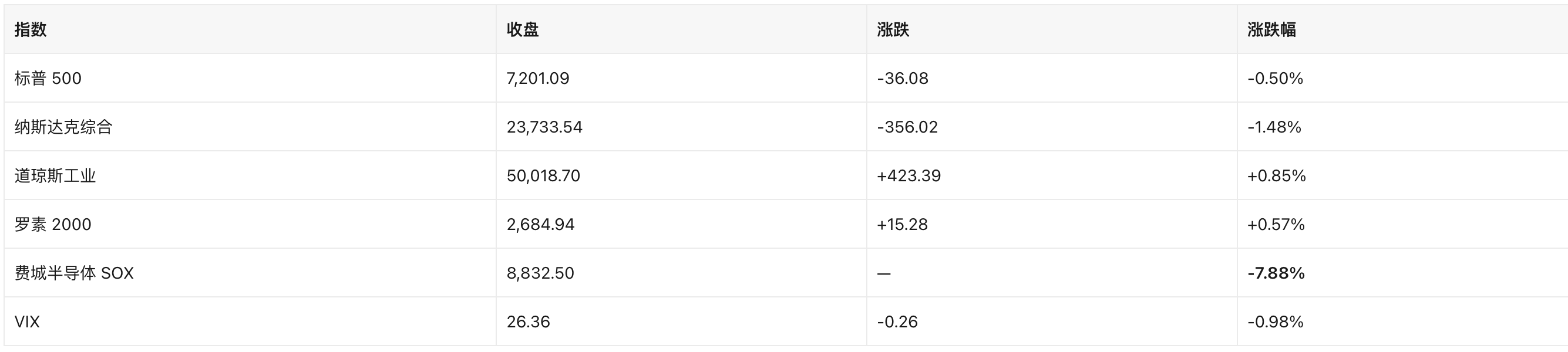
Nvidia closed 5.86% lower and lost another 2.27% after hours. Huang apologized at an all-hands meeting over personal-conduct issues and disclosed additional information to the board. Politico also reported rising pressure for congressional hearings on controls over exports to China. The combination has brought a governance discount into the market’s valuation of Nvidia.
Anthropic fell below its IPO price on the fourth trading day after listing. The source material describes the move as the failure of the last major pricing anchor in the AI private market and identifies the reversal in the profitability of AI new issues as one psychological trigger for the technology selloff.
The session was not a blanket risk-off event. The Dow Jones Industrial Average gained 0.85%, while the health-care ETF XLV rose 2.95% and the consumer-staples ETF XLP gained 1.66%. The market showed a rotation from long-duration AI assets toward assets with more certain cash flows. That distinction is central to judging the depth of any subsequent decline.
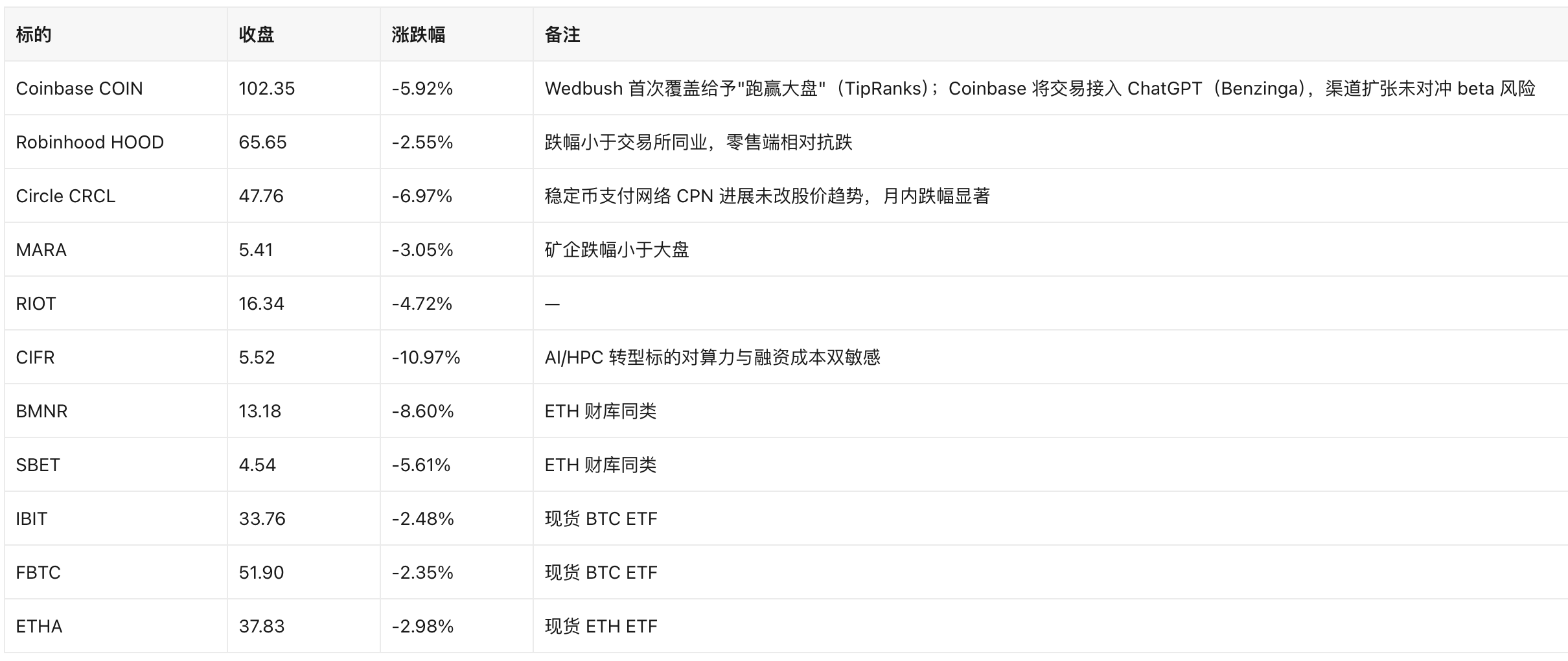
Crypto assets and crypto-linked equities broke lower alongside technology stocks. Bitcoin traded at $59,223.5, down 1.30% over 24 hours and only about 7% above its 52-week low. Strategy closed at $77.55, a new 52-week low. U.S. spot Bitcoin ETFs have recorded $4.71 billion in net outflows so far in November, a monthly record.
Indexes, economic data and rates
The source material identifies four links in Tuesday’s reversal. Anthropic’s break below its IPO price weakened the AI valuation anchor; Nvidia’s governance news reduced confidence in institutional holdings; a rating downgrade for Micron exposed a structural conflict between strong AI demand and excess memory supply; and higher expectations for a December rate increase lifted real yields and compressed valuations for long-duration assets.
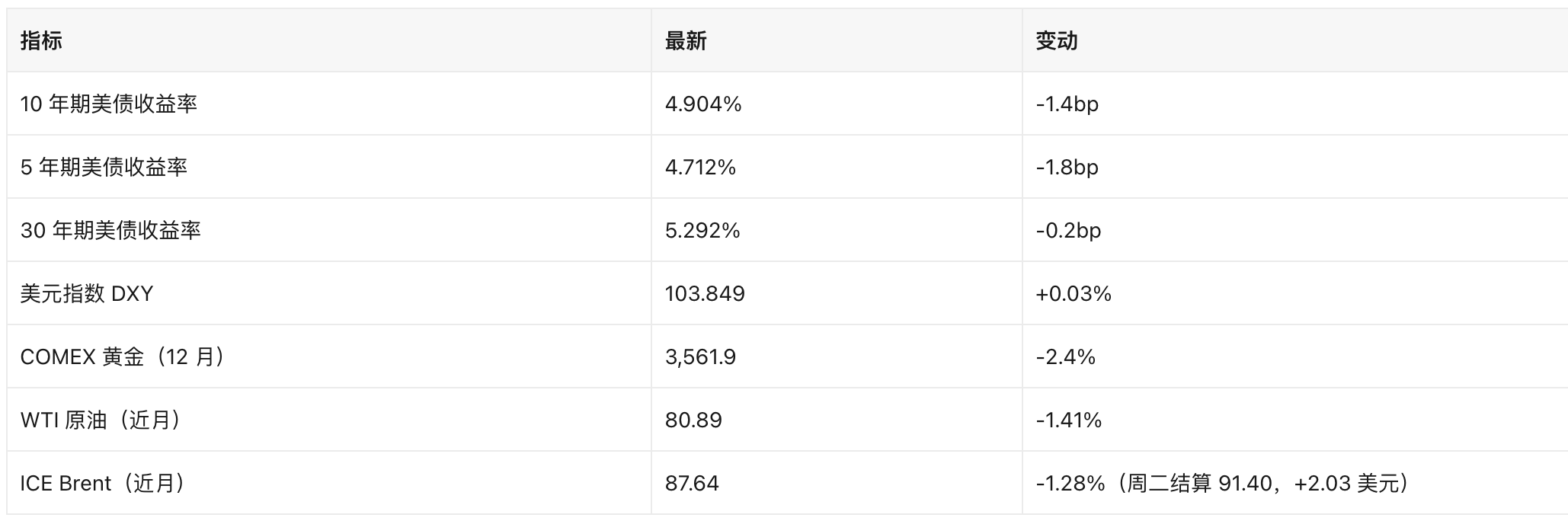
The VIX edged down to 26.36 but remained above Monday’s low. The pattern suggests investors were buying protection rather than capitulating in a broad panic. The S&P 500 is 8.2% below its 52-week high of 7,844.52. The Nasdaq is 14.4% below its high of 27,722.75. The SOX is down 33.2% from its Oct. 6 peak, while the Russell 2000 is 12.5% below its 52-week high. The S&P 500 remains in the upper part of its yearly range, but its leadership structure has been damaged.
November consumer confidence came in at 103.3, above the 92.4 estimate and the prior reading of 91.9. The index reached its highest level in nearly two years. The source material links the improvement to a mood recovery after Democrats won the midterm elections, while CNBC said inflation concerns remained. The soft demand data does not support a recession narrative and weakens the case for rate cuts.
The preliminary November Markit composite PMI was 54.6, compared with an estimate of 55.6 and a prior reading of 55.9. Manufacturing PMI was 54.5, in line with expectations, while services PMI was 54.7, below the 55.6 estimate. Activity remains in expansion territory, but momentum has eased. The Richmond Fed manufacturing index rose to plus 3 from an estimate and prior reading of minus 2, pointing to a regional manufacturing recovery.
Housing momentum was broadly flat. The FHFA house-price index was unchanged month over month, against an estimate of a 0.2% increase. The seasonally adjusted S&P/Case-Shiller 20-city index rose 0.1% month over month and 2.6% year over year, below the 2.7% estimate. Weekly ADP employment increased by 21.0K, down from 23.8K previously, indicating a gradual cooling in the labor market rather than a sharp deterioration.
Federal Reserve official Williams said on Nov. 23 that inflation remained too high and that rates needed to stay restrictive for some time. The source material identifies the remarks as a direct source of this week’s hawkish pricing.
Long-term Treasury yields barely moved during the equity selloff. The 10-year yield fell only 1.4 basis points. That combination is more consistent with high real rates and a repricing of risk premiums than with a recession trade. Gold fell 2.4%, also indicating that capital was not moving decisively into traditional safe-haven assets and was instead shifting toward cash and the short end of the curve.
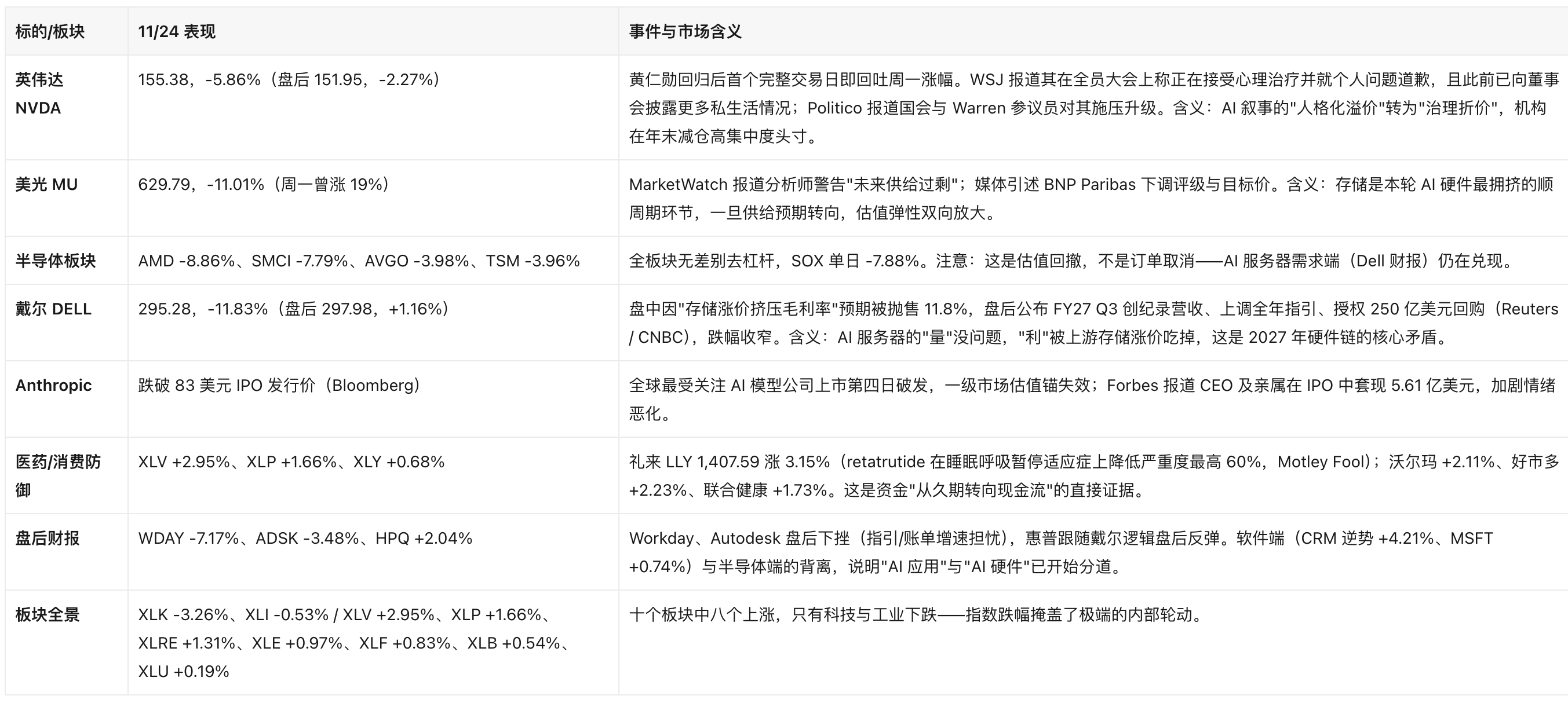
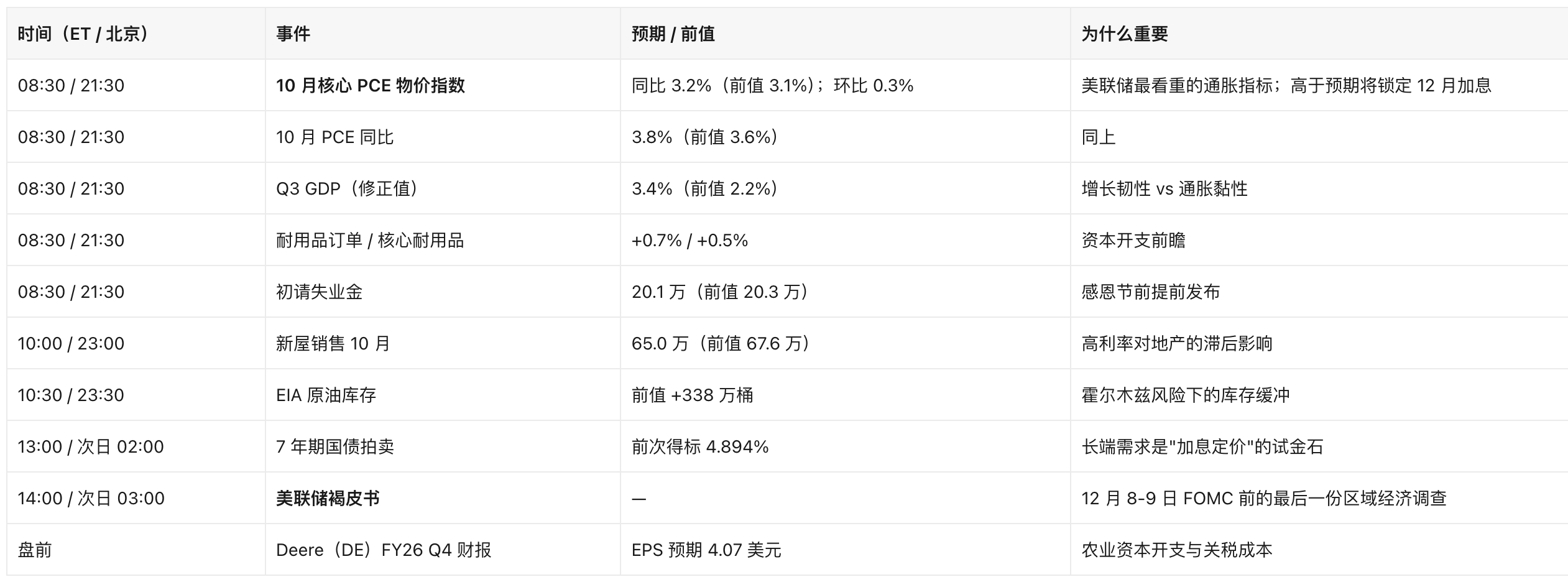
The Federal Open Market Committee is scheduled to meet on Dec. 8-9, with a quarterly Summary of Economic Projections. CME FedWatch showed an 88% probability of a December rate hike after the Nov. 10 CPI report. CoinDesk reported on Nov. 23 that traders had abandoned bets on a 50-basis-point hike, with the base case converging on 25 basis points. A hotter-than-expected core PCE reading on Nov. 25 would further reinforce that pricing.
Strategy’s Bitcoin model faces a discount problem
Strategy (MSTR) closed at $77.55 on Nov. 24, down 8.12%. The stock broke below its previous 52-week low of $77.69 and set a new 52-week low. Its market capitalization was $32.696 billion, with a 52-week range of $198.40 to $77.69.
According to Strategy’s SEC Form 8-K filed on Nov. 23, the company bought 457 BTC between Nov. 16 and Nov. 22 for $29.6 million, at an average price of $64,898. Its total holdings reached 851,305 BTC, acquired for an aggregate cost of $64.23 billion at an average cost of $75,446.
Using Bitcoin’s Nov. 24 closing price of $59,223.5, the holdings were worth about $50.42 billion. The position carried an unrealized loss of $13.81 billion, or 21.5%. On a simple market-capitalization-to-Bitcoin-holdings basis, the ratio was 0.65, implying a 35.1% discount to the value of its holdings. This calculation excludes convertible debt and preferred stock and is therefore an upper-bound measure. Yahoo Finance also described the stock as trading at a discount to book value.
Financing data showed that Strategy sold 1,925,676 MSTR shares through its at-the-market program during the week, raising $176.7 million net. Only $29.6 million went toward Bitcoin purchases; the remainder was used to repurchase STRC. The company raised its authorization for digital credit securities repurchases from $3 billion to $4 billion. As of Nov. 22, $1.12 billion remained available, and the company repurchased $211.8 million of STRC during the week. It held $3.73 billion in dollar reserves and $1.09 billion in dollar cash.
When the stock trades below the value of its Bitcoin holdings, or when mNAV is below one, the positive feedback loop in which new share issuance increases Bitcoin per share no longer works. Issuance can dilute shareholders instead. Strategy’s $29.6 million of Bitcoin purchases for the week amounted to roughly one-seventh of the $211.8 million spent on preferred-stock repurchases. The source material presents this as a major structural change for the DAT model and characterizes Strategy’s shift as a move from a premium-arbitrage machine toward credit repair.
Other crypto equities and treasury activity
No new company met the criteria for a first announcement of Bitcoin purchases or a DAT conversion during the previous 24 to 48 hours. The source material says it checked CoinDesk, The Block, Decrypt, Bitcoin Magazine and Google News aggregation, but found no first-purchase announcement that could be cross-verified.
Among existing DAT companies, Twenty One Capital added 172.25 BTC and held 43,841 BTC, according to a Nov. 23 report. Strive (ASST) made no purchases last week and kept its holdings at 43,404 BTC. The stock closed at $14.19, down 8.27%, continuing to show high beta relative to Bitcoin.
ETH treasury companies began deleveraging. BTCS sold 27,300 ETH for $43.8 million to repay Aave debt. CoinDesk reported on Nov. 24 that its CEO said the decision was not made lightly. CoinShares liquidated its ETH position and sold half of its SOL holdings for $19.3 million. The source material says these transactions show how DeFi leverage at ETH treasury companies can turn into forced selling when market conditions deteriorate. It describes the mechanism as a negative feedback loop of falling prices, insufficient collateral ratios, asset sales and further declines, and identifies it as a structural reason for ETH’s relative weakness against BTC.
Trump Media (DJT) closed at $3.65, down 6.05%. Its $884 million convertible debt matures on Nov. 30. The Financial Times reported that the company had warned it might sell some Bitcoin to repay the debt. The source material identifies the maturity as one of the clearest potential forced-selling windows over the next five trading days.
ETF outflows add to crypto market pressure
U.S. spot Bitcoin ETFs have seen $4.71 billion of net outflows in November, the largest monthly outflow on record. They posted $570 million of net outflows on Nov. 24 as Bitcoin fell below $60,000. The week of Nov. 17-21 recorded $1.8 billion of outflows. The source material cites analysts saying the withdrawals have become structural.

Bitcoin is down 39.5% from its 52-week high and only 7.4% above its 52-week low. Decrypt described the decline as the worst since the FTX event. The source material attributes the main pressure to ETF redemptions and the contraction in DAT financing, including the mNAV discount at MSTR and ETH treasury companies selling assets to repay debt, rather than to an on-chain fundamental event.
On the trading side, a court dismissed a class-action lawsuit by Terra stablecoin holders involving Coinbase. Coinbase also connected spot trading to ChatGPT. The source material says both developments had limited effects on the stock.
Crypto-linked equities are amplifying Bitcoin’s moves. MSTR’s 8.12% decline was 6.2 times Bitcoin’s 1.30% loss, while CIFR fell 10.97%, or 8.4 times Bitcoin’s decline. The source material says leveraged crypto equities are currently magnifying rather than leading Bitcoin’s move. That reverses the transmission direction seen in 2024-2025, when equities led the token market, and points to a contraction led by the financing side through ETF redemptions and DAT discounts.
Geopolitics, oil and supply chains
ABC News, citing UKMTO, reported that three oil tankers were attacked in the Strait of Hormuz. The United States imposed a maritime blockade on Iran. Treasury Secretary Bessent announced a new round of sanctions on Nov. 23-24 targeting Iran’s oil shadow-banking network and corrupt oil traders, according to Fox News and Benzinga. Reuters and Iran International reported that Iran warned it would use every tool available in response to the blockade and threatened European bases within a range of 4,500 kilometers. Al Jazeera reported that a Saudi-led coalition ordered the evacuation of Hodeidah port.
Brent crude settled at $91.40 on Tuesday, up $2.03 and in a three-month high range. Electronic trading later pulled the price down to $87.64, a decline of $1.28, after reports that U.S.-Iran diplomacy was continuing, according to Bloomberg. The transmission described in the source material is higher oil prices, higher inflation expectations, stronger December-hike pricing, higher real yields and pressure on long-duration AI stocks and crypto assets. Energy equities gained: XLE rose 0.97%, XOM rose 0.85% and CVX rose 1.24%. A ceasefire or diplomatic progress could lower oil prices while lifting risk appetite, so the direction of the effect is not one-way.
Democrats won the U.S. midterm elections. CNBC linked the political result to the jump in November consumer confidence to 103.3. The source material says divided government generally limits fiscal expansion and reduces uncertainty around tariffs and industrial policy, which is broadly neutral to modestly positive for U.S. equities. Politico reported that Warren was pressuring Nvidia, however, creating a risk of reordered priorities for AI regulation and crypto legislation.
In the supply chain, a shortage of RAM pushed AI server quotations as much as 45% higher after contracts were signed, according to Tom’s Hardware. Costs at three memory-heavy CPU nodes doubled. The source material presents this as evidence that AI demand is real but that profit is being redistributed inside the supply chain. It also describes the same dynamic from two sides: margin pressure at Dell and HP, alongside concerns about excess supply at Micron.
Next 24 hours
Nov. 25 is the final full trading session before Thanksgiving. U.S. markets will be closed on Nov. 26 and will close early at 1 p.m. ET on Nov. 27. Thinner liquidity may amplify passive selling in AI stocks, while the Friday half-day session can produce one-way moves linked to month-end rebalancing.
- Nov. 30: Trump Media’s $884 million convertible debt matures, creating a potential Bitcoin-selling event. Month-end ETF flow data will show whether November outflows exceed $4.7 billion.
- Around Dec. 1: Strategy is expected to disclose its weekly Bitcoin purchases. The key comparison is whether purchases remain below preferred-stock repurchases.
- Three figures to monitor are core PCE year-over-year growth at or above 3.3%, the 10-year Treasury yield holding 4.9%, and whether MSTR closes below $77.69 for a second consecutive day.
The source material treats consecutive closes below $77.69 as confirmation of a new 52-week low and says the mNAV discount could widen below 0.6 times, accelerating the financing contraction. Its monitoring framework is conditional: if core PCE meets or undershoots expectations and long-end yields fall, the rotation into the Dow, health care and consumer stocks may continue. If inflation exceeds expectations while the SOX keeps breaking lower, high-beta assets may decline together, with crypto equities exposed to larger losses because of their leverage and financing structures.
The source material was compiled from Yahoo Finance, Msx market data, Strategy’s Nov. 23, 2026, Form 8-K, CoinDesk, Decrypt, the Financial Times, Bloomberg, Reuters, CNBC, Politico, Tom’s Hardware and economic calendars. It is for information and analysis only and does not constitute investment advice.



