
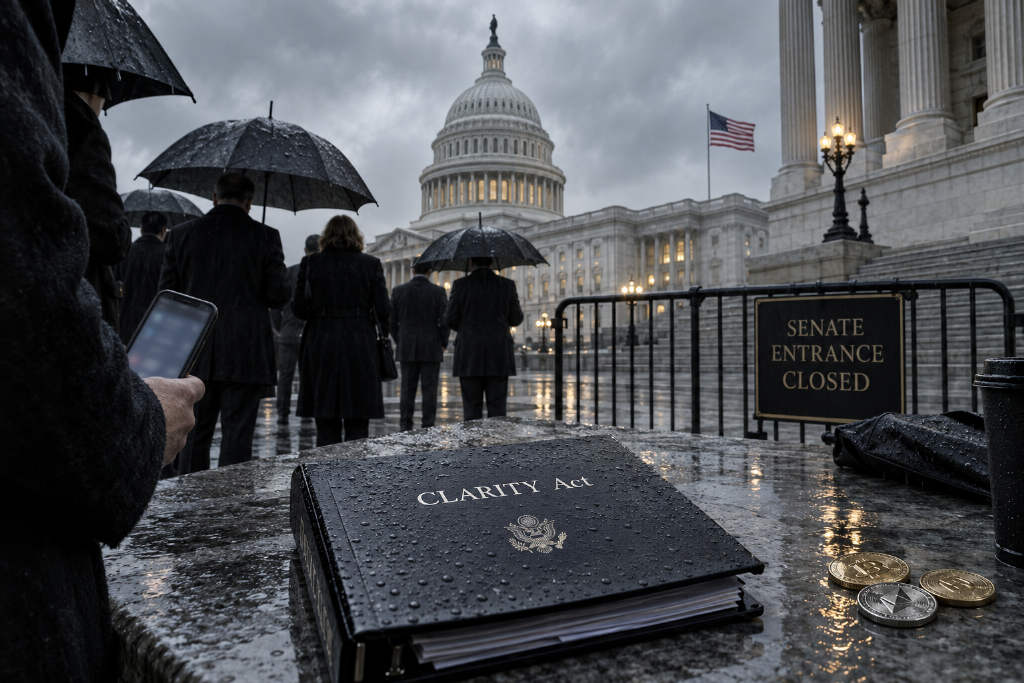
The U.S. Senate voted 49-50 on Tuesday afternoon against taking up the Digital Asset Market Clarity Act, blocking the crypto market structure bill a day after Republicans released what they described as the final text.
Under a unanimous consent agreement entered on Aug. 8, cloture on the motion to proceed to H.R. 3633 required 60 votes. The Senate Daily Press floor log shows voting began at 2:18 p.m. and the result was announced at 3:00 p.m. Senator Chris Coons did not vote.
Republicans hold 53 seats in the chamber. Four of them — Susan Collins, Josh Hawley, Jerry Moran and Thom Tillis — voted no. That left 49 Republican yes votes, which accounted for the full tally in favor of proceeding. No Democrat or independent voted to take up the bill.
The House passed H.R. 3633 by a 294-134 vote in July 2025. The Senate text that failed on Tuesday was drafted as an amendment in the nature of a substitute to that bill.
Tillis keeps a second vote alive
Tillis voted no in order to preserve the right to move for reconsideration, according to the floor log, and he made that motion at 3:01 p.m. Under Senate procedure, a senator must be on the prevailing side to move for reconsideration. That keeps open the option of a second cloture vote on the same motion without requiring a new filing.
The Senate then moved immediately to S. 4668, with a cloture vote on that measure scheduled for about 4:15 p.m.
Ethics language remained a central dispute
Seven Senate Democrats who had negotiated the bill for a year — Mark Warner, Angela Alsobrooks, Cory Booker, Catherine Cortez Masto, Ruben Gallego, John Hickenlooper and Raphael Warnock — said in July that the Republican text "falls short" and put ethics rules for elected officials at the top of the list of issues that still needed work. None of them withdrew that statement before Tuesday's vote.
On Monday, Senators Cynthia Lummis, John Boozman and Tim Scott released what they called the final text. Their release said the draft incorporated 126 changes requested by Democrats, including five in the ethics division, and said the ethics language reflected "substantially all of the Tillis-Gallego ethics proposal."
The Defiant reported Monday that the revised ethics division removes the Jan. 20, 2029 sunset, reverses the July text's bar on enforcement by state attorneys general, and raises civil penalties to 20% of the take or $500,000, whichever is greater.
"After a year of intense daily bipartisan negotiations, this bill is ready," Lummis said in the release. "Democrats got what they wanted; now they need to take yes for an answer."
Democrats sent back a counterproposal on Monday night after a meeting in Minority Leader Chuck Schumer's office, according to a report first published by Politico. Katie Warbinton, a spokesperson for Lummis, told The Block that "if Democrats are serious about reaching a deal, they need to actually start negotiating instead of resubmitting the same demands and calling it progress." Warner told Semafor that the language Democrats wanted had been on the table for about a year. The counterproposal has not been published.
Gallego, one of the seven Democratic negotiators, told reporters before the vote that "the compromise we had was a good ethics compromise that would have bought a lot of Dem votes," according to CNBC.
Eighteen attorneys general urged rejection
Eighteen state attorneys general asked the Senate on Monday to reject the bill as written. In a letter sent to Tim Scott and Senate Banking Committee Ranking Member Elizabeth Warren, they asked Congress to preserve state enforcement authority over tokenized and non-tokenized securities and to codify state registration regimes for digital assets.
"As written, the Clarity Act would embolden scammers and potentially strip attorneys general of our authority to protect our states' investors and their wallets," New York Attorney General Letitia James said in a statement released with the letter.
The signatories besides New York were Arizona, California, Connecticut, Delaware, Illinois, Kansas, Maryland, Massachusetts, Michigan, Minnesota, Nevada, New Jersey, Ohio, Virginia, Washington, Wisconsin and the District of Columbia.
The letter arrived in the same week that the ethics division was rewritten to give state attorneys general enforcement standing that the July text had denied them.
Prediction market odds and crypto prices moved lower
After the vote, Polymarket priced the odds of the CLARITY Act being signed into law in 2026 at 6.5%, based on $19.8 million in cumulative volume. That was down 22 points over 24 hours. The same market had been at 19.5% on Tuesday morning, 29.5% on Monday afternoon and 18% on Friday.
CoinGecko data showed Bitcoin at $75,901, down 4.1% over 24 hours. Coinbase recorded a 24-hour low of $74,887.50 against an open of $78,982.77. Ether traded at $2,403, down 5.5%. XRP fell 11.1% to $1.30, Solana dropped 5.3% to $97.70, and BNB slipped 0.9% to $719.44.
The Federal Open Market Committee opened a two-day meeting on Tuesday and is set to release its decision on Wednesday afternoon.
Less than three weeks of scheduled session remain
The Senate's 2026 legislative calendar sets a state work period from Oct. 5 to Nov. 6, with senators returning on Nov. 11 after the Nov. 3 election. That leaves less than three weeks of scheduled session time for a second cloture vote on the motion Tillis moved to reconsider.
Traders had already pushed passage odds into 2027 in early August, when Majority Leader John Thune allowed a first cloture filing to pass without moving ahead. He filed on Aug. 8 with 16 Republican co-signers.