
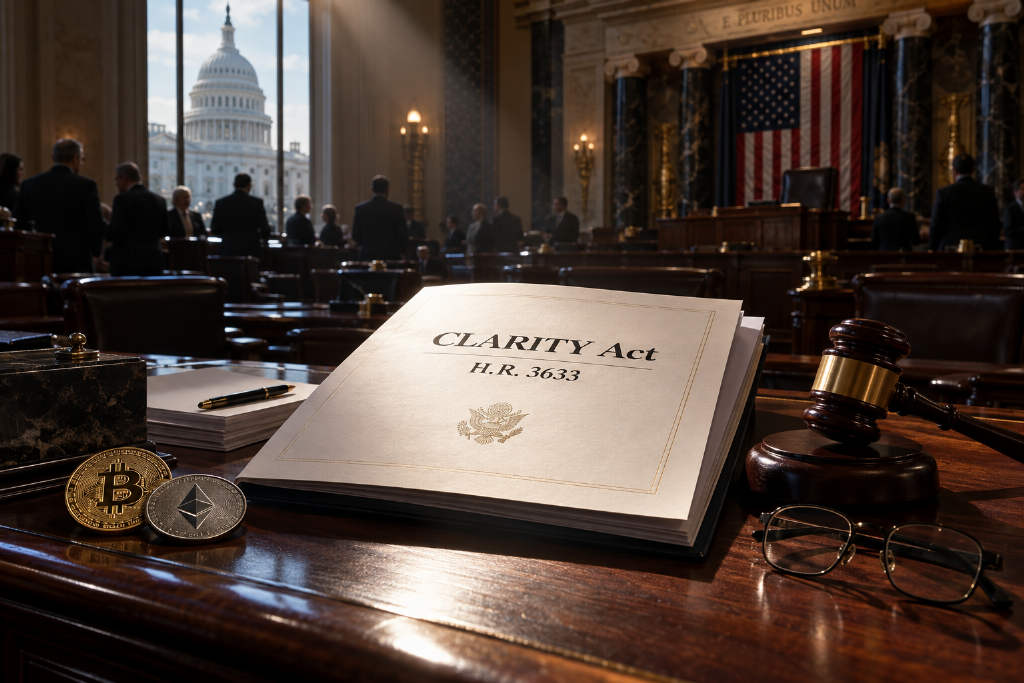
Senators Cynthia Lummis, John Boozman, and Tim Scott on Monday released what they called the final text of the Digital Asset Market Clarity Act, one day before the Senate is set to vote on whether to take the bill up. The revised version includes ethics restrictions that President Donald Trump agreed to, applying to the president, members of Congress, federal judges, and their spouses.
The vote scheduled for Tuesday at 2:15 p.m. is a cloture vote on the motion to proceed to H.R. 3633. Under a unanimous consent agreement entered on Aug. 8 and carried on the Senate Calendar of Business, it needs 60 votes. Republicans hold 53 seats, while Democrats hold 45 and two independents caucus with them. If every Republican votes to proceed, seven Democrats would be needed to carry the motion.
Final draft expands from 616 pages to 635 pages
The final text runs 635 pages, compared with 616 pages for the version Lummis posted on July 22. Lummis had also posted an interim revision on Sept. 10 that listed three changes, none of them in the ethics division.
Monday's release lists 126 changes requested by Democrats, five of them in the ethics division, and says the new ethics language reflects "substantially all of the Tillis-Gallego ethics proposal." Senator Ruben Gallego of Arizona, one of the seven Democrats central to the math on the vote, had not commented through his office.
Lummis said in the release: "After a year of intense daily bipartisan negotiations, this bill is ready. President Trump voluntarily agreed to unprecedented ethics restrictions, holding every federally elected official, judge, and their spouses to some of the toughest ethics restrictions in U.S. history. Democrats got what they wanted; now they need to take yes for an answer."
Sunset clause removed in the final version
The July text ended the ethics ban at noon on Jan. 20, 2029, the end of Trump's term, and barred any penalty for conduct before that date. The final text no longer includes that sunset section.
Three other provisions also changed. The July version said that "no action, public or private, may be brought under this section by any State attorney general or any person other than the Attorney General." The final text gives state attorneys general standing to sue.
Civil penalties also increased. They moved from 10% of the consideration received or $500,000, whichever is less, to 20% or $500,000, whichever is greater, with both adjusted for inflation.
The definition of a covered individual now includes a president, vice president, or member of Congress who has been certified as elected but not yet sworn in, along with their spouses.
Ownership language rewritten around "significant financial interest"
The July draft covered a "direct interest," meaning holding a digital asset or owning 20% or more of the equity in a business entity that drew more than 50% of its revenue from issuing or sponsoring digital assets. Divesting the interest or putting it into a blind trust was treated as a defense against the issuance ban.
The final text creates a separate prohibition on maintaining a "significant financial interest." It defines that as $15,000 or more of equity in an entity that drew a plurality of its revenue from issuing or sponsoring digital assets in any of the preceding three calendar years.
Anyone holding such an interest must divest or use a qualified blind trust by the effective date of the division and notify the supervising ethics office within three days. That office must post the notice publicly three days later.
One July carve-out is no longer there. That earlier text said a covered individual did not violate the ban if an issuer that had used the person's "name, image, or likeness" before they took office continued doing so after divestiture, "including through the minting, sale, or distribution of additional digital assets." No equivalent language appears in the final draft.
How state attorneys general can bring cases
When a state attorney general alleges a violation of the issuance, sponsorship, or significant-interest bans, the final text gives that state standing to bring an action for injunctive relief against the Attorney General of the United States, not against the official who issued the token. Lummis's own fact sheet describes it in those terms.
States may, however, sue a digital asset intermediary directly over the listing ban and collect penalties of up to $250,000 per violation per day.
Two provisions narrow that state route. No action may be brought if the supervising ethics office issues a legal opinion saying the activity is not prohibited. No action may be brought over a significant financial interest once that office publishes the divestiture or blind trust notice.
A state or its residents must also show harm, including financial harm above $100.
The district court enters findings of fact and refers the case to the en banc court of appeals for conclusions of law. The appeals court reviews the facts de novo.
In her statement on the July text, Senate Banking Committee Ranking Member Elizabeth Warren said the president "can, and will, simply ignore the law because he handpicked his personal lawyer to lead the Department of Justice that is charged with enforcement and everyone else – including state attorneys general – are explicitly prohibited from bringing any enforcement actions." Her office had not commented on the final text.
Already-issued tokens fall outside the new bans
The prohibitions on issuing and sponsoring digital assets apply only to assets issued or sponsored on or after the effective date of the division. Tokens that were already launched are outside those restrictions.
That effective date is the earlier of 360 days after enactment or 60 days after the Securities and Exchange Commission publishes the final rule under Section 10102(b). The same timetable applies to the divest-or-blind-trust requirement.
Once an interest is placed in a qualified blind trust, the text says neither the trustee's actions nor those of any entity in which the trust holds an interest, "including the issuance or sponsorship of any digital asset," are attributed to the covered individual.
AP reported White House accepted about 80% of the proposal
The Associated Press reported that Trump agreed to a ban on issuing meme coins and to the divest-or-blind-trust requirement, and that the White House accepted about 80% of the Tillis-Gallego proposal. Lummis's release described the final result as "substantially all."
Trump and his wife launched the TRUMP and MELANIA tokens in January 2025, days before his second inauguration.
AP also quoted Senator Angela Alsobrooks of Maryland, another of the seven Democrats, as saying: "We need the state attorneys general to also have the power to prosecute if the Department of Justice refuses to," and, "I have been very clear about the fact that I will not vote for any legislation that does not cover ethics."
According to AP's reading of Trump's annual ethics disclosure, Trump reported more than $1.4 billion from crypto businesses, including more than $500 million from World Liberty Financial product sales and more than $600 million from meme coin sales through CIC Digital LLC.
No public backing yet from the seven Democrats
None of the seven Democrats who negotiated the bill had issued a statement on the final text as of Monday. Their July statement, signed by Senators Mark Warner, Angela Alsobrooks, Cory Booker, Catherine Cortez Masto, Ruben Gallego, John Hickenlooper, and Raphael Warnock, said ethics for elected officials, consumer protection, illicit finance, conflicts of interest, and market integrity were the areas that still needed to be strengthened.
As of Monday afternoon, neither Gallego nor Senator Thom Tillis, the North Carolina Republican whose joint proposal with Gallego was cited by Lummis, had posted anything on the final text.
Prediction markets repriced the Senate vote
On Polymarket, the odds of the CLARITY Act being signed into law in 2026 stood at 31% on Monday, with $16.3 million in cumulative volume. The same market was at 18% on Friday.
A companion market on how many senators will vote for the bill put the odds of more than 50 votes at 62%, up from 36% on Friday. Traders had pushed passage odds into 2027 in early August, when Majority Leader John Thune let a first cloture filing pass.
Bitcoin traded at $77,666, up 0.5% over 24 hours and down 2.7% over seven days, with a 24-hour range of $76,439 to $77,831, according to CoinGecko.
Tuesday's vote is procedural, not final passage
Tuesday's Senate vote is on the motion to proceed, not on final passage of the bill. If the Senate clears that step, debate and amendments would follow.
Whatever the Senate passes would still have to go back to the House because the Senate text is an amendment in the nature of a substitute to the bill already sent over by the House. The House passed H.R. 3633 on July 17, 2025, by a vote of 294-134. Every no vote came from Democrats, while 78 Democrats voted yes.
The Senate Banking Committee approved its version 15-9 on May 14 and reported the bill with the strike-and-insert amendment on June 1. Majority Leader John Thune moved to proceed and filed cloture on Aug. 7.