
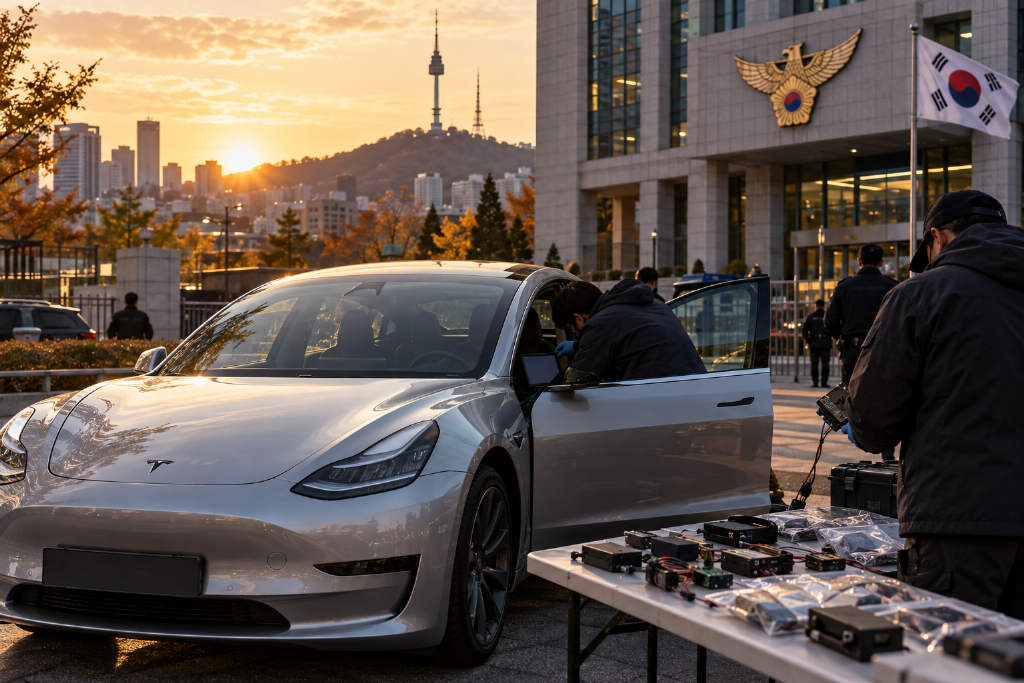
Seoul Metropolitan Police Agency said on Oct. 27 that 80 Tesla owners were referred for prosecution for allegedly violating South Korea’s Motor Vehicle Management Act after using uncertified devices to activate Tesla’s supervised Full Self-Driving system, or FSD. Police seized 21 devices in the case. The Dong-A Ilbo reported that the 80 owners were sent to prosecutors last week.
Devices were bought from Europe and China or built by users
The report said some of the modified Tesla computer devices were purchased from Europe and China, while others were made by the users themselves. Korean media said the case began when an IT worker obtained source code from the open-source platform GitHub and built a device that enabled FSD. Owners then shared activation methods in online communities and exchanged tips on how to avoid leaving records in their cars.
FSD is Tesla’s driver-assistance feature. Under driver supervision, it can change lanes, make left and right turns, and continue driving to a destination. Under normal conditions, eligible vehicles must subscribe to the service and receive the required software update before the feature can be activated.
Only U.S.-built Tesla models can legally use FSD in South Korea
Under the Korea-U.S. Free Trade Agreement, U.S.-built vehicles that meet Federal Motor Vehicle Safety Standards, or FMVSS, are exempt from related Korean certification requirements. As a result, only U.S.-built Model S, Model X, and Cybertruck vehicles can legally use FSD in South Korea.
Tesla vehicles produced in China and Europe have not obtained the relevant safety certification. Activating FSD on those cars without approval is illegal. Whether the feature can be used legally depends on where the vehicle was built.
The number of Teslas that can legally run FSD in South Korea is small. The country has 180,684 registered Teslas, and only 4,292 of them are eligible for legal FSD use, equal to 2.4% of the total. That figure includes 2,708 Model X vehicles, 1,193 Model S vehicles, and 391 Cybertrucks. On average, only 1 out of every 42 Teslas in the country can legally use FSD.
The report also said that some owners of China-built vehicles, including the Model Y, have recently used unofficial external devices or source code to enable FSD.
Police say uncertified activation creates safety risks
South Korea’s Motor Vehicle Management Act prohibits arbitrary changes, installation, addition, or deletion of software that could affect the safe operation of a vehicle. Violators can face up to 2 years in prison or a fine of up to 20 million won. The report said 20 million won is about NT$490,000.
Police said the suspects used uncertified devices to activate FSD and bypassed Tesla’s official software update and certification procedures. Police said, 「The vehicle may fail to properly recognize driving conditions or may make movements that differ from the driver’s intent, and safety risks have been confirmed.」
Multiple Korean media outlets described the 80 people as vehicle owners. Existing reports did not mention the price of the devices or the sellers. Police said they will continue working with relevant agencies to investigate illegal acts that threaten road safety. The case has been sent to prosecutors, who will decide whether to file charges.
Key figures disclosed in the case
- Owners referred: 80
- Devices seized: 21
- Models legally allowed to use FSD: U.S.-built Model S, Model X, and Cybertruck
- Eligible Teslas in South Korea: 4,292, or 2.4% of all registered Teslas
- Maximum penalty: up to 2 years in prison or a fine of up to 20 million won



