
Crypto and adjacent tech markets saw a broad set of developments between Sept. 27 and Sept. 28, spanning protocol upgrades, ETF approvals, token unlocks, whale positioning, regulatory comments, and AI company news.
Hyperliquid to raise HIP-4 deployment limits and lower funding-rate cap
Hyperliquid co-founder Jeff Yan said in an announcement on the project’s official Discord that the next network upgrade will adjust HIP-4 parameters based on builder feedback.
The number of active results a single deployer can keep at the same time will rise from 100 to 200, and the daily deployment cap will increase from 500 to 1,000. At the same time, the cap on perpetual funding rates will be cut from 4% per hour to 0.5% per hour. The team said that upper bound is rarely reached in actual trading.
Vitalik says Hegota may be Ethereum’s last “regular” upgrade
Ethereum co-founder Vitalik Buterin published an article titled The cryptographic world computer, saying Ethereum is evolving from a traditional blockchain into a system that combines blockchain infrastructure, cryptographic privacy and verification, and decentralized off-chain components.
He said Hegota, which is planned for next year, may be Ethereum’s last “regular” upgrade. After that, the main direction will include recursive STARKs, automated formal verification, highly optimized consensus algorithms, and quantum safety.
According to Buterin, by 2030 Ethereum block verification will move away from full download and re-execution toward SNARK verification and PeerDAS data-availability sampling. Consensus will shift toward an optimized proof-of-stake design with short-slot finality and an available-chain mechanism, while block building will move from a single proposer model to multi-party participation.
On the user side, he said the network could offer stronger censorship resistance, better privacy, lighter node requirements, slot times of about 4 to 8 seconds, and final confirmation in roughly 8 to 32 seconds.
He added that PeerDAS has already started Ethereum’s transition from a pure blockchain into a stronger system, and that after Hegota this transition will become Ethereum’s main narrative.
Anthropic president Daniela Amodei enters the Forbes 400
Anthropic co-founder and president Daniela Amodei entered the Forbes 400 list in the U.S. for the first time with an estimated net worth of about $15.5 billion, becoming the youngest self-made female billionaire on the list.
The report said she oversees day-to-day operations at the AI company, which was described as having a valuation close to $1 trillion and plans for a U.S. IPO in November, while also serving as board chair. Citing market expectations, the report said Anthropic’s annualized revenue climbed from $1 billion at the start of 2025 to $65 billion by the end of July 2026, and that its valuation in the private secondary market was at one point pushed to about $1.5 trillion. As the company prepares for what was described as one of the largest tech IPOs on record, the value of founder and employee equity has risen sharply, putting several co-founders among the world’s wealthy ranks.
Lummis says rejected Clarity Act language already gave Treasury authority over offshore exchange laundering
U.S. Senator Cynthia Lummis of Wyoming said in a post that Democrats had previously asked for new Treasury powers to cut off money-laundering channels running through offshore exchanges such as Binance, and that her proposed Clarity Act already provided that authority.
She said Democrats then voted against the bill, blocking what she described as a legislative attempt to strengthen oversight of money laundering through offshore crypto exchanges.
NYSE Arca approves listing of Bitwise spot NEAR ETF
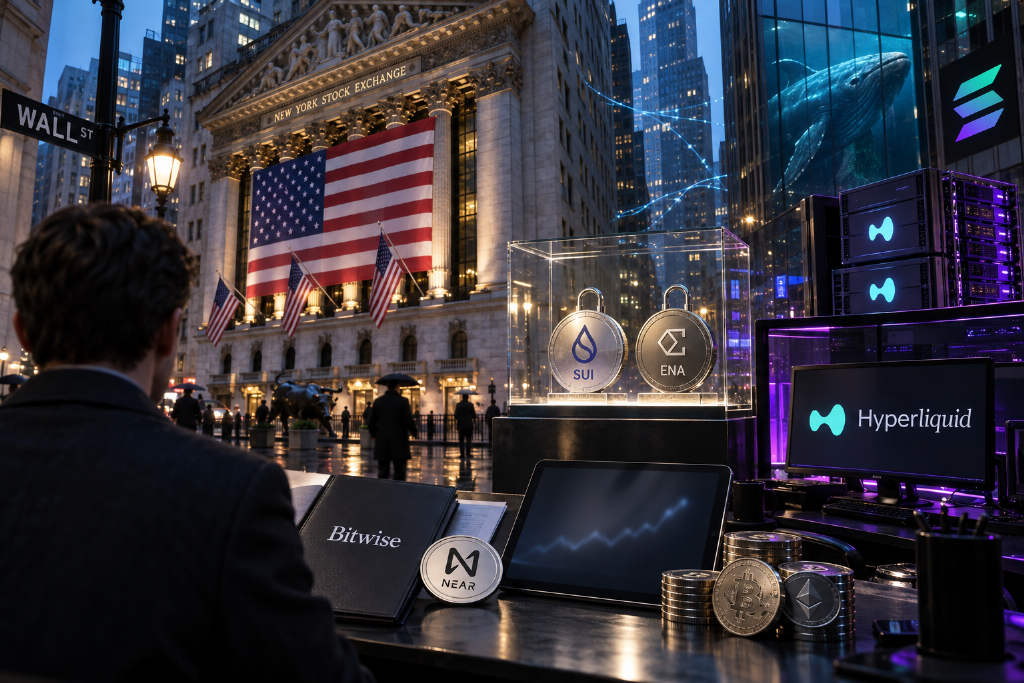
NYSE Arca has approved the listing of the Bitwise NEAR Protocol spot ETF under the ticker “NRR,” making it the first spot NEAR ETF in the United States. Before this, investors mainly used Grayscale’s NEAR trust for exposure.
The fund carries a 0.75% management fee, with Coinbase Custody handling custody and staking of NEAR. A listing date has not been announced. After the news, NEAR briefly rose to around $5.
Large token unlocks scheduled for next week
Data from Token Unlocks showed that several tokens, including 2Z, SUI, and ENA, are set for sizable unlocks next week:
- DoubleZero (2Z) will unlock about 1.66 billion tokens at 9:00 p.m. Beijing time on Oct. 2, equal to about 47.69% of circulating supply and worth about $114 million.
- Sui (SUI) will unlock about 13.26 million tokens at 8:00 a.m. Beijing time on Oct. 1, equal to about 0.32% of circulating supply and worth about $16.7 million.
- Ethena (ENA) will unlock about 40.63 million tokens at 3:00 p.m. Beijing time on Oct. 2, equal to about 0.45% of circulating supply and worth about $11 million.
- Kamino (KMNO) will unlock about 229 million tokens at 8:00 p.m. Beijing time on Sept. 30, equal to about 2.81% of circulating supply and worth about $10.8 million.
- Collector Crypt (CARDS) will unlock about 59.26 million tokens at 3:00 a.m. Beijing time on Sept. 30, equal to about 10.62% of circulating supply and worth about $10.7 million.
- EigenCloud (EIGEN) will unlock about 36.82 million tokens at 12:00 p.m. Beijing time on Oct. 1, equal to about 5.19% of circulating supply and worth about $10.3 million.
- Falcon Finance (FF) will unlock about 77.14 million tokens at 9:00 p.m. Beijing time on Sept. 29, equal to about 2.51% of circulating supply and worth about $10.2 million.
MiniMax launches M3.1-Flash-Preview
AI company MiniMax unveiled its new text model, M3.1-Flash-Preview, which is now live in MiniMax Code. The company positioned it for everyday development work and said it can be used in coding tasks for fast bug fixes and full feature implementation, with an emphasis on response speed and stability.
MiniMax also launched a limited-time campaign in MiniMax Code. From Sept. 28 to Oct. 7, UTC+8, users who check in daily can receive double points. The promotion applies to code models including M3.1-Flash-Preview and to the H3 model used for video generation.
Monochrome Exchange opens MCR IEO
Monochrome Exchange, founded by former Binance Australia CEO and co-founder Jeff Yew, has launched the MCR token IEO. The fundraising total has already exceeded 5.5 million USDT.
Solana whale sits on more than $23 million in unrealized profit
Address 0x9c6a opened a 20x leveraged long around one month ago, taking a bullish position on 550,087 SOL with a notional value of about $67.88 million. The position is now showing more than $23 million in unrealized profit.
The trader has placed take-profit sell orders around $200. If SOL rises to $200, cumulative profit on the leveraged trade could exceed $65 million.
Analyst says Robinhood-chain group cashed out $18.43 million across 53 token launches
On-chain analyst Wazz said in a post that he had identified an ongoing rug-pull cash-out group on Robinhood chain. Over the past two months, the group was linked to at least 53 token launch projects and extracted about $18.43 million in total, with the real scale possibly larger.
He added that the DEED token, which triggered the investigation, did not even rank in the group’s top 10 cash-outs.
Vitalik publishes 32-chapter sci-fi novel Snowmoon
Vitalik Buterin said in a post on X that he had completed his 32-chapter science-fiction novel Snowmoon. He said all text was written by him, with AI used only for proofreading and consistency checks.
The story is set in the fictional city-state of Veridia and includes governance and technical elements such as quadratic voting, quadratic funding, cryptographic sortition, and zero-knowledge privacy credentials. The work is open-sourced under GPL v3, and any film or animation adaptation must also open-source the adaptation process.
Trump plans private White House dinner for Anthropic CEO
U.S. President Donald Trump plans to host a private dinner at the White House on Sunday evening for Anthropic CEO Amodei. The dinner would mark the first one-on-one meeting between Trump and Amodei.
The report said the event points to easing ties between Anthropic and the Trump administration. It added that government officials and their allies had long had a tense relationship with Anthropic. Trump and House Speaker Johnson are also scheduled to meet several top AI company CEOs at the White House on Tuesday, and the private dinner was described as a warm-up for that meeting.
Bloomberg analyst says crypto has underperformed on a risk-management basis
Bloomberg senior analyst Mike McGlone wrote that, from a risk and portfolio management perspective, Bitcoin and other cryptocurrencies may be classified as underperforming assets over roughly the past decade.
He said the Market Vector Digital Assets 100 Index, or MVDA, which is about two-thirds Bitcoin, has been largely flat since 2017, while the Nasdaq 100 Index, or NDX, kept rising over the same period. MVDA’s volatility has averaged about three times higher, and its positive correlation with equities meant it did not provide effective diversification, leading him to describe its performance as weak from a portfolio-management standpoint.
McGlone argued that after Bitcoin futures launched in 2017 and crypto entered the mainstream, MVDA stopped outperforming NDX. He added that the U.S. ETF listings and Trump’s shift in stance before the 2024 election may already have marked crypto’s peak moment, and said that situation is unlikely to change.
Quant jumps more than 340% in seven days after The Clearing House partnership news
Market data showed Quant (QNT) up 342.1% over the past seven days and 97.6% over the past 24 hours, trading at $298.75.
According to an official announcement on Sept. 24, The Clearing House will use Quant, a provider of programmable money infrastructure, to support its “on-chain money movement” initiative. The project is a new interoperable payments network designed to let financial institutions of all sizes clear and settle tokenized deposit transactions.
Quant’s technology will support the network’s interoperability, orchestration, and transaction-management layer to coordinate the clearing and settlement of tokenized deposit transactions. It will also connect with existing fiat payment systems used by financial institutions and their customers, including the RTP and CHIPS networks.
The Clearing House operates U.S. payment networks and processes more than $2 trillion in clearing and settlement activity each day through wire transfers, ACH, check image exchange, and real-time payments.
USDT adds 845,900 holders in seven days
Token Terminal data showed that over the past seven days, USDT added 845,900 holders, while USDC added 390,800, EURC added 69,800, USDG added 23,300, and CASH added 18,600.
Archetype partner sees tokenized stock holders reaching 100 million in three years
Archetype partner Dmitriy Berenzon said in a post that tokenized stocks currently have about 4 million holders, and predicted that figure will reach 100 million within three years.
China’s Ministry of State Security says crypto “anonymity” is a false proposition
In a post titled “Virtual currency crimes can’t be traced? Think again!”, the ministry’s official account said virtual currencies have become an important tool for illegal and criminal activity, creating security risks in several areas, including as a “breeding ground” for money laundering, a “cover” for cyberattacks, and an “accomplice” in espionage and theft of secrets.
It also said the so-called anonymous nature of virtual currencies is fundamentally a false proposition because blockchains preserve complete transaction records and other data that support full-chain tracing. The post said transaction activity leaves traces on the ledger, identity is hard to hide when tracing the path, and private keys do not provide a safety net for assets.
GNGN-linked address deposits 6,100 ETH to Coinbase
A GNGN-linked address deposited 6,100 ETH to Coinbase eight hours ago, worth $16.38 million. The ETH had been bridged from Robinhood network to the Ethereum mainnet six days earlier and may represent Robinhood network fee revenue.
DYORSWAP says incident was not a DYOR contract exploit
DYORSWAP said in a statement that the recent incident was not an attack on the DYOR contract itself. Instead, it said the application was affected by a fraudulent network called “GIWA Chain 9134.” According to the statement, that network was launched by operators controlling bridge infrastructure and ultimately drained the real ETH backing the network.
A recovered dataset showed that about 1,335 addresses bridged funds, around 767.65 ETH entered the bridge, and about 766.25 ETH was ultimately drained. DYOR said there were 1,479 operation records on that chain, of which 1,148 succeeded, involving 298 wallets and 104 pools.
The team said it has already paid more than 200 ETH in compensation to affected users from its own funds. It is continuing to trace the deployer, funding sources, batch-processing infrastructure, and the path of the drained funds, while using on-chain evidence to distinguish attackers from genuine victims.
An earlier report said DYORSWAP had stated that the fake GIWA mainnet scam caused user losses of about 766 ETH.