
This article was originally published by Bit.Fan. For more cryptocurrency news and market insights, visit www.bit.fan.
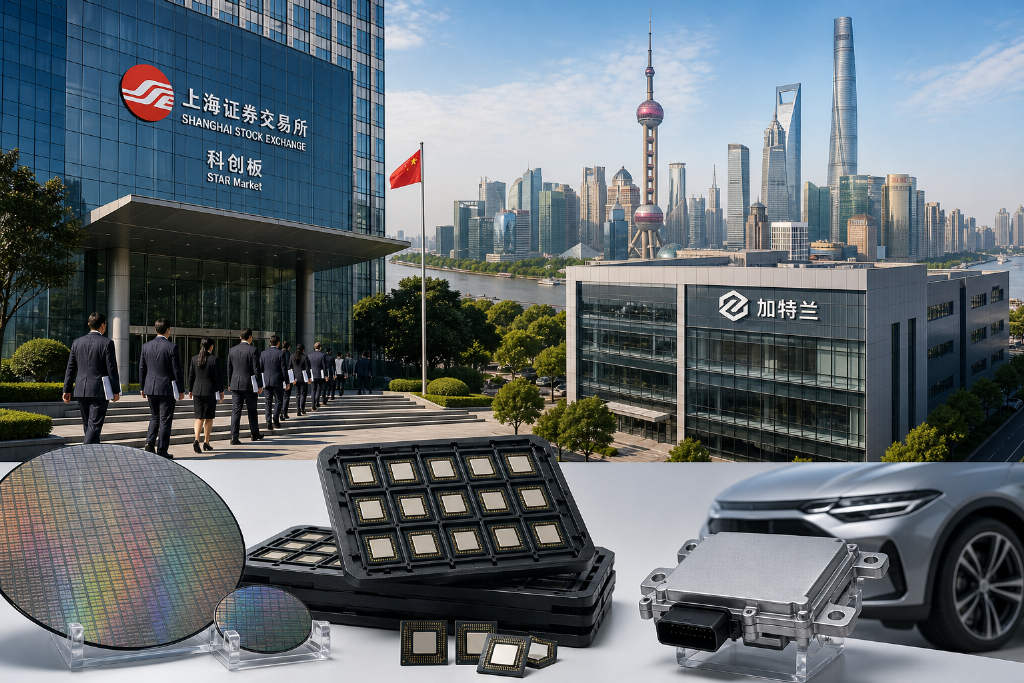
Shanghai automotive chip unicorn Calterah files for STAR Market listing
N
News EditorCalterah Microelectronics, a Shanghai-based automotive radar chip unicorn, has filed for a STAR Market IPO and plans to raise 3.489 billion yuan. The company says its 2025 share of China’s in-vehicle millimeter-wave radar chip market reached 31.1%, with more than 30 million chips shipped and customers including BYD, Geely, Nio and Volvo. Over 12 years, it completed 11 funding rounds and crossed a 10 billion yuan valuation.
Calterah Microelectronics (Shanghai) Co. has filed for an IPO on Shanghai’s STAR Market, seeking to raise 3.489 billion yuan.
The company, which develops automotive-grade millimeter-wave radar chips, traces its roots to a Berkeley laboratory team. In its filing, Calterah said its share of China’s in-vehicle millimeter-wave radar chip market reached 31.1% in 2025, ranking second in China and fourth globally. It has shipped more than 30 million chips, and its customer list includes BYD, Geely, Nio and Volvo.
The company was founded in 2014 and has completed 11 funding rounds. Its backers include the second phase of the National Integrated Circuit Industry Investment Fund, Walden International, Gopher Asset, Guangzhou Automobile Capital, Pudong Venture Capital, Silergy, Zhangjiang Kechuang Investment and the Greater Bay Area Sci-Tech Innovation Fund. Calterah said its valuation has exceeded 10 billion yuan.
Calterah’s story started when founder Chen Jiashu returned to China after earning a PhD in electrical engineering from the University of California, Berkeley at the age of 30. He chose Shanghai and focused on millimeter-wave radar. Before that, he had led a team in the U.S. that developed the world’s first 60GHz WiGig CMOS SoC chip, and he received the U.S. State Department’s Fulbright Science and Technology Award, the only Chinese national among that year’s 27 awardees.
Chen also brought in his former adviser Ali Niknejad, director of Berkeley Wireless Research Center, to co-found the company. The name Calterah combines “CAL” as a nod to Berkeley and “TERAH” from terahertz.
The pair took a different path from the industry norm. Most players used gallium arsenide or silicon-germanium processes for multi-chip assembly. Those approaches were stable, but costly and less integrated. Calterah bet on CMOS from the start. The process offered lower cost and higher integration, even though its high-frequency performance had long been questioned for automotive use.
The bet paid off. In 2015, just a year after its founding, Calterah taped out the world’s first fully integrated 77GHz radar transceiver single chip. In 2017, it mass-produced Yosemite, the world’s first automotive-grade 77GHz millimeter-wave radar RF front-end chip based on CMOS. In 2019, it put the antenna into the package and launched a 77/60GHz millimeter-wave radar AiP SoC, lowering the design barrier for radar modules. In 2024, it introduced the Kunlun platform, which relies mainly on domestic suppliers.
Cost has been the key advantage of the CMOS route. Radar modules built with traditional gallium arsenide solutions can cost more than $100 and are often reserved for premium cars. A CMOS single-chip approach cuts that cost to a fraction, helping millimeter-wave radar move from luxury vehicles into common family cars. Calterah has not only supported domestic substitution, but also expanded the market itself.
By 2025, the company said it held a 31.1% share of China’s market, ranked fourth globally, shipped more than 30 million chips, worked with more than 30 automakers and covered more than 300 vehicle models. Its domestic customers include BYD, Geely, Changan, Chery, Nio and Leapmotor.
The company has also entered Europe. It became the first domestic millimeter-wave radar chip supplier for the global platforms of two leading Tier 1 suppliers, with products used in Volvo and Rivian models. A Chinese automotive chip supplier entering the front-end supply chain of overseas automakers has been rare.
Funding has been extensive. Silergy was among the earliest investors, joining the angel round in November 2015 when the company had just taped out its first 77GHz chip and had registered capital of only 50,000 yuan. Silergy remained a significant shareholder when the prospectus was signed.
The pace accelerated in later years. Calterah completed its A round in 2017 with FreesFund and Zhongguancun Industrial Investment; its B round in 2019 with CICC Capital, Shaanxi Hongchuang, Huaxing Capital, China Mobile Innovation Industry Fund and others; a strategic round in July 2020 with Shangqi Capital, Guangzhou Automobile Capital and Chao Sheng Capital; a Series C round in September 2021 led by SDIC Venture Capital with participation from Langmafeng Venture Capital, Bank of Communications International and Huaxing New Economy Fund, raising hundreds of millions of yuan; and a Series C+ round in January 2022 with Fosun RZ, China Merchants Capital, Gopher Asset, Yinggang Capital and Juntong Capital.
In July 2024, Calterah closed a Series D round led by the second phase of the National Integrated Circuit Industry Investment Fund, with participation from Guoxin Venture Capital, Fuchuang Venture Capital, SDIC Venture Capital and Walden International, raising hundreds of millions of yuan.
The pace quickened further during the reporting period. In January 2025, the company completed a capital increase in which the second phase of the Big Fund invested 50 million yuan, Shanghai Guoxin invested 49 million yuan, the Advanced Manufacturing Phase II Fund invested 30 million yuan, Innovation and Sci-Tech Fund invested 20 million yuan, and Hong Kong Ziten invested $1 million, for a total of about 179 million yuan. In its September 2025 E1 round, Lingang Fund, Zhangke Yaokun, Ruishi Phase IX and the Greater Bay Area Fund contributed a combined 208 million yuan. In its 2026 E2 round, Huaxin Dingxin invested 300 million yuan alone, while CCTV Rong Media, Ruishi Phase VII and Guofeng Investment New Technology each invested 100 million yuan, bringing the round to about 955 million yuan. The three rounds totaled about 1.34 billion yuan.
In the E2 round, Huaxin Dingxin paid 300 million yuan for a 3.63% stake, implying a valuation of about 8.26 billion yuan. Calterah’s IPO plans, with a minimum 25% offering and a 3.489 billion yuan fundraising target, imply a listing valuation of about 14 billion yuan. That would mean the E2 investor’s paper gain was about 70% in less than a year.
Alongside the capital injections, old-share transfers also took place. Between September 2025 and March 2026, 23 new shareholders, including Lingang Fund, Huaxin Dingxin and CCTV Rong Media, bought in or acquired existing shares. New shares were priced at 292.25 yuan each, while secondary transfers were priced between 176.99 yuan and 287.93 yuan per share.
Founder Chen Jiashu directly holds 12.1376% of the company and indirectly controls 20.8730% through Nanchang Xichuang, giving him 33.0106% of the voting rights and making him the actual controller. No single shareholder holds more than 30%. The shareholding structure is dispersed, which is not unusual for STAR Market chip companies. The Big Fund’s 0.6266% stake is small, but its presence carries symbolic weight.
Financially, Calterah is still losing money, even as revenue grows fast. Revenue rose from 206 million yuan in 2023 to 303 million yuan in 2024 and then to 632 million yuan in 2025, a compound annual growth rate of 75.28%. In 2025 alone, revenue more than doubled. In the first quarter of 2026, revenue was 154 million yuan, with automotive millimeter-wave chips contributing more than 99%.
Net losses for 2023, 2024 and 2025 were 323 million yuan, 334 million yuan and 193 million yuan, respectively. The company lost another 60.28 million yuan in the first quarter of 2026. Cumulative losses over the 3.5-year period topped 900 million yuan, and accumulated uncovered losses stood at 172 million yuan as of March 2026.
Most of that money went into R&D. Calterah said it spent more than 1.039 billion yuan on research and development during the reporting period. R&D expense in 2023 was 304 million yuan, or 1.5 times revenue. By 2025, the ratio had fallen to 58.55%, but it remained high. As of March 2026, the company had 275 R&D staff, or 65.63% of total employees.
Gross margin was not the problem. The company’s main-business gross margin was 47.80%, 43.81%, 47.25% and 48.97% across the reporting periods, consistently above the domestic peer average. The products themselves made money, but much of that profit was being poured back into R&D.
Losses are narrowing. In 2025, the company’s net loss shrank 42% from 2024’s 334 million yuan to 193 million yuan. Operating cash flow improved from negative 249 million yuan in 2024 to negative 18 million yuan in 2025, nearly breaking even.
Two risks remain. First is customer concentration. The top five customers accounted for 99.77%, 99.07%, 99.90% and 99.97% of revenue in the reporting periods. In 2025, BYD alone accounted for more than half of sales to end customers. The filing says that since 2026, revenue from that customer has come under pressure as downstream automakers adopt second-source strategies to diversify supply.
Second is supplier concentration. Purchases from the top five suppliers rose from 54.50% of total procurement in 2023 to 80.16% in the first quarter of 2026. One supplier’s share climbed from 37.20% to 58.68%. Overseas procurement remained above 50% in every period, and EDA tools as well as some interface IP still depend on foreign suppliers.
Calterah is going public because it needs capital to expand capacity, win more customers and reduce dependence on a narrow set of buyers and suppliers.
330
Disclaimer:
The market information, project data, and third-party content displayed on this platform are for industry information sharing only and do not constitute any form of investment advice or return commitment.
Cryptocurrency trading carries high risks. Users should fully assess their risk tolerance and make independent decisions. All profits, losses, and legal responsibilities are borne by the users themselves.