
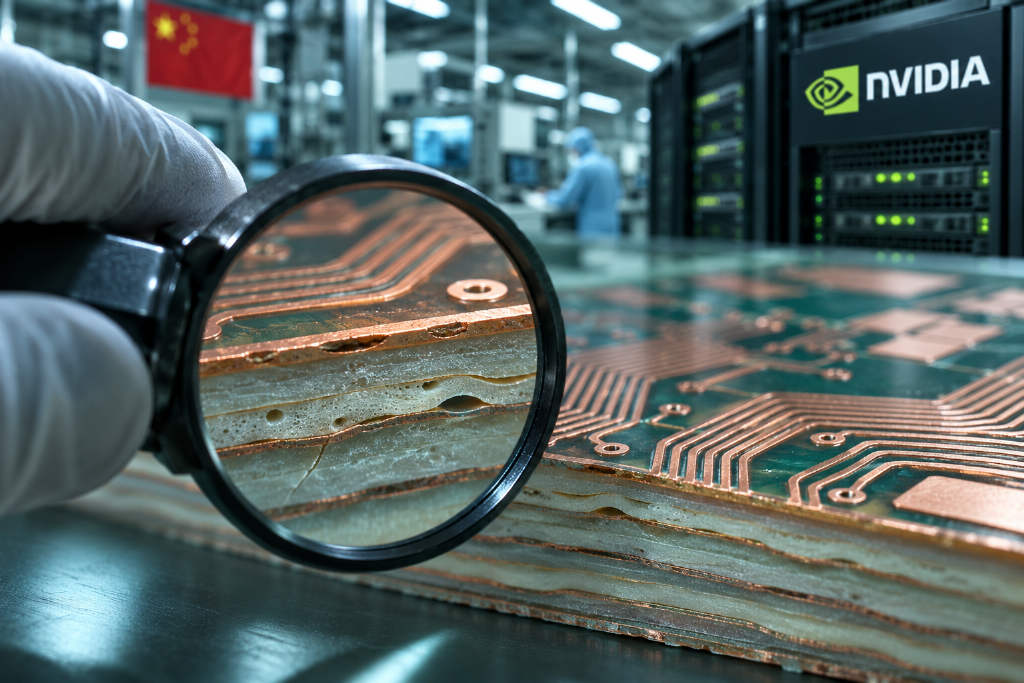
Nvidia may be reshuffling the copper-clad laminate (CCL) supply chain for the NVLink Switch, codenamed Rosalind, on its next-generation Vera Rubin platform. Investor Outer Ninth recently relayed supply-chain information saying that a large incumbent CCL supplier may have exited, prompting Nvidia to turn to Taiwan Union Technology, or TUC (TWSE: 2383), to secure capacity.
The original supply-chain report did not identify the supplier. Market speculation has linked the claim to China-based Shengyi Technology, but the name was not confirmed in the original report.
Dielectric material issue reportedly pushed yields below 10%
A supply-chain article that was later deleted but circulated in the industry yesterday reportedly said the unnamed CCL supplier had planned to take 50% of the Rosalind product line in 2026. Its S9GN2, or M8+ LowDK2, dielectric material was said to have suffered serious quality problems, pushing PCB mass-production yields below 10%.
That figure was far below the 70% to 80% yield reported for TUC’s EM-892K2 material. The report said Nvidia turned to TUC to secure the high-speed CCL capacity required for Rosalind. PCB industry analyst kokycpcb did not reject the claim and said TUC would likely take the initial production volume, making a larger market share almost certain.
Higher layer count may magnify material defects
The circulating information said Rosalind’s PCB stack-up had been upgraded from the 22-layer plated-through-hole, or PTH, design used for Blackwell Juliet to a 32-layer, 16+16 N+N structure. The number of sequential lamination cycles has also increased to three times the previous level.
With more layers and substantially more lamination, instability in the material can be amplified from one production stage to the next. That raises the requirements for dielectric materials’ dimensional stability and consistency between batches.
The report also said the material issue had caused large-scale yield problems during mass production at major PCB makers including Victory Giant Technology (SZSE: 300476) and Kingboard Holdings (HKEX: 0148).
TUC could become the sole high-end CCL supplier
Outer Ninth also cited a forecast from SemiAnalysis that TUC could become Rosalind’s sole high-end CCL supplier. The research firm pointed to TUC’s continued capacity expansion, the dimensional stability associated with its low coefficient of thermal expansion, or CTE, and its stable batch quality.
Based on that view, TUC could strengthen its position in the high-end CCL supply chain for Nvidia’s next-generation AI hardware. The reported quality issue at the previous supplier could also affect deliveries of Rosalind switches and NVL72 racks, with shipments potentially delayed into the fourth quarter of 2026.
Analyst expects a two-supplier structure over time
kokycpcb offered three points on the rumor: TUC is likely to expand its share; Shengyi Technology could eventually return; and a two-supplier structure is more likely to remain the long-term norm.
The analyst said TUC’s batch consistency and stable production-line yields are publicly known within the industry. As the Rubin platform pushes signal margin toward its theoretical limit, flagship products would favor substrates with lower perceived production risk. TUC could therefore take the first wave of higher volume.
kokycpcb also said formula problems can occur at leading process nodes. If Shengyi adjusts its formulation and passes production-line validation, its scale and cost advantages could give it a route back into the supply chain.
Upstream constraints include specialty glass fiber and ultra-low-roughness copper foil. In kokycpcb’s view, cloud service providers would not permanently set aside an established large-volume supply pillar while those materials remain structurally tight. Supplier shares can change with the cycle, but a dual-supplier structure is more likely to persist across the ecosystem. The analyst had previously described TUC’s leadership as secure and Shengyi Technology as the only rival with comparable scale potential.



