


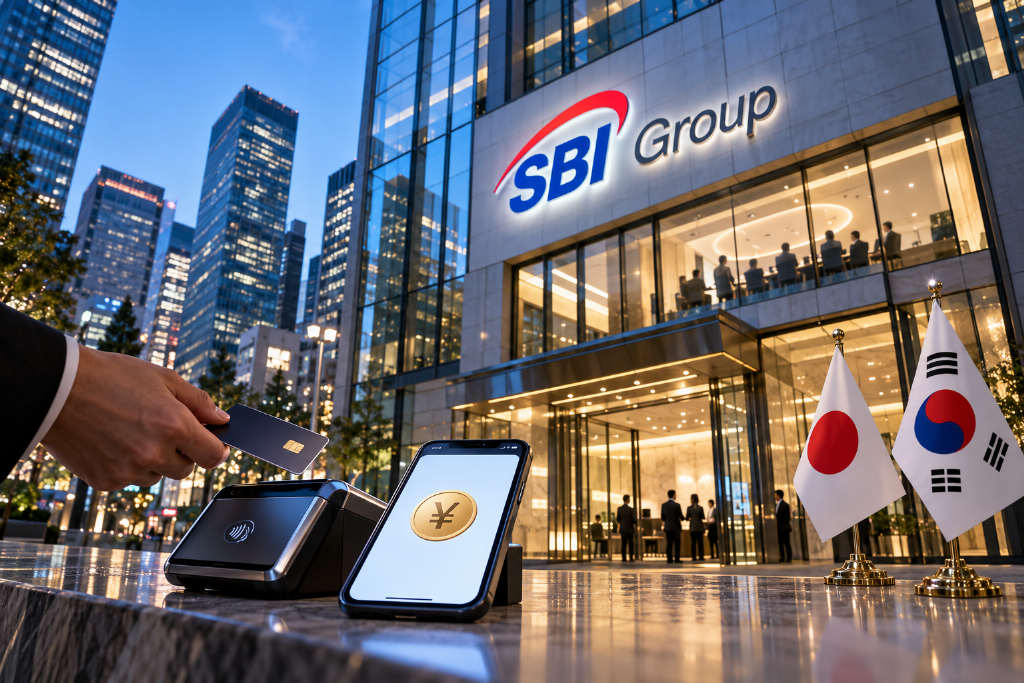
Shinhan Card, the credit card arm of South Korea’s Shinhan Financial Group, is working with SBI VC Trade and SBI XDC Network APAC on a test that would connect a yen stablecoin to card payments in South Korea, opening a path for Japanese travelers to spend at Korean merchants without exchanging won in advance.
According to an official announcement from SBI, the three companies signed a memorandum of understanding in Tokyo on Oct. 20. They also held a signing ceremony at SBI Group’s headquarters in Tokyo. The stated aim is to expand the global payments ecosystem. A photo released by Shinhan Card showed SBI XDC Network APAC COO Tadashi Yoshida, Shinhan Card President Park Chang-hoon, and SBI VC Trade CEO Tomohiko Kondo after the signing.
Card-based spending is the main test case
The core focus is the integration of a yen stablecoin with card payments at physical stores. The companies said they want Japanese visitors in South Korea to use a payment card linked to stablecoins while getting an experience close to that of a conventional credit card, rather than asking users to manage blockchain transfers directly.
The collaboration also covers wallet-to-wallet, or W2W, transfers, cross-border trade settlement, and testing tied to anti-money laundering, or AML, and fraud detection systems.
Still, removing the need to exchange won before a trip does not mean foreign-exchange costs disappear. The companies have not disclosed how Korean merchants would receive won, who would manage conversion between yen and won, or what fees would be charged.
Heavy Japan-Korea travel flows form the business backdrop
Travel demand between Japan and South Korea is a major part of the commercial logic behind the project. Based on official tourism statistics from Japan and South Korea, about 7.42 million travelers went from South Korea to Japan in the first eight months of 2026, while about 2.7 million traveled from Japan to South Korea. Combined, the two-way total exceeded 10.1 million.
If stablecoins can be tied into existing card networks, travelers may not need to look for merchants that specifically accept crypto. They could instead complete transactions through payment terminals already in use.
Shinhan and SBI have not disclosed how many merchants are involved in the test, what transaction fees would look like, or how much settlement cost could actually be saved. At this stage, there is no basis to conclude the service would be cheaper than credit cards or existing electronic payment options.
Trade settlement is also part of the plan
The partnership is not limited to tourism payments. Another major area is corporate cross-border settlement. SBI XDC Network APAC has been active in blockchain-based trade finance infrastructure, and the three companies said they will study whether stablecoins can improve settlement speed and fund-processing efficiency in cross-border transactions.
SBI Group has announced two South Korea-Japan stablecoin payment partnerships this month. On Oct. 1, SBI DigiTrust said it had partnered with South Korea’s NICE Information & Telecommunication and DSRV to test QR code payments for Japanese travelers at Korean merchants, with verification expected to be completed by the end of December this year.
That initiative is separate from the Shinhan Card project, but the two efforts show SBI is exploring several payment settings at once, including card payments, QR code payments, and cross-border settlement.
Dollar stablecoins still dominate the market
DeFiLlama data dated Oct. 23 put the total stablecoin market capitalization at about $301.4 billion. USDT accounted for about $182.6 billion and USDC for about $72.6 billion, giving the two a combined market share of roughly 84.7%. Dollar-backed stablecoins remain the dominant force in the sector.
Compared with USDT and USDC, which are used mainly for crypto trading and dollar transfers, a yen stablecoin connected to existing payment rails could be used in travel spending and corporate trade flows.
Even so, Shinhan and SBI have not confirmed which stablecoin will be used in the test, nor have they said which blockchain will handle final settlement. The project’s main challenge is whether it can deliver better efficiency than existing cross-border credit cards, electronic payments, and bank settlement while staying within regulatory requirements.
The work remains in the proof-of-concept stage, and no formal commercial launch date has been announced.