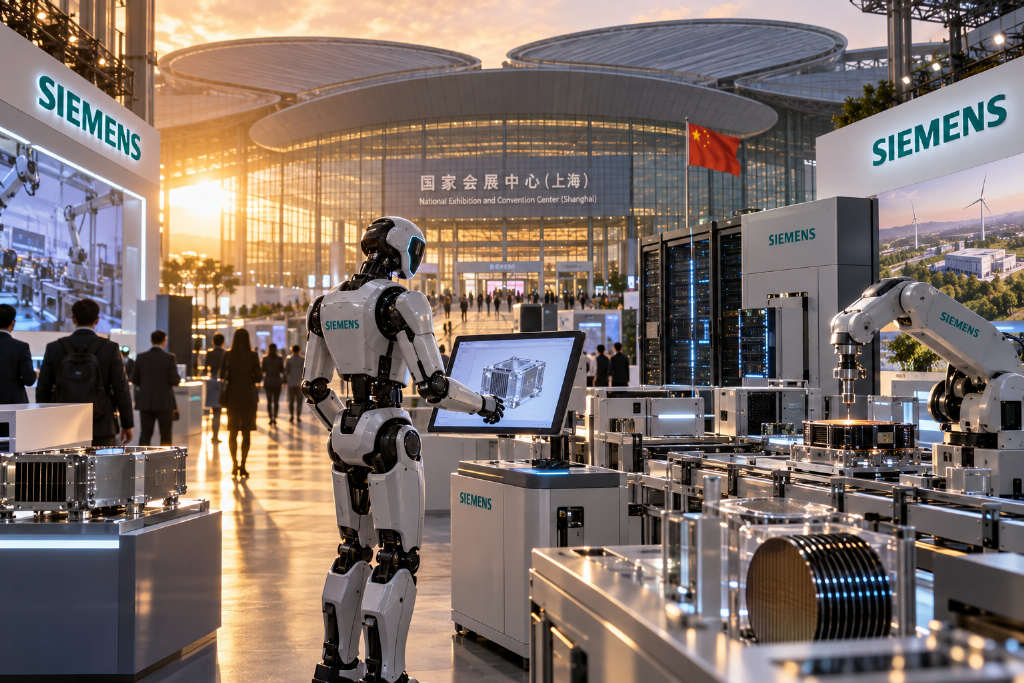
Siemens said it will make its first full presentation of an end-to-end solution for humanoid robots at the 26th China International Industry Fair, showing a workflow that spans research and design, manufacturing, final assembly and integration, and deployment in industrial settings. The company also plans to launch more than 20 new products and open six embodied-intelligence factory scenarios aimed at advancing the use of physical AI in industrial applications. Beyond humanoid robotics, Siemens will showcase combined automation, digitalization, and industrial AI applications in several growth areas, including data centers, electronics and semiconductors, and zero-carbon factories. It said its Data Center 5.0+ architecture is designed to address rising energy demand tied to surging AI computing power, while an AI-assisted programming solution can reportedly cut delivery time for optical module assembly projects by about 50%. Pei Anzi, an executive at Siemens Digital Industries Group, said the key to unlocking AI value in industrial environments is efficient coordination across automation equipment, software, data, and industry know-how.
Siemens will make its first full presentation of an end-to-end solution for humanoid robots at the 26th China International Industry Fair, covering the full process from research and design to manufacturing, final assembly and integration, and industrial on-site deployment.
The company also plans to release more than 20 new products and open six embodied-intelligence factory scenarios to push physical AI into industrial use.
Humanoid robotics and industrial applications
Siemens said it will also showcase integrated automation, digitalization, and industrial AI applications in several high-growth areas, including data centers, electronics and semiconductors, and zero-carbon factories.
Among the examples, its Data Center 5.0+ architecture is intended to respond to the energy-consumption challenge created by a surge in AI computing demand. Siemens also said an AI-assisted programming solution can shorten delivery cycles for optical module assembly projects by about 50%.
Executive comment on industrial AI
Pei Anzi, an executive at Siemens Digital Industries Group, said the key to realizing AI value in industrial settings lies in efficient coordination between AI and automation equipment, software, data, and industry knowledge. Siemens said it will use its full-stack industrial capabilities to help customers improve productivity and resilience.
The information was cited by QbitAI.
This article was originally published by Bit.Fan. For more cryptocurrency news and market insights, visit www.bit.fan. Disclaimer:
The market information, project data, and third-party content displayed on this platform are for industry information sharing only and do not constitute any form of investment advice or return commitment.
Cryptocurrency trading carries high risks. Users should fully assess their risk tolerance and make independent decisions. All profits, losses, and legal responsibilities are borne by the users themselves.