
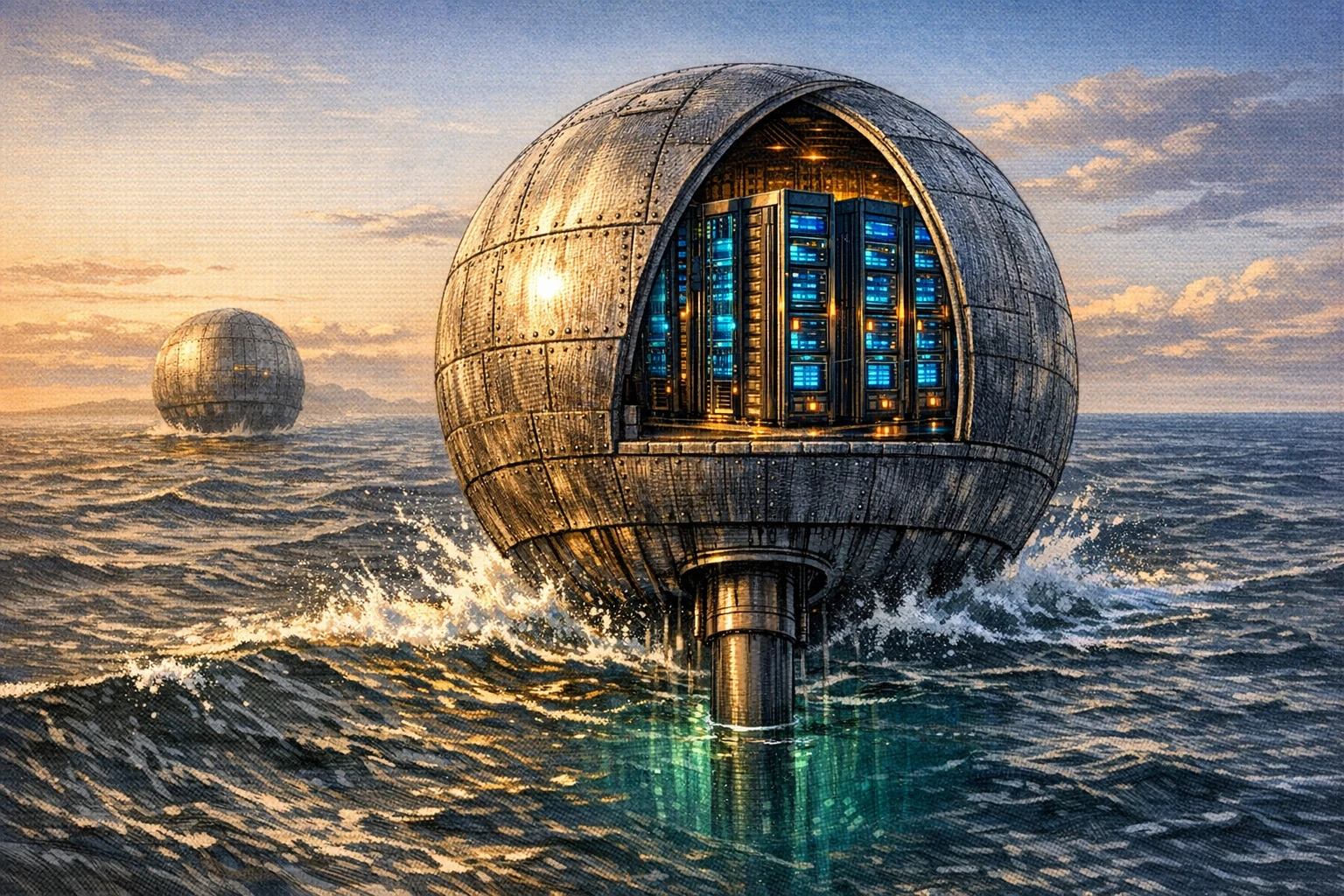
A giant steel ball floats on the ocean. A vertical tube extends beneath it. Waves crash in, forcing water into a pressurized reservoir. Released, the water spins a turbine, generating electricity that feeds directly into AI chips inside the ball. That is the technology Panthalassa has been testing in the Pacific for a decade.
This week, the Oregon-based public-benefit corporation announced a $140 million Series B financing round led by Peter Thiel. Co-investors include John Doerr, Marc Benioff's TIME Ventures, Max Levchin's SciFi Ventures, Susquehanna, server maker Super Micro Computer, and Sozo Ventures. Total capital flowing into the "ocean AI data center" direction from Silicon Valley now stands at several hundred million dollars.
Wave-Powered Compute
Conventional thinking moves electricity from power plant to data center. Panthalassa moves compute next to energy, then beams results back via satellite. Data travels long distances instead of electrons—and data transmission has far lower marginal cost than submarine power cables.
Each "wave-driven node" is a self-contained unit: waves for power, seawater for cooling, satellites for backhaul. AI models are uploaded from land, inference requests are handled at sea, and results are returned via satellite. The system requires no connection to the land power grid and no new substations or transmission lines.
Cooling is the most straightforward structural advantage of ocean compute. Land-based data centers burn massive electricity and fresh water to keep servers at safe temperatures. Ocean ambient temperatures are far lower, reducing cooling costs to near zero. With hyperscale centers currently spending up to 30% of power on cooling, the gap could drive a fundamental cost restructuring.
Ten Years of Prototypes, Three Generations—Commercial Start in 2027
Panthalassa is not a fresh concept company. Founded in 2016, the team has tested three prototype generations at sea, each validating different engineering assumptions: wave power stability, node durability under harsh conditions, and satellite latency/bandwidth limits.
Proceeds from the Series B, per the official release, go to two areas: building a pilot production plant near Portland for scaling node hardware, and accelerating deployment of the third-generation commercial node Ocean-3. The plan calls for Ocean-3 to be positioned in the North Pacific in 2026, with commercial operations starting in 2027.
Experts caution, however, that ocean-based inference requires first transmitting entire model parameters to sea nodes, then handling ongoing requests from land. Larger models mean higher initial transfer costs; many nodes spread across a wide area add complexity to model synchronization and version management. These are solvable challenges, but they introduce engineering layers that land data centers don't have to deal with.
Ocean vs. Land: Grid Constraints Push Compute to the Edge
Panthalassa's bet on the ocean reflects a rising systemic pressure on land-based site selection, both political and infrastructural. Maine recently passed the first U.S. ban on building large data centers, citing AI training and inference electricity consumption as a visible burden on local grids and residents. Similar public discontent is brewing legislative responses in other U.S. states and parts of Europe.
The investor list itself sends a signal. Thiel, Doerr, Levchin, Field—these names in Silicon Valley represent not just capital but a long-term market endorsement of a technical direction. Wave energy is not new, but coupling it directly with AI inference compute, bypassing the grid altogether, is what Panthalassa is really doing. Whether it can deliver measurable commercial data by 2027 will decide if this becomes the starting point for the next generation of compute infrastructure—or just an elaborate fundraising narrative.