
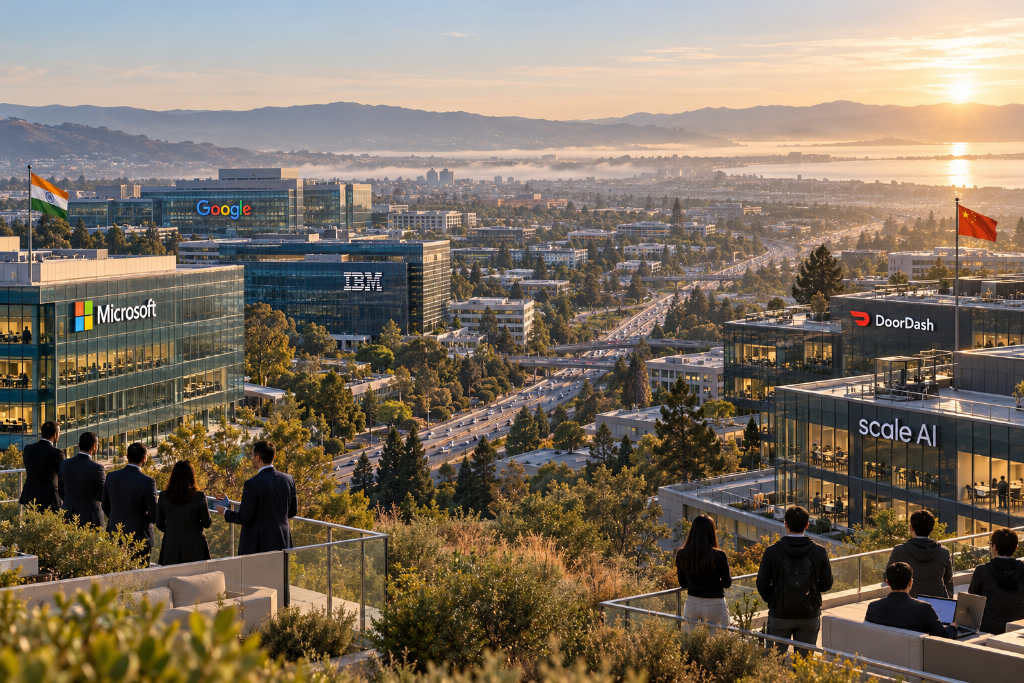
Silicon Valley’s upper tier is showing a visible split. In the billionaire class of professional CEOs, first-generation Indian executives in their 50s and 60s remain the dominant presence. In the camp of founder-CEOs tied to multi-billion-dollar fortunes and even larger upside, the names skew younger and more Chinese.
That is the central argument in a commentary republished by MarsBit from the WeChat account Tech商业. The article frames the divide around immigration generation, risk appetite, and different models of wealth creation rather than a simple comparison of ability.
Indian-born executives remain prominent in big tech leadership
The article points to Microsoft CEO Satya Nadella, Alphabet CEO Sundar Pichai, and IBM CEO Arvind Krishna as examples of first-generation Indian leaders who rose to the top of major U.S. technology companies.
It describes that path as the professional manager track. In the article’s telling, many first-generation Indian immigrants entered the U.S. under heavy pressure tied to visas, green card queues, and the sunk cost of relocation. Under those conditions, joining a large company, starting in engineering, and climbing into management became the more rational route than taking startup risk.
The piece also says Indian executives often benefited from business-school training and a strong command of Western corporate management practices. It further argues that mentorship and promotion networks among Indian managers in Silicon Valley helped reinforce that rise inside established organizations.
Under this model, the job of a management CEO is to preserve and expand an existing business: balancing stakeholders, dealing with Wall Street, and running a large organization. The wealth attached to that role, the article says, usually comes from salary, stock, and options accumulated over two or three decades, producing net worth in the billionaire range.
Younger Chinese leaders are taking the founder route
On the other side, the article says a newer generation of Chinese entrepreneurs is moving away from the older pattern of joining large tech companies as highly paid senior engineers. Instead, they are choosing to start companies and build systems of their own.
Its examples include DoorDash co-founder and CEO Tony Xu and Scale AI founder Alexandr Wang. The article argues that younger Chinese founders are more likely to pursue this route because they have a stronger safety net than earlier immigrant generations. In its account, their parents have often already resolved immigration status and built at least middle-class wealth, reducing the pressure to prioritize stable corporate jobs for visa or residency reasons.
The second factor it highlights is the overlap between technical depth and the AI cycle. The article says Asian families’ long-standing emphasis on STEM education has given some Chinese founders an edge in mathematics, logic, and core algorithms. When the AI wave arrived, that background made it easier to seize zero-to-one opportunities.
It cites Wang as having dropped out at 19 to found Scale AI, targeting data infrastructure for large AI models. It also says Xu started DoorDash while attending Stanford Graduate School of Business and later built it into a leading U.S. food delivery company. In the article’s framing, people in their 30s and early 40s are no longer just adding technical value inside someone else’s system; they are creating companies and hiring professional managers themselves.
Two paths, two wealth models
The article reduces the contrast to two different economic models: selling time versus creating assets.
For first-generation Indian executives, the path is to become exceptional inside a system designed by others and, over many years, earn a place at the top. For younger Chinese founders, the path is entrepreneurship — using family resources as a springboard, building a business system, taking larger risks, and keeping the equity upside.
That difference matters because founder wealth can scale much faster. Once a company goes public, the article says, a founder’s equity can expand into the tens of billions of dollars. That is presented as one reason founder-CEOs often end up several times wealthier than management CEOs.
VC preference and the AI boom are described as accelerants
The piece also says venture capital has reinforced the shift. In its view, VC firms are naturally drawn to young founders who are aggressive, technically strong, and willing to bet everything on a high-growth outcome. When younger Chinese founders arrive on Sand Hill Road with disruptive technology and conviction, the article says, investors are willing to fund that ambition.
It argues that this is becoming more visible in AI. Rather than staying at the application layer, younger Chinese founders are described as moving into large-model infrastructure and computing chip development.
The article gives two examples. First, it says Chinese scientists account for roughly 30% to 50% of OpenAI’s core team. Second, it points to younger domestic teams such as DeepSeek, saying they drew global attention with very low-cost work.
The article’s conclusion: a generational handoff in Silicon Valley power
The commentary closes with a broader claim about Silicon Valley’s hierarchy. Excelling inside an existing framework can make someone an outstanding steward, it says, but building a new framework through entrepreneurship offers a shot at greater control and larger wealth creation.
In that reading, an older generation of Indian elites rose through the governance structures of large companies, while a younger generation of Chinese founders is using the AI cycle to push toward higher valuations and larger fortunes.
The article was originally published by the WeChat account Tech商业 and credited to Tech商业.



