
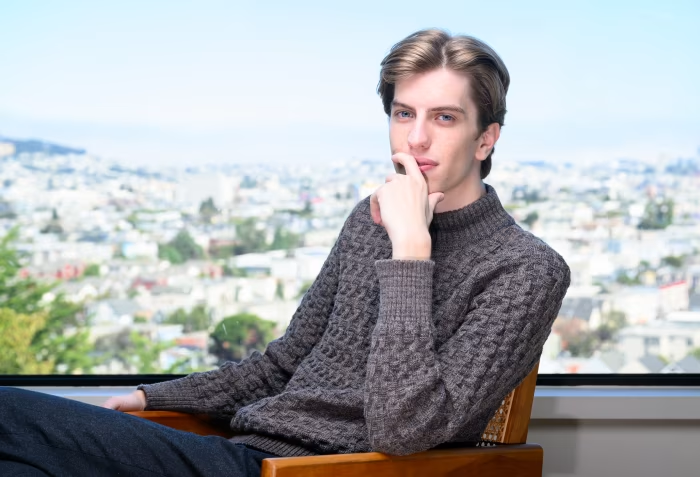
Leopold Aschenbrenner’s hedge fund, Situational Awareness, has sparked a new wave of investor interest in Silicon Valley even after a near-blowup tied to leverage.
Bloomberg reported on August 8, citing people familiar with the matter, that a large number of Silicon Valley investors contacted the fund within days of the crisis to express interest in committing more capital. Sequoia Capital partner Pat Grady also said publicly that he believes Aschenbrenner will remain an important figure in Silicon Valley for a long time.
After the shock, the fund moved to strip out leverage
A previous Wallstreetcn report said Aschenbrenner acknowledged mistakes in a letter to investors and said he had removed all leverage from the fund. He described the episode as a “costly but invaluable lesson.”
After receiving margin calls from financing providers, Situational Awareness rushed to sell most of its stock holdings to Ken Griffin’s Citadel at a discount of more than 10%. The fund’s remaining portfolio, including private investments, is currently worth about $10 billion. Despite the damage, the fund is still up roughly 80% this year.
One crisis, two readings
The episode laid bare the gap between Silicon Valley and Wall Street. On Wall Street, it is being read as a classic case of an AI market star paying the price for too much leverage. In Silicon Valley, many investors have taken the opposite view, treating the selloff as a chance to back a former OpenAI researcher who turned into an investor.
Situational Awareness has told investors it is not accepting new capital for now. That has not cooled outside interest.
Silicon Valley leans into the founder story
Rather than becoming a lasting stain, the blowup appears to have reinforced Aschenbrenner’s standing with some venture investors.
Redpoint Ventures managing director Logan Bartlett put it bluntly: “There is a heroic archetype here. Leopold got punched in the face, and it actually rallied people around him.” Veteran investor Elad Gil also publicly said he had applied to invest in Aschenbrenner’s fund for the first time.
Asked about the turmoil at Situational Awareness in a Bloomberg Television interview on Thursday, Grady said: “Our view is that he will be an important figure in Silicon Valley over the long term.”
Gygmy Gonnot, an adjunct professor at New York University’s Stern School of Business and managing director at Focus Investment Group, offered a structural explanation for the divide: “Silicon Valley rewards people who are right about transformative technologies, while Wall Street rewards generating attractive risk-adjusted returns while preserving capital.”
Wall Street’s concerns are familiar
For Wall Street, the near-collapse at Situational Awareness was not especially surprising. The underlying issues — leverage and concentrated positions — are old ones in the hedge fund business.
From the late-1990s collapse of Long-Term Capital Management, or LTCM, to the implosion of Archegos Capital Management, excessive borrowing has been a recurring feature of major failures. S3 Partners founder Bob Sloan said on Bloomberg Television on Tuesday: “Let’s call it what it is. This was a super concentrated position, a super crowded position, and also a super leveraged position.”
According to the report, some Wall Street firms had reservations about the fund from the start. Unlike many peers, Situational Awareness drew capital mainly from wealthy individuals and family offices in the San Francisco Bay Area, rather than from pension funds and sovereign wealth funds that often back more established managers.
Bloomberg had previously reported that Barclays’ prime brokerage unit declined to take the fund on as a client weeks before the collapse, citing overly concentrated exposure to a single sector.
The report also said, citing people familiar with the matter, that Morgan Stanley initially refused to provide prime brokerage services when the fund launched, pointing to Aschenbrenner’s lack of experience. Those people said Morgan Stanley later changed its position and plans to add the fund as a prime brokerage client in the coming weeks. Goldman Sachs, JPMorgan Chase, and Bank of America had provided leverage to the fund.
AI hedge funds have been delivering both volatility and returns
The AI-focused hedge fund segment in which Situational Awareness operates is volatile by nature, but the returns can be outsized.
Rival Value Aligned Research Advisors includes veterans from BlackRock and Hudson River Trading on its team. As of the end of June, it managed more than $26 billion. An investor document reviewed by Bloomberg showed that the firm’s AI fund returned about 194% through June this year, far ahead of the nearly 10% gain in the S&P 500 over the same period.
The selloff in AI stocks last month hit far beyond one fund. Bloomberg reported that multi-strategy giant Millennium Management fell 2.1% in July, Point72 Asset Management lost 3.3%, and the more concentrated hedge fund at Altimeter Capital Management dropped 11% for the month.
Some funds with positions similar to Situational Awareness had already picked up on the risk. One person familiar with the matter said one such fund put on hedges early out of concern that Aschenbrenner’s fund could be forced to sell.
The rebuilding phase still runs through Wall Street
After removing leverage, Aschenbrenner now faces a basic challenge: finding a workable balance between Silicon Valley’s enthusiasm and Wall Street’s demands on risk control.
In his investor letter, he said the fund has eliminated all leverage and is no longer using bank prime brokerage to amplify bets, at least for now. He wrote: “These are costly scars, but I am committed to making sure they become invaluable lessons for our institution and for me as we move forward.”
Still, if he wants to reproduce the kind of returns the fund posted earlier this year, Aschenbrenner will eventually need to persuade Wall Street to extend leverage again. That leaves him trying to rebuild with support from Silicon Valley while meeting the stricter standards Wall Street applies to risk management.