
Six blockchain projects that raised more than $500 million combined generated only $360 in onchain fees over the past 24 hours, according to a Protos review based on figures highlighted by X user and crypto marketer Stacy Muur.
Muur wrote on July 14 that the projects had raised more than $500 million and added, “VCs do also cry.” Protos then examined the six networks one by one to look at how those capital raises line up against current network activity.
Berachain
Berachain emerged from the 2021-era Bong Bears NFT collection. The chain describes itself as the first proof-of-liquidity blockchain and says it is built to serve as a “growth engine for onchain businesses.”
The project raised a total of $142 million across two rounds in 2023 and 2024. But in its latest end-of-year statement, the team said it had been dealing with weak sentiment, a shrinking crypto-native total addressable market, and “increased skepticism around the value of infrastructure as a whole.”
Since launching in early 2025, the BERA token has fallen 98%. Berachain was also among the networks affected by the Balancer hack in November, prompting validators to temporarily halt the network. Later that month, one of its backers, Brevan Howard’s Nova Digital, was disclosed to have received a one-year, risk-free refund right on its $25 million investment.
Celestia
Celestia was one of the better-known names in the 2023 data availability trade. Part of the Cosmos ecosystem, it pitches modular, high-throughput chains tailored for companies handling internet-scale traffic.
Its funding came in several stages: $1.5 million in 2021, another $50 million in 2022, and $100 million in 2024.
The token launch drew significant attention and was viewed as one of the earliest bright spots after the deep bear market that followed the major crypto failures of 2022. TIA initially climbed about 10x in its first months and reached an all-time high above $20, but later slid roughly 98% and now sits at $0.40.
Scroll
Scroll raised $83 million over three rounds. Its latest financing in March 2023 valued the Ethereum layer-2 network at $1.8 billion.
Protos said the zkEVM chain generated only $24 in fees yesterday. Scroll’s total value locked once peaked at $585 million as users aggressively farmed what later became a disappointing airdrop. In the following months, the network lost around 75% of its TVL. It now has just under $12 million onchain.
The article also notes that 365 days have passed since Pump Fun said an airdrop was “coming soon.”
Eclipse
Eclipse marketed itself as “Solana on Ethereum,” an SVM layer-2 network designed to combine Solana’s performance with Ethereum’s liquidity. Eclipse Labs raised $65 million in total, with most of that coming from a $50 million Series A led by Placeholder and Hack VC in March 2024.
DeFiLlama data shows TVL on the chain peaking at almost $50 million in late February last year. It has since fallen to $1.15 million, a decline of about 98%.
The project’s latest blog post was published a year ago and announced the launch of its ES token and an airdrop. Since then, Eclipse Labs has pivoted to building The Human API, described as a marketplace where AI agents can hire humans.
Sonic
Sonic, previously known as Fantom, was launched by developer Andre Cronje, the Yearn Finance founder. The network, known for its speed and low cost, migrated to Sonic in 2024. According to ICODrops, it raised a total of $61 million across six rounds between 2018 and 2024.

During the Fantom era, the network was hit by the Multichain fallout, and many bridged assets lost their peg to native versions. Fantom’s TVL reached $7.9 billion in 2022 and now stands at just under $5 million. Sonic later reached $1.2 billion last spring, but that figure has dropped to $16 million.
Protos said Cronje’s involvement with Sonic ended last month. It also said he has spent much of the past 18 months building Flying Tulip.
Manta
Manta, a project focused on zk technology, raised $60 million across four rounds between 2021 and 2023.
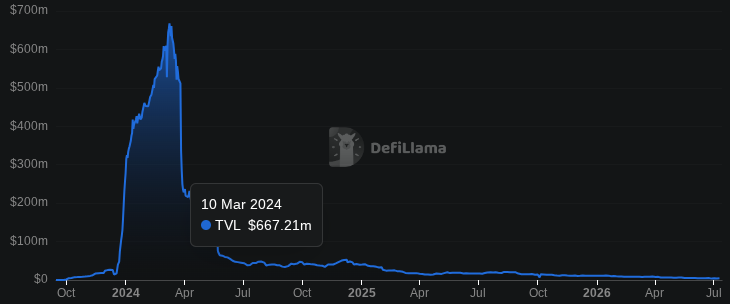
Its TVL chart shows a sharp rise and fall tied to an intense, heavily gamified airdrop campaign that brought more than $650 million onto the chain. In early 2024, TVL was still below $20 million just weeks before the peak. Within four months, it had dropped back below $50 million. Today, only $4 million remains on the chain.
A funding boom, then a weak revenue picture
Across Berachain, Celestia, Scroll, Eclipse, Sonic, and Manta, the funding total exceeds $500 million. Yet the figure highlighted by Stacy Muur and cited by Protos shows that the six chains together produced only $360 in fees over the last 24 hours.
The trajectories differ from project to project. Some saw token prices collapse after launch. Some lost most of their TVL after airdrop campaigns ended. Others were hit by hacks, cross-chain turmoil, or strategic pivots away from their original blockchain focus. Taken together, the six cases offer a snapshot of how much of the infrastructure fundraising wave from recent years has faded from market attention.
At the end of the story, Protos also linked to other coverage involving AscendEx withdrawal uncertainty, the Balancer exploit that drained $129 million, and Andre Cronje’s claim that someone used his code to build a $1 billion DeFi project.
