
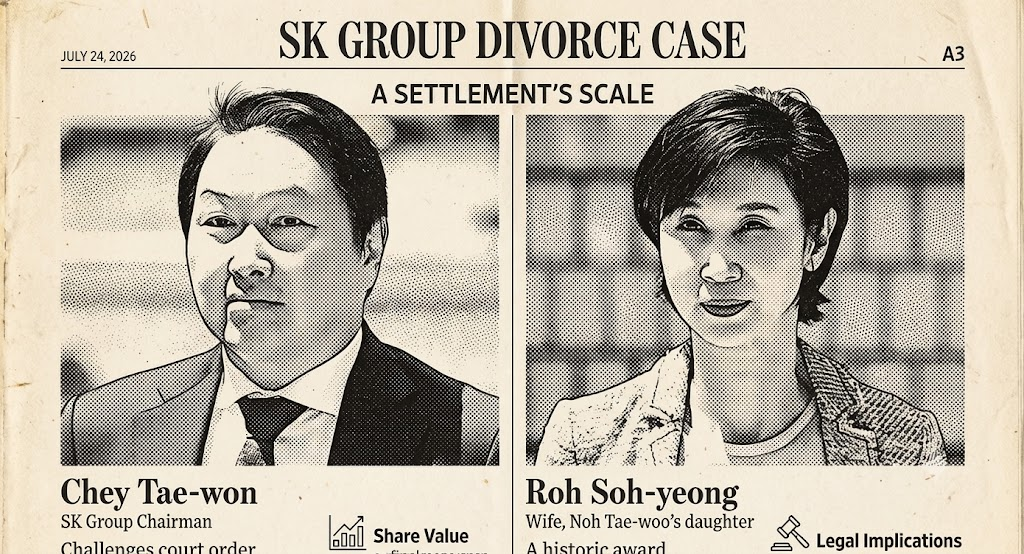
Seoul High Court on July 24 ordered SK Group Chairman Chey Tae-won to pay 944 billion won, about $643 million, to his former wife Roh Soh-yeong in a property division ruling that now stands as the most expensive divorce judgment in South Korean legal history.
The case has run for nearly a decade. The amount moved from a first-instance ruling in 2022 worth about $50 million to an appellate court decision in 2024 that put the figure near $1 billion, before the Supreme Court sent the case back for rehearing. It has now landed at 944 billion won.
The immediate question is no longer only the size of the award. It is also how Chey will pay it — in cash, stock, borrowing, or through asset sales — and whether the payout could alter the stability of his control over SK Group. Analysts said Chey may need loans or asset disposals if the payment is enforced in cash, though they do not expect SK Group’s core control structure to come under short-term pressure.
A marriage once called the wedding of the century
The marriage began in 1988, shortly after the Seoul Olympics, when South Korea had only recently shifted to democratic politics. Roh, the daughter of then-President Roh Tae-woo, married Chey, the nephew of SK Group’s founder, at the Blue House presidential compound. Then-Prime Minister Lee Hyun-jae officiated, and South Korean media described it as the “wedding of the century.”
The two met while attending graduate school at the University of Chicago. The marriage linked political power and a business empire at a time when such unions carried broad public meaning in South Korea. They had three children, all of whom later worked at SK subsidiaries after becoming adults.
That marriage began to unravel publicly in 2015.
The 2015 public letter
In December 2015, Chey published a three-page public letter in a South Korean newspaper, acknowledging that he had a relationship with another woman and a son from that relationship. He quoted the opening line of Anna Karenina: “Happy families are all alike; every unhappy family is unhappy in its own way.” He wrote that his 27-year marriage with Roh could not be restored and that he hoped to end it “cleanly.”
Four months before that letter, in August 2015, Chey had been released after receiving a presidential pardon. It was the second pardon of his career.
Roh’s initial response was widely reported by South Korean media. She told people around her that she wondered whether she had been too selfish and not understanding enough toward her husband. She later told the media, “I will not divorce.” She did not agree to divorce until 2019.
Two prison terms, two pardons
Before the divorce case took center stage, Chey had already built a separate legal record.
In 2003, he was sentenced to three years in prison for illegal stock trading and accounting fraud. He was released on bail months later, the court reduced the sentence to a suspended term, and he later received a presidential pardon that cleared the record. In 2013, he was sentenced to four years for embezzling about $42 million in company funds to cover personal investment losses. The judge rebuked him in court, saying he lacked “a sincere awareness of his responsibility.”
Chey denied the charges in court and said the transactions were legitimate corporate investments. “I don’t know what I still haven’t explained clearly, but I can honestly say I did not commit this crime,” he said.
During his imprisonment, he did two things that stood out. He strengthened his control over SK Holdings by merging two SK subsidiaries, and he published a 229-page book, New Exploration: Social Enterprise, on how governments could encourage companies to help address social problems.
He received his second presidential pardon in August 2015. Four months later, he announced the divorce in a newspaper.
In 2018, Chey and his current partner Kim Hee-young, whose English name is Chloe, founded the T&C Foundation for youth scholarships and education projects. They made their first public appearance together in 2019, when Chey said, “I reflected on the past and realized I had lived wrongly.”
SK hynix and the AI boom changed the price of the divorce
A central factor behind the swelling value of the case was SK hynix.
SK hynix is a major global supplier of HBM, a key component used to train large AI models. Since early 2025, according to the report, its stock has risen nearly tenfold. By the end of May, the company’s market capitalization had passed $1 trillion. On July 10, Chey rang the opening bell at Nasdaq as SK hynix completed a U.S. listing that raised about $26 billion.
Bloomberg’s Billionaires Index put Chey’s net worth at about $5.6 billion, more than double from a year earlier. Last month, he and Nvidia CEO Jensen Huang drank whisky at a fried chicken restaurant in Seoul, where Chey offered to pay for everyone in the venue. He had also met Donald Trump on a golf course, and in 2022 Joe Biden publicly called him an “old friend” during a visit to South Korea.
That sharp change in value fed directly into the dispute over valuation. Roh’s side argued that SK hynix’s surge rested on a foundation built during the marriage, and that using an older valuation at the time of division would be unfair to her. Her lawyers said a newer valuation should be used.
After the 2022 first-instance ruling of about $50 million, Roh appealed and said the judgment “denied women’s contribution to the family.” In 2024, the appellate court awarded 35% of the assets in dispute, a figure then worth nearly $1 billion. Chey’s side argued that Roh had not contributed to SK’s recent success and that the valuation should be based on the period before the AI-driven rally.
After the Supreme Court sent the matter back, Seoul High Court fixed the amount at 944 billion won on July 24, 2026.
How the payment is made now matters
Bloomberg’s main question on the day of the ruling was straightforward: cash or stock. The answer matters because it bears directly on Chey’s control over SK Group.
Chey directly owns 17.9% of SK Inc., the holding company of SK Group. Bloomberg cited analysis saying that if the ruling is carried out in cash, he may have to borrow heavily or sell part of his assets. Even so, those views did not point to any near-term destabilization of the group’s control structure.
Roh’s public identity extends well beyond the divorce
Roh is not only the former spouse in a headline-grabbing court fight. She also runs Art Center Nabi, described in the report as South Korea’s first media art museum. The center was originally located inside SK’s headquarters building.
In 2023, an SK subsidiary accused the museum of illegal occupancy, saying the lease had expired. In June this year, Roh moved the museum near an old royal palace in Seoul. Its opening exhibition was titled A Pregnant Pause.
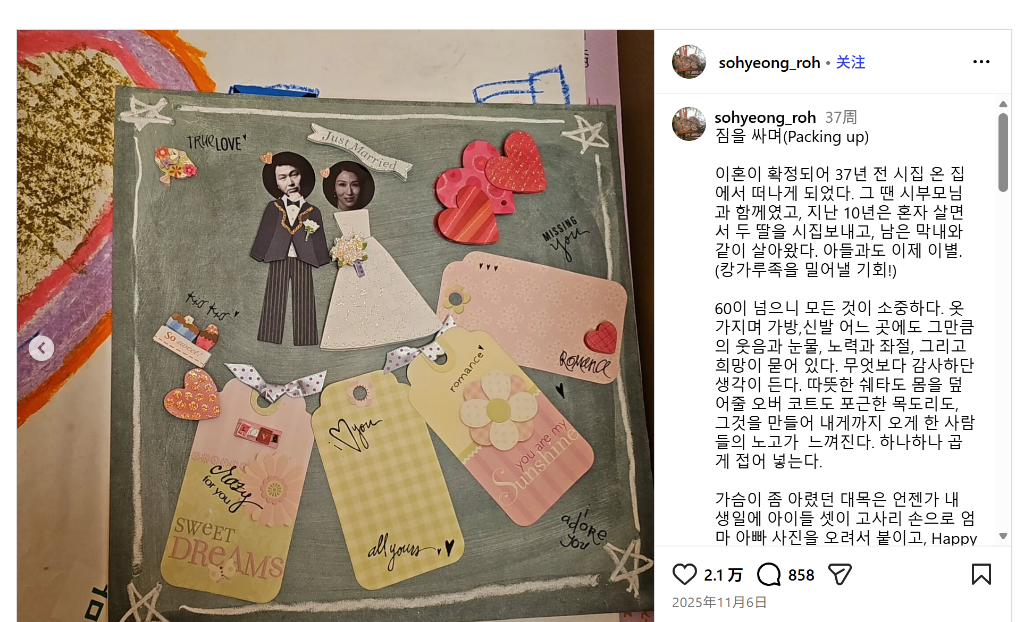
She has also lectured at the University of Cambridge. When she moved out last year from the home where she had lived for 37 years, she posted old belongings on social media, including her wedding dress, handbags, and a wedding poster her three children had made when they were young. The children had cut out photos of their parents, placed them on a paper wedding dress and tuxedo, drawn hearts and stars next to them, and written, “Love is supreme.”
In October 2024, Chey and Roh both attended their youngest daughter’s wedding. Their daughter walked the red carpet alone. Of their three children, only one still works at an SK subsidiary.
Three fault lines behind the case
The case has continued to draw attention not only because of the money involved, but because it touches several sensitive issues in South Korea.
The first is the relationship between chaebol families and the justice system. Chey went to prison twice and received presidential pardons twice. In both the 2003 illegal trading case and the 2013 embezzlement case, the record was ultimately cleared through pardon. That pattern kept resurfacing during the divorce proceedings.
The second is how to value spousal contribution inside a marriage. Roh’s legal team submitted evidence tied to whether the Roh Tae-woo administration gave SK special treatment when it obtained South Korea’s second mobile telecommunications license in 1992. Kim Dae-jung, then the opposition leader, publicly criticized the matter as “a shameless act of presidential cronyism,” and there was opposition within the ruling party as well. SK later returned the license.
Roh’s side also submitted a handwritten note that they said showed the Roh Tae-woo government had funneled 30 billion won, about $23 million, to SK. SK denied receiving the money. The appellate court still accepted the related evidence and found that Roh had made a “substantial contribution” to SK Group’s development, a finding that directly affected the ratio used in the division across the case.
The third is the position of women in elite marriages. After Chey publicly acknowledged the affair in 2015, Roh’s first public instinct was self-questioning rather than retaliation. Her comment — “Was I too selfish?” — became part of a wider discussion in South Korea about women’s roles in marriage.
There are still unresolved variables
The 944 billion won ruling can still be appealed. But the bigger uncertainties may sit outside the courtroom.
The report says the AI trade around SK hynix still shows no sign of ending. The company recently announced more than $250 billion in additional investment in South Korea to expand production capacity. President Lee Jae-myung called Chey and the head of Samsung “heroes of the nation and the people.”
If SK hynix stock keeps climbing, Roh’s side could press to recalculate the division using an updated market value. If Chey ends up trimming his holdings to raise cash, SK Group’s ownership structure could also come under fresh scrutiny. For now, those questions remain open.
The Wall Street Journal, in the closing lines of its coverage, cited a social media post Roh wrote last November as she left her old home: “Now that I’m past 60, everything has become precious.”