
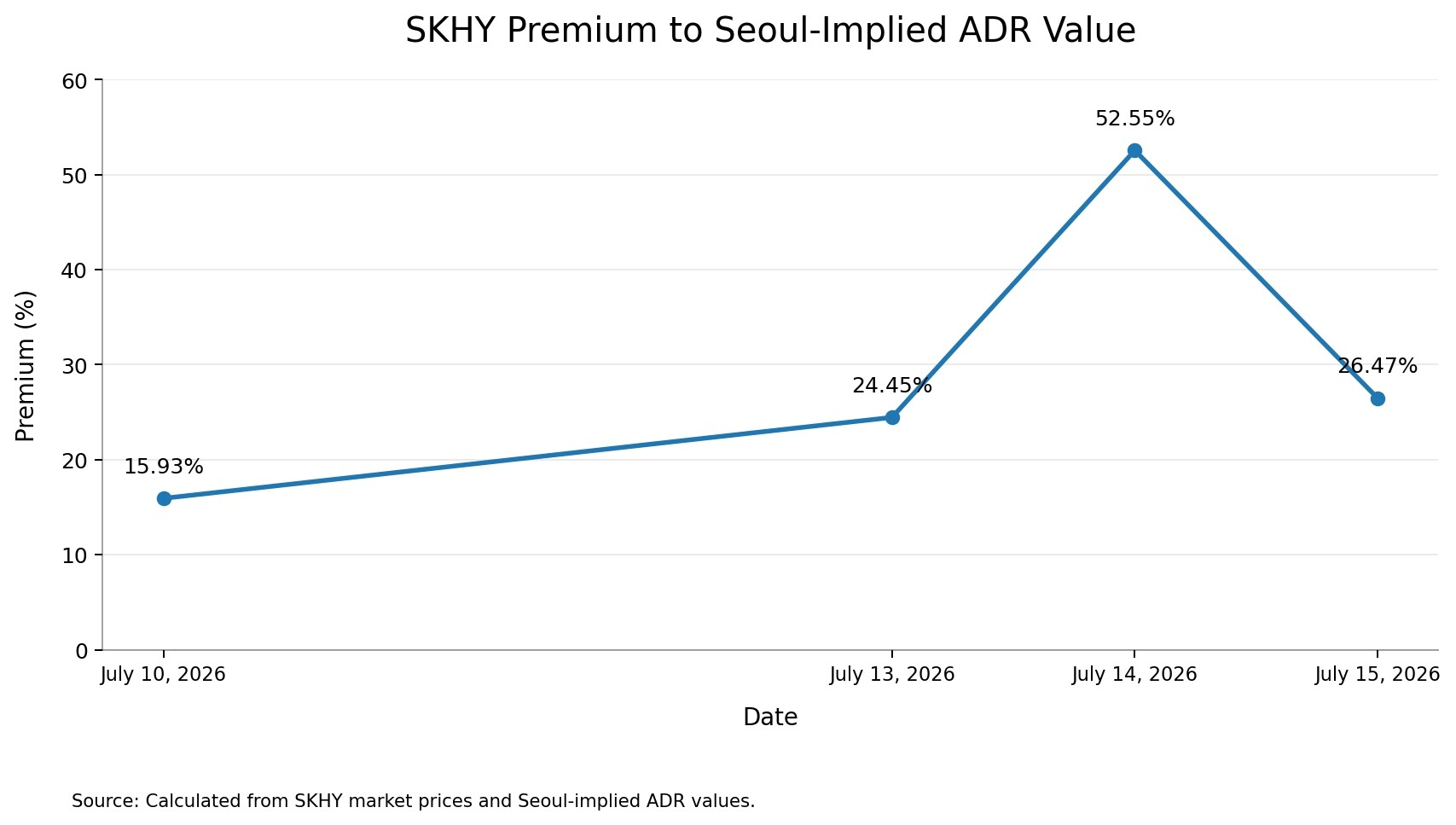
SK Hynix’s Nasdaq-listed American depositary shares, ticker SKHY, closed on July 14 at a 52.55% premium to the implied value of the company’s Seoul-listed common shares. By July 15, that premium had fallen to 26.47%. The speed of that reversal suggests the move was not simply a clean repricing of the AI memory maker’s fundamentals. Market structure was central to the gap.
How the premium was calculated
SKHY is the Nasdaq ticker for SK Hynix’s American depositary shares. Each ADS represents one-tenth of one Korean common share, so 10 ADS equal one locally listed share in South Korea. On that basis, the implied value of one ADS can be derived by dividing the Korean share price by 10 and then dividing by the relevant USD/KRW exchange rate. The ADR premium is then calculated by dividing the SKHY price by that implied ADS value and subtracting 1.
On July 14, SKHY closed at $193.92, while SK Hynix common stock in Korea closed at KRW 1,913,000. Using a USD/KRW rate of 1,504.9, the implied value of one ADS based on the Korean share price came to about $127.12. That produced a closing premium of 52.55%.
The premium had been much lower in the preceding sessions. It was about 15.9% on July 10 and roughly 24.5% on July 13. It then widened to more than 50% on July 14 before easing back to around 26.5% on July 15.
That sequence matters. A company’s underlying business value rarely changes enough in a single day to justify a move from roughly 24% to 52% and then back to 26%. The pattern points instead to a temporary imbalance in market access, available supply, and price discovery across two markets.
There is also an unavoidable timing issue. Seoul and New York do not trade at the same time, and by the time SKHY closes in the U.S., the Korean market has already been shut for several hours. Some part of the observed premium could therefore reflect new information that has not yet been incorporated into Korean prices. Still, even after giving Korea time to react, the gap remained unusually large. Comparing the July 15 Korean close with the previous U.S. close still yields a premium of about 39%. Time-zone effects inflated the headline number, but they do not fully explain it.
Why arbitrage did not close the spread immediately
In theory, the trade looks straightforward. An arbitrageur could buy the cheaper common shares in Korea, deposit them with the relevant custodian, create new SKHY ADS, and then sell those higher-priced ADS in the U.S., capturing the spread after transaction, funding, currency, and depositary costs. If conversion were instant, unlimited, and fully symmetric, a 50% gap would normally draw enough capital to compress the spread quickly.
The article argues that SKHY did not offer that kind of frictionless channel. Under the deposit agreement, ADS holders have a contractual route to cancel their ADS and receive the underlying Korean common shares, subject to fees, legal requirements, and settlement procedures. The reverse direction is more restrictive. Depositing Korean shares to create new ADS may require proof that Korean regulatory conditions have been met. The depositary may refuse deposits in certain cases, company consent may be needed, and SK Hynix can impose limits on the number of shares deposited into the facility.
As described in the company’s final U.S. offering prospectus, the arbitrage path faces several constraints. The filing warns that investors who cancel ADS and withdraw Korean shares may not necessarily be allowed to redeposit those shares to obtain ADS again. The deal also did not include an over-allotment or greenshoe option, and the company together with certain related holders is subject to a 90-day lock-up.
That creates an asymmetric setup. Converting expensive ADS into Korean stock may exist as a contractual path, but creating enough new ADS to sell into the U.S. market and pressure prices lower may be slower, conditional, or quantity-limited. Exiting from the expensive security in one direction is not the same as having scalable creation and shorting capacity. The practical issue is not whether conversion exists in legal theory. It is whether traders can create, borrow, and deliver enough securities fast enough to meet U.S. demand.
Heavy volume did not mean ample arbitrage supply
In the ordinary sense, SKHY was not illiquid. SK Hynix sold 177.9 million ADS in the offering at $149 each, raising about $26.5 billion. Because each ADS represents one-tenth of one common share, the deal corresponded to 17.79 million newly issued Korean shares.
Trading activity was unusually strong from the start. Volume was about 107.7 million ADS on July 10, then 57.3 million on July 13, 72.6 million on July 14, and 76.3 million on July 15. Total turnover across the first four trading days reached about 313.9 million ADS, equal to roughly 176% of the initial offering size.
That is not a market without trading liquidity. But high trading volume and ample arbitrage inventory are not the same thing. The same ADS can change hands several times in one session. High turnover recycles existing float; it does not automatically create extra securities that arbitrageurs can deliver. The article adds that supply was also constrained by depositary procedures, regulatory conditions, possible quantity limits, and the absence of publicly verifiable securities lending depth showing that short sellers could tap a deep borrow market.
The cleaner description, then, is that SKHY was liquid in trading volume but scarce in immediately deliverable arbitrage inventory. The premium emerged because concentrated demand pushed the marginal price up faster than arbitrageurs could expand the pool of securities available for sale.
What the U.S. market was actually repricing
The U.S. market was not necessarily saying that SK Hynix’s fabs, patents, or future cash flows were worth 50% more when represented by a U.S.-listed security. It was, at least in part, pricing the convenience and scarcity of immediate U.S. market access.
A dollar-denominated Nasdaq listing removes several frictions for investors who would otherwise need to use the Korean shares. Those frictions include Korean account and custody requirements, KRW settlement, different trading hours, local market operating procedures, fund mandates that strongly favor U.S.-listed securities, and restrictions on using synthetic exposure such as swaps.
That means a U.S.-listed security with limited supply can carry an access premium even if it represents exactly the same underlying economic interest as the Korean common shares. Still, convenience alone is unlikely to support a premium of any size. A mature ADR can trade at a modest sustained premium because investors value familiarity, liquidity, and portfolio fit. A premium above 50% points to those structural advantages combining with unusually concentrated demand, limited shorting capacity, and temporarily constrained creation mechanics. The market was not only repricing SK Hynix. It was also pricing the scarcity of the specific security through which U.S. investors wanted to own the company.
Why fundamentals still mattered
Compared with the typical newly listed foreign issuer, SK Hynix had stronger fundamental support. The company is a major supplier of high-bandwidth memory, or HBM, which is widely used in advanced AI accelerators. Earnings have benefited sharply from demand for HBM, server DRAM, and other higher-value memory products.
SK Hynix reported 2025 revenue of KRW 97.15 trillion, up 47% year over year. Operating profit reached KRW 47.21 trillion, with an operating margin of 49%. The company said HBM revenue doubled during the year and that mass production of HBM4 was progressing smoothly.
Results accelerated again in the first quarter of 2026. Revenue came in at KRW 52.58 trillion and operating profit at KRW 37.61 trillion. In its first-quarter 2026 financial results, the company tied that performance to strong demand for higher-value AI memory products.
Those numbers help explain why U.S. investors wanted direct exposure. The article places SK Hynix close to a bottleneck in the core infrastructure buildout tied to the AI investment cycle. On that basis, its fundamentals can support a re-rating relative to companies affected by the traditional “Korea discount,” and they can also support some degree of convenience premium for a U.S.-traded security.
But the article does not treat that as proof that a 52.5% ADR premium represents a sustainable fundamental valuation gap. It also lists major business risks: HBM competition from Samsung Electronics and Micron, the pace and profitability of HBM4 adoption, customer concentration, large capital spending needs, possible shifts in AI infrastructure spending, a future downcycle in conventional DRAM or NAND pricing, and rising memory supply as competitors add capacity. The piece’s core distinction is that fundamentals explain the strength of demand, while market structure explains why that demand briefly translated into such an extreme cross-market spread.
What July 29 does and does not mean
SK Hynix has said that the newly issued common shares underlying the ADR offering are scheduled for additional listing on KOSPI on July 29, 2026, Korea time. The company’s official Nasdaq listing announcement supports that schedule. SK Hynix also plans to hold its second-quarter earnings call on the same day.
Some market commentary has treated July 29 as the date on which smooth two-way conversion between ADRs and common shares will open up. The article says the primary documents do not support that certainty. What is confirmed is the additional listing of the newly issued underlying shares on KOSPI, which could improve the operational conditions for settlement, custody, and cross-market arbitrage. But that does not automatically prove that unrestricted two-way conversion will begin, that all quantity limits will disappear, or that securities lending supply will become ample at once.
For that reason, July 29 is better viewed as a test of market plumbing than as a guaranteed convergence date. The more important questions are whether the number of outstanding ADS begins to rise, whether the depositary starts accepting large volumes of new Korean share deposits, and whether publicly visible short interest begins to develop. The market will also watch whether the premium keeps narrowing after the underlying shares are listed, whether the Korean stock catches up to U.S. valuations, and whether second-quarter earnings provide new fundamental reasons for price moves in either market. A narrowing premium would point to operational constraints as the main driver of the initial gap. A persistent premium would suggest the market is assigning more durable value to U.S. market access.
What investors should verify next
The article’s final point is that the most useful signal is not whether SKHY rises or falls on any isolated trading day. It is whether the relationship between SKHY and the Korean common shares becomes more stable over time.
Three indicators stand out. First, the premium itself should be calculated with explicit timestamps, because comparing a U.S. close against a stale Korean close can exaggerate the apparent spread. Second, investors should monitor the supply of deliverable ADS rather than headline trading volume alone, since repeated trading in existing shares does not mean arbitrage capacity has expanded. Third, the market should separate a fundamental re-rating of the company from scarcity at the security level. Strong earnings and AI capital spending may raise SK Hynix’s value as a business, but they do not by themselves explain why identical economic interests should trade at sharply different prices across two markets without taking conversion, settlement, and investor-access frictions into account.
The article’s conclusion is straightforward: SK Hynix’s U.S. listing did not create a second fundamental value for the company. It temporarily created a second market structure, one in which the premium for immediate access to a scarce U.S.-listed security was priced far more aggressively than the underlying stock in Seoul.