A market analysis jointly produced by BIT Securities and CSOP Asset Management argues that investors who are positive on a company do not necessarily have to express that view only through the company’s stock. If the thesis is tied to an industry or an entire supply chain, exchange-traded funds can offer other ways to take part.
AI memory demand puts SK Hynix back in focus
The article uses the AI storage segment as its main example. As AI data center buildouts continue, storage products such as high-bandwidth memory, or HBM, have drawn market attention. SK Hynix, described in the piece as an important supplier in the HBM market, recently reported record results for the third quarter of 2026: revenue of KRW 104.62 trillion, operating profit of KRW 83.33 trillion, and an operating margin of about 80%.
Still, the article says a constructive view on an industry does not automatically mean an investor can accurately predict how every company in that industry will perform. Even when fundamentals are strong, a stock price can still be shaped by valuation, market expectations, industry cycles, and the macro environment.
How single stocks and ETFs differ
Owning the stock means taking company-specific risk directly
Buying SK Hynix shares means taking direct exposure to the company’s operating performance, competitive position, earnings results, and changes in market valuation. The article says the stock may benefit if earnings beat expectations, but it may also swing sharply if product demand, profit expectations, or market sentiment change.
The advantage of a single-stock investment is clarity. It gives investors concentrated participation in one company’s growth opportunity. The trade-off is that the outcome depends much more heavily on the investor’s judgment about that company.
ETFs offer exposure through a basket of assets or a defined strategy
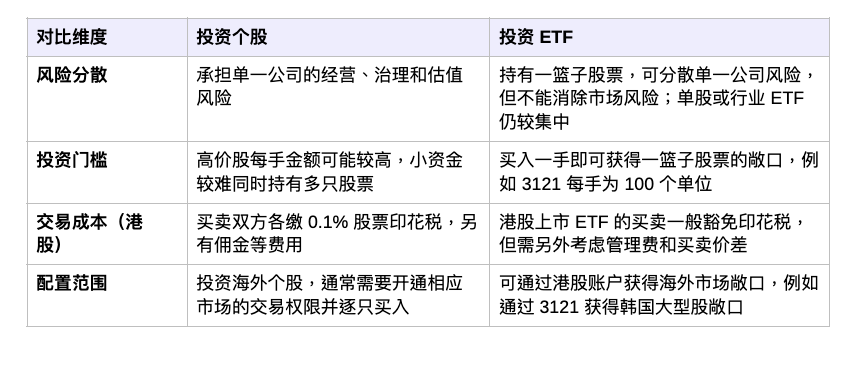
The article describes ETFs as exchange-traded funds and notes that their scope and strategy vary widely. Some track broad indexes, some focus on specific sectors, and some follow a single stock with leverage.
For investors who want exposure to a market or industry without concentrating everything in one company, ETFs that hold multiple stocks can help spread company-specific risk and reduce the work involved in selecting and managing individual names one by one.
The piece highlights several ETF characteristics:
- Diversification of single-company risk: For ETFs that hold multiple stocks, weak performance from one constituent usually does not affect the whole portfolio in the same way as direct ownership of that stock. The article adds that diversification does not remove market risk.
- Easier access to a market or sector: Investors can use an index ETF to gain exposure to a basket of stocks without buying each constituent separately.
- More strategy choices: The market includes traditional index ETFs, sector ETFs, leveraged products, and inverse ETFs, allowing investors to study different tools based on their goals and risk tolerance.
- Relatively straightforward trading: ETFs can usually be bought and sold on an exchange like stocks, though trading costs, liquidity, bid-ask spreads, and fund fees still need to be compared product by product.
The article also warns that ETFs are not automatically less risky than individual stocks. A single-stock ETF still depends heavily on the performance of that stock. A sector-focused ETF can also be volatile if industry concentration is high. Leveraged products add another layer of strategy risk.
In that sense, choosing an ETF does not mean an investment is safer or easier to profit from. The key, the article says, is understanding the product structure and deciding whether it matches the investor’s objective.
Three ways to approach SK Hynix exposure
Against the backdrop of continued interest in AI storage, the article compares three investment routes based on the type of market exposure an investor wants.
Option 1: Buy SK Hynix directly
This route is presented as suitable for investors who want concentrated exposure to SK Hynix’s own operating performance and are willing to accept the volatility that comes with a single company.
The article says the company’s latest quarterly results were strong and reflected the boost from AI memory demand. Even so, investors still need to consider whether the market has already priced in growth expectations, and how future competition, capital expenditure, and industry cycles may affect the stock.
One of the article’s clearest points is that strong earnings do not guarantee that the share price will keep rising.
Option 2: Use a Korean market index ETF
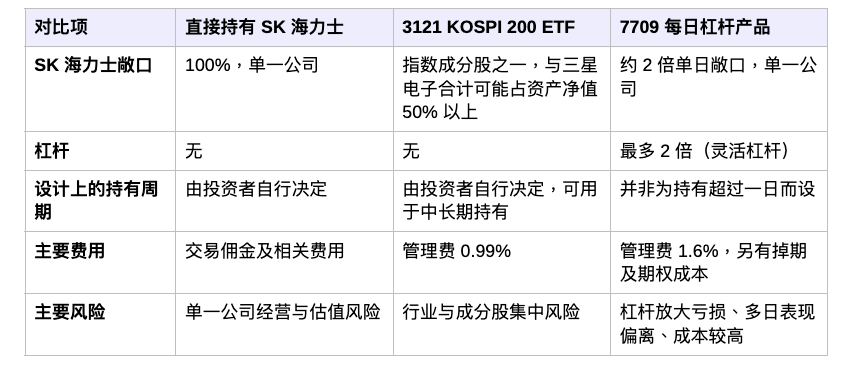
As an example, the article points to 3121.HK, the CSOP KOSPI 200 ETF, which tracks the KOSPI 200 Index and gives investors index exposure to large-cap Korean equities. The product was listed on the Hong Kong Stock Exchange on June 18, 2026, uses a full replication strategy, directly holds index constituents, and charges a management fee of 0.99%.
Compared with owning SK Hynix directly, an index ETF covers multiple companies and can reduce reliance on a single name. For investors who are constructive on the Korean market as a whole but do not want to place the entire bet on one company, the article says this is a route worth studying.
That said, the piece stresses that an index ETF does not eliminate concentration risk. The KOSPI 200 is heavily concentrated in Samsung Electronics and SK Hynix, both in semiconductors. According to the product key facts statement for 3121, the combined weight of the two may account for more than 50% of the product’s net asset value. In practical terms, holding 3121 still gives investors a sizable storage semiconductor exposure. The article says it may suit investors who want exposure to Korea’s semiconductor leaders without relying on only one company.
It also advises investors to check the latest constituent list and weightings on the product website to understand what they actually own.
Option 3: Use a single-stock leveraged product for amplified daily exposure
For investors with a positive view on a specific company, the article says there is another route besides buying the stock outright: a leveraged product linked to a single stock.
The example used is 7709.HK, the CSOP SK Hynix Daily Leveraged (2x) Product. Unlike a traditional index ETF, this type of product does not spread risk through a basket of stocks. It uses leverage to amplify the underlying stock’s daily price movement.
The article lists several practical features of this product type when compared with direct stock ownership:
- Trading convenience: It can be bought and sold through a Hong Kong stock account, trades in Hong Kong dollars, and has a board lot size of 100 units, so investors do not need to open a separate Korean market account.
- Losses limited to invested principal: Unlike margin trading, buying the product does not trigger margin calls. The maximum loss is the capital invested.
- Scale and turnover: As of early October 2026, 7709 had about $4.5 billion in assets under management, making it the largest product of its kind across the Hong Kong and U.S. markets, with relatively active trading.
The article then turns to the mechanics investors need to understand before using it:
- A daily trading tool: The product seeks leveraged performance on a daily basis only. Both the issuer and the Hong Kong Securities and Futures Commission have stated that products of this kind are not designed to be held for more than one day.
- Holding cost: The management fee is 1.6%, and the annual ongoing charges figure is about 2.00%, excluding swap costs. Based on the product key facts statement, the longer the holding period, the more visible the cost impact becomes.
- Volatility and drawdown: Leverage magnifies both gains and losses. The article gives one example from late June to the end of July this year: SK Hynix fell by about 49% from its high, while 7709’s net asset value drew down by more than 80% over the same period. After a drawdown of that size, the product needs a much larger rebound to recover, so investors should assess losses using a worst-case framework before entering.
The article makes a separate point here: a daily leverage target is not the same thing as a fixed multiple of long-term cumulative return. In a volatile market, compounding can cause the product’s performance to diverge materially from the underlying stock’s cumulative move over the same period. That means investors need to understand the product mechanism, holding horizon, and potential drawdowns, not just the company’s fundamentals.
Questions to ask before choosing a stock or ETF
The article says investors can start with a few basic questions before deciding between a single stock and an ETF:
- Am I positive on one company, or on an industry or market as a whole? If the view is concentrated on one company, the stock may be the more direct route. If the goal is exposure to a basket of stocks, an index or sector ETF may be worth studying.
- How long do I plan to hold the position? Traditional index ETFs and daily leveraged products are built for different objectives and should not be approached with the same holding logic. Daily leveraged products are not designed to be held for more than one day.
- How much volatility and drawdown can I tolerate? The article says investors should not focus only on upside potential during rallies, but also on possible losses when the market moves the other way.
- What are the actual trading conditions of the product? Management fees, bid-ask spreads, trading volume, tracking performance, and product terms all need to be compared instead of relying only on recent price moves.
Common ETF mistakes and practical checks
Common mistakes
- Holding too many similar ETFs: Buying a large number of funds with similar themes can create heavy overlap, leaving the portfolio close to a single broad ETF while making it harder to manage.
- Looking only at the name or the hot theme: Even ETFs built around themes such as “Korea” or “semiconductors” can differ sharply in holdings, weights, and rules. The article says investors should review holdings and the product key facts statement before buying.
- Focusing only on recent gains: A product that has risen sharply in the near term is not automatically suitable for an investor’s objective or holding period.
- Treating daily leveraged products like ordinary ETFs: The article repeats that daily leveraged products are not designed to be held for more than one day and should not be handled like standard index ETFs.
Practical points
- Compare similar products: If several products cover the same theme, investors can compare scale, fees, tracking error, and trading volume.
- Watch premiums and discounts: An ETF’s trading price can deviate from net asset value. For products investing in overseas markets, those deviations may be more likely when the underlying market is closed or after it has shut.
- Pay attention to trading hours and order type: Prices can move more sharply during the Hong Kong market’s pre-open auction session, so limit orders may help control execution price.
- Keep currency effects in mind: ETFs investing in overseas assets can be affected by exchange-rate moves in the relevant currencies.
Producers, sources, and risk disclosure
The article states that it was jointly produced by BIT Securities and CSOP Asset Management.
BIT Securities is described as a U.S. and Hong Kong stock trading service platform under the BIT group, formerly Matrixport, operated by its wholly owned subsidiary Matrix Gelephu Pte. Ltd., which holds a financial services license in the Bhutan Special Administrative Region. Hong Kong stock services are provided through a licensed partner broker regulated by the Hong Kong Securities and Futures Commission.
CSOP Asset Management is described in the article as the largest ETF issuer in Hong Kong and the first overseas subsidiary established by a mainland Chinese public mutual fund company, with a focus on issuing and managing ETFs as well as leveraged and inverse products.
On sourcing, the article says the materials for products 3121 and 7709 were provided by CSOP Asset Management Limited. Fee and weighting information came from product key facts statements and issuer announcements and may change, so investors should refer to the latest information on the product website.
The risk disclosure says the article is intended only for general market information and investor education. It does not constitute investment advice or a recommendation to buy or sell any security or fund. Investments in securities and ETFs may result in loss of principal, and leveraged and inverse ETFs carry higher risk. Investors are advised to read the relevant product documents and fully understand the risks before investing.