
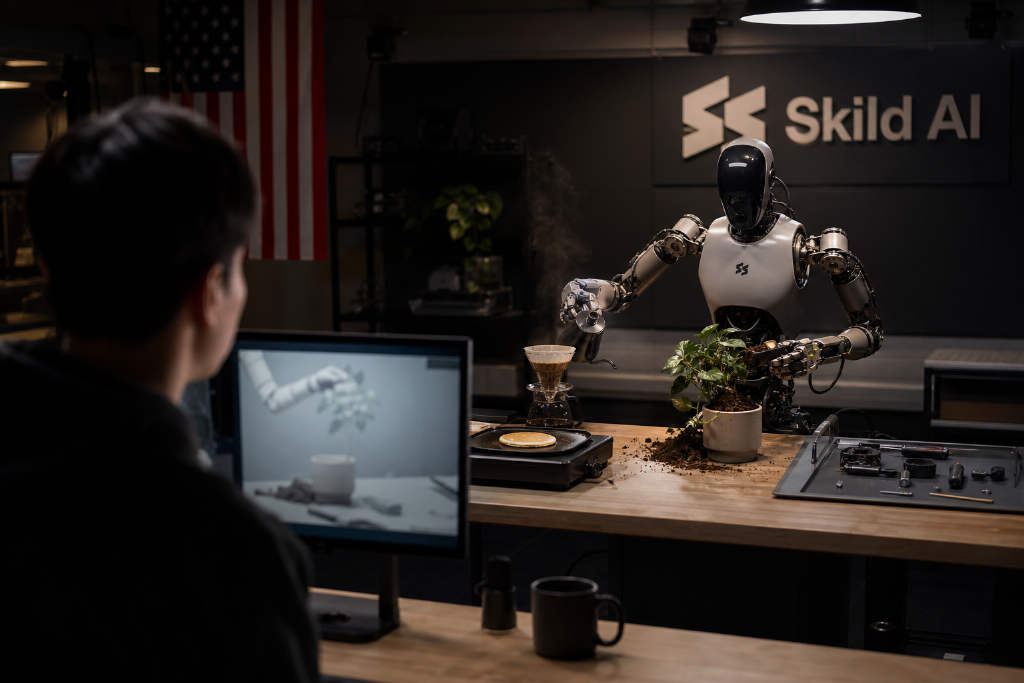
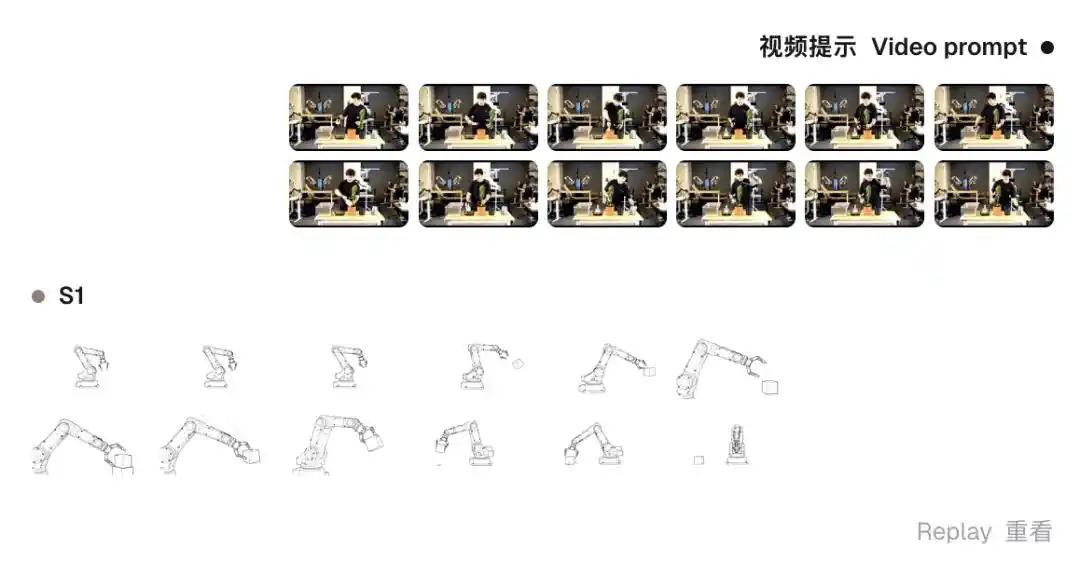
Skild AI has released S1, a new robot foundation model centered on in-context learning, or ICL. The company says S1 can learn a new operation by watching a human demonstration video, then execute a full task it has not seen before without fine-tuning, post-training, or any change to model weights.
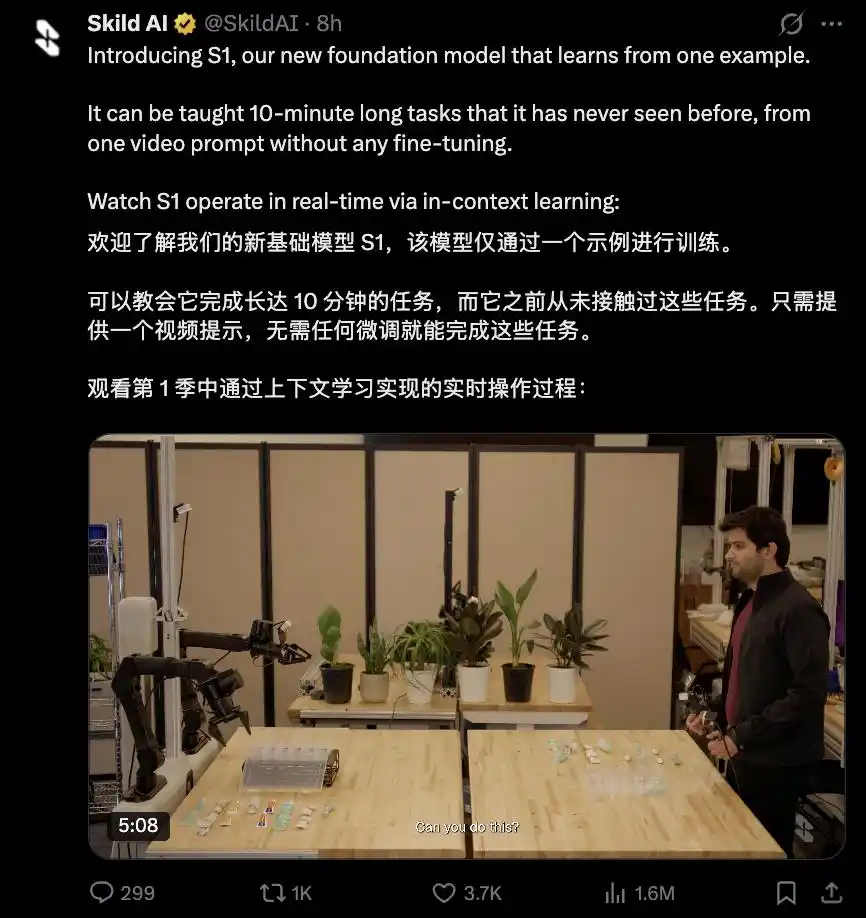
In the company’s demos, the robot completed long-horizon tasks including making pancakes, brewing coffee, repotting a plant, and assembling equipment. The source article says S1 posted a 66% success rate on unseen tasks, far ahead of a language-prompted vision-language-action, or VLA, setup at 9%. It also says a conventional post-training path would need about 380 task demonstrations to reach the same level S1 achieved after a single example.
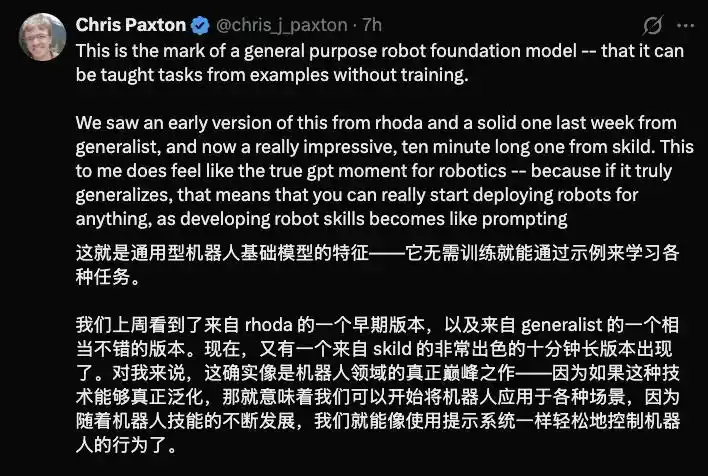
The release comes shortly after Generalist presented Gen 1.5 last week, a system described in the article as being able to learn actions lasting 3 to 12 seconds. Skild’s new model pushes the task length for robotic in-context learning past 10 minutes. The article cites social media reactions arguing that general-purpose robots may arrive sooner than some earlier expectations, while others linked Rhoda, Generalist, and Skild S1 as signs that robotics may be approaching its own GPT-style moment.
From BERT-style robotics to a GPT-style shift
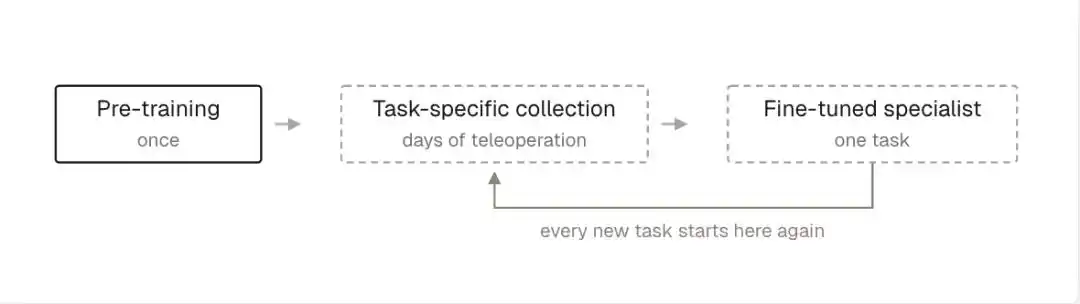
Skild’s technical framing starts with the standard robotics pipeline. A model is first pre-trained on large datasets to build basic capabilities. After that, for a specific deployment setting, developers collect task data and run post-training so the robot can acquire a specialized skill.
Skild argues that the workflow may resemble large language models, but the cost structure does not. For language models, much of the pre-training corpus comes from the internet. In areas such as coding and agents, a sizable share of post-training data can also be collected online or even generated automatically. Robotics has no such advantage. Pre-training data has to be gathered in the physical world, and post-training data also has to be gathered in the physical world.
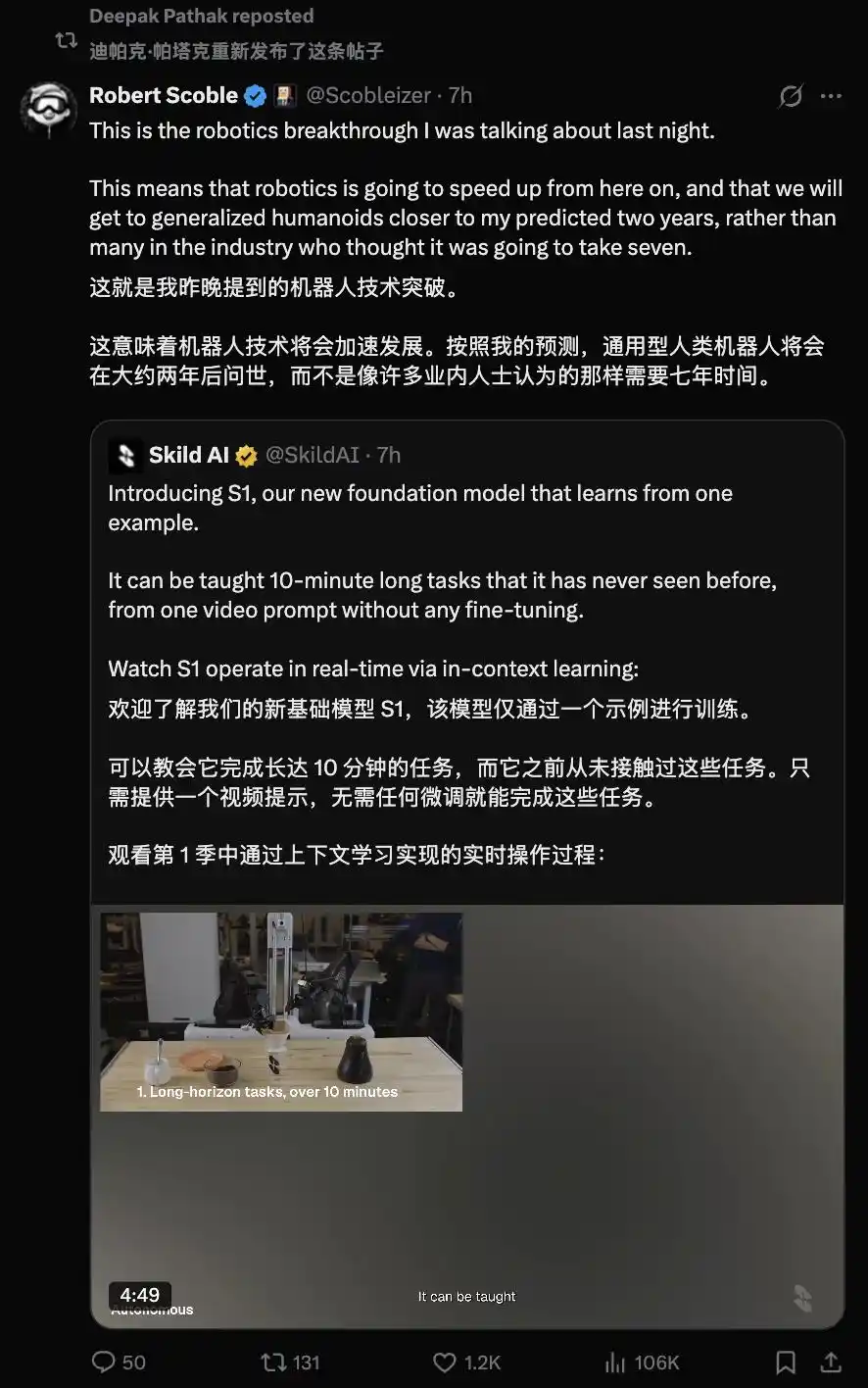
That leads to the question Skild raises in its blog: if a robot foundation model still needs dozens or hundreds of hours of real-robot data and another round of post-training every time it faces a new task, what exactly makes it a foundation model. The article adds that Skild cites earlier research suggesting that if enough task-specific data is available, a model trained from scratch can in some cases catch up with a pre-trained and fine-tuned foundation model.
Skild’s answer is in-context learning. The company draws a comparison with language model development. Early BERT systems were already strong, but they usually still required fresh data and fine-tuning for each new task. The bigger change came later, after GPT-3, when in-context learning started to show that a model could pick up a new task from examples in a prompt without updating weights. Skild argues that robotics is still stuck in an equivalent of the BERT era and that the real goal is a similar shift for robots.
What S1 is meant to learn from context
According to Skild, robotic in-context learning should be judged on two fronts. First, can the robot learn a skill that never appeared in training. Second, can it recombine skills it already has and use them to finish a long and complex new task.
The pancake example is used to make that point. After watching one video of pancake flipping, the robot can learn how to make pancakes even if that skill was absent from its training data. Compared with the second-long clips highlighted by Gen 1.5 last week, S1 extends robotic in-context learning to sequences as long as 10 minutes.
In tasks such as repotting a plant, each job involves dozens of consecutive actions. The source article says the robot has to do more than copy motions. It has to track which step it is currently on, determine what comes next, combine skills across stages, and recover when part of the process goes wrong. In that framing, S1 is meant to capture task intent and action structure from the demonstration rather than perform simple behavior cloning.
The article says the plant-repotting workflow took 11 minutes from recording the demonstration to the robot carrying it out on its own. Throughout the process, S1 did not use fine-tuning or post-training, and the same fixed set of weights was used across all tasks shown in the blog. The comparison drawn in the article is explicit: language prompts in GPT-style systems are replaced here by action videos aligned with downstream robotic tasks.
Tests: when video ICL overtakes language prompting
In the experimental section, Skild compared video-prompt ICL with a traditional language-prompt VLA setup on both in-distribution tasks and out-of-distribution tasks.
The article says language prompting worked better when the training set was only 1,000 hours. As the training corpus expanded, ICL moved ahead. At 100,000 hours, ICL reached 96% on tasks seen during training, versus 89% for language prompting. On the more important out-of-distribution tasks, ICL scored 66% and language prompting scored 9%.

Skild also tested generalization under different experimental conditions. The article says performance degradation in the language-prompt VLA setup was as much as three times larger than in ICL. The interpretation offered is that ICL is not merely replaying fixed motions from fixed scenes, but adapting task execution to the current environment.
One-shot learning is another part of the comparison. S1 used no post-training at all on a new task and still reached a 66% success rate after watching a single demonstration video. A traditional VLA approach, by contrast, needed about 380 demonstrations of post-training to match that level. If demonstration count was increased to 2,000, the conventional setup eventually rose to 86%.
The article does not present that as proof that robots will no longer need training. The narrower claim is that the cost of teaching a new skill may fall sharply: from having to show the robot something hundreds of times to showing it once and getting a partial but usable result immediately.
Skild’s ICL scaling law claim
The report summarizes this trend as an ICL scaling law. As data volume grows, the model does not just accumulate more skills. It also gets better at learning new skills from demonstrations. On that view, the central question is no longer only whether robots can master more tasks, but whether the cost of acquiring a new task can shift from “teach it hundreds of times” to “do it once, let it watch once.”
Who is behind Skild AI
Skild was founded in 2023 by Deepak Pathak and Abhinav Gupta, both professors at Carnegie Mellon University’s Robotics Institute. The article describes Pathak’s work as focusing on robot learning, reinforcement learning, and computer vision, while Gupta is known for computer vision and self-supervised learning.
The two previously collaborated on WHIRL in 2022, a project aimed at one-shot imitation from human video. The source uses that history to argue that S1 is not a sudden departure but a continuation of an earlier line of research.
On financing, the article says Skild emerged from stealth in 2024 with a $300 million Series A and a $1.5 billion valuation. In January this year, it then raised a $1.4 billion Series C at a valuation above $14 billion, led by SoftBank, with Nvidia and Jeff Bezos continuing to participate. The article says the company’s valuation has climbed by nearly 10 times in a little more than two years.
Any robot, any task, one brain
The article places Skild in a distinct position within the North American embodied AI field. It says PI is closer to pursuing a “robot GPT,” Generalist has lately emphasized the one-shot learner angle, and Genesis AI and Sunday have shown momentum around full-stack approaches. Skild, by contrast, has stayed with one line: “Any robot, any task, one brain.”
That means an emphasis on cross-embodiment deployment. The idea is for the same Skild Brain to run on robot arms, quadrupeds, humanoids, and other forms. The source article describes the ambition in simpler terms: to become something like Android for the robot era, a common intelligence layer inserted into many different bodies.
That ambition shapes Skild’s data strategy. The company breaks robotic data into three dimensions: hardware proximity, diversity, and scalability. Real-robot teleoperation is closest to the hardware but expensive. First-person human video scales more easily but differs more from the robot’s body. Simulation is cheap and can produce a lot of data quickly, but it comes with a sim-to-real gap.
As a result, the article says Skild uses all of them: Robot Teleop, UMI, Egocentric Video, and Simulation. In that reading, S1’s in-context learning is a natural extension of the same strategy.
From LocoFormer to S1
The article lays out a timeline for that path:
- September 2025: LocoFormer.
- February 2026: first in-domain ICL.
- May 2026: first pancake-flipping result.
- August 2026: S1 launches and extends in-context learning to out-of-distribution long-horizon tasks lasting up to 10 minutes.
The piece ends by saying that if this scaling law continues to hold, the “GPT moment” framing in robotics may be more than a marketing slogan.
Reference: https://www.skild.ai/blogs/s1
Source article credited to the WeChat public account QuantumBit, written by henry.