

Five treasury companies appear to have sold about $203 million in crypto
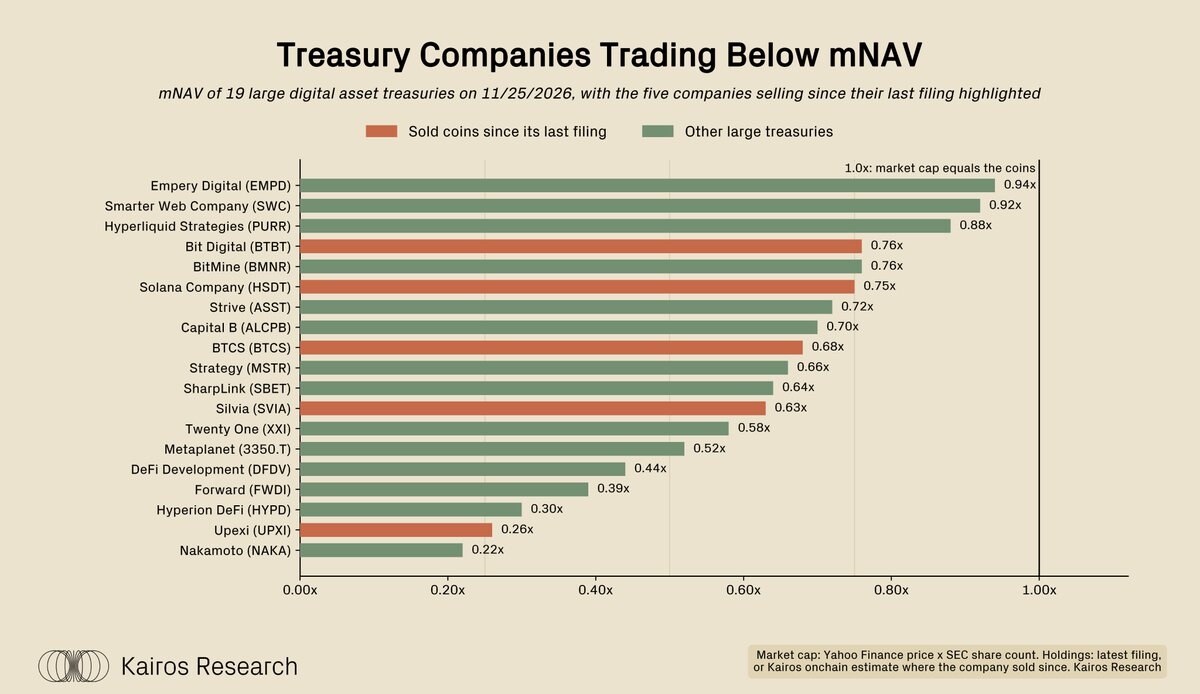
Several digital-asset treasury companies appear to have begun selling crypto holdings as they seek to bring their market-value-to-net-asset-value ratio, or mNAV, back toward 1, according to research from Kairos Research.

Over the past several weeks, Silvia (SVIA, formerly ProCap Financial), Bit Digital (BTBT), BTCS (BTCS), Upexi (UPXI) and Solana Company (HSDT) appear to have sold a combined 410 BTC, 57,300 ETH and 986,000 SOL. Valued at the prices on the days the tokens moved, the assets were worth about $203 million.
The five companies share a key feature: their equity market values are currently well below their net asset values, leaving each with an mNAV below 1. That makes the financing strategy that previously supported treasury growth harder to use. Issuing shares below the value of the assets already held would reduce, rather than increase, the amount of underlying crypto represented by each share. Borrowing to acquire more assets also becomes more difficult when balance sheets are under pressure.
On-chain transfers were checked against prior filings
Two of the five companies have publicly acknowledged related sales.
BTCS said in an 8-K filing submitted on Nov. 23 that it sold about 27,300 ETH on Nov. 20 to repay $43.8 million borrowed through Aave.
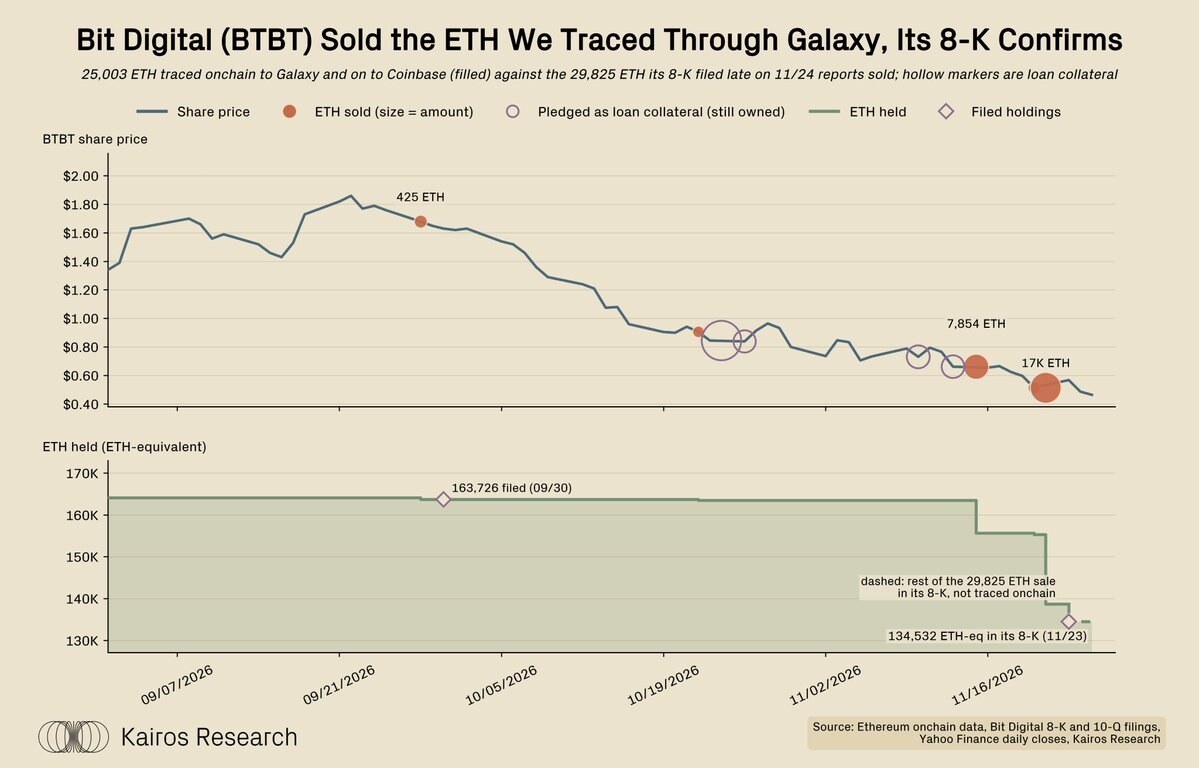
Bit Digital disclosed in an 8-K filed late on Nov. 24 that it sold 29,825 ETH between Nov. 15 and Nov. 23. The sale generated about $50 million and cut the company’s loan with Galaxy in half. Kairos had completed its on-chain review before that filing was published.
The transactions involving the other three companies were identified through wallet tracing. The research matched each company’s treasury wallets with its historical regulatory filings. Before classifying a recent transfer as a sale, the team checked whether the same wallets and transfer routes could reproduce transactions the company had previously disclosed.
The method produced several close matches:
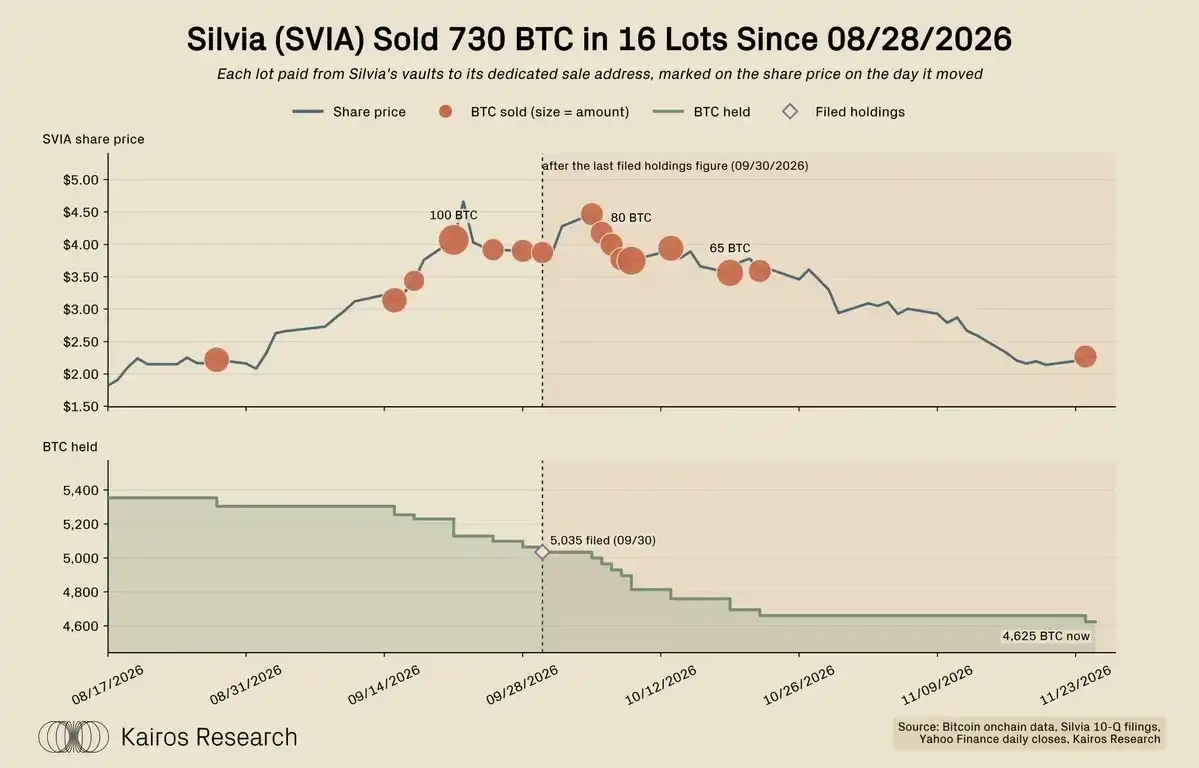
- Silvia’s third-quarter sale: 320 BTC traced on-chain, exactly matching the 320 BTC reported by the company.
- Bit Digital’s third-quarter sale: 1,625 ETH traced on-chain, again matching the company’s disclosure.
- Solana Company’s first-quarter sale: $5.459 million traced on-chain versus $5.452 million disclosed.
- Upexi’s quarterly net sales: the traced amount differed from the company’s disclosure by about 4,000 SOL.
Those historical matches gave the researchers greater confidence in the recent flows from the same wallets after the companies’ latest financial reports. Bit Digital’s filing provided a real-time test of the approach. Kairos identified the transfers before the company disclosed them, and the later figures were broadly consistent.
Using on-chain data alone, the research identified 24,793 ETH moving through Galaxy between Nov. 15 and Nov. 21, or about 83% of the 29,825 ETH Bit Digital later reported as sold. Kairos estimated that Bit Digital had about 138,900 ETH-equivalent assets remaining, while the company’s latest disclosure listed 134,532.
The researchers also correctly identified the LsETH Bit Digital moved to Galaxy in November. Those assets were collateral for the loan. The traced collateral totaled 69,088 LsETH, almost exactly matching the 69,089 LsETH listed in the company’s announcement.
Sales represented very different portions of each treasury
The effect of the transfers varied according to each company’s treasury size.
- BTCS sold nearly half of the ETH holdings it reported at the end of September.
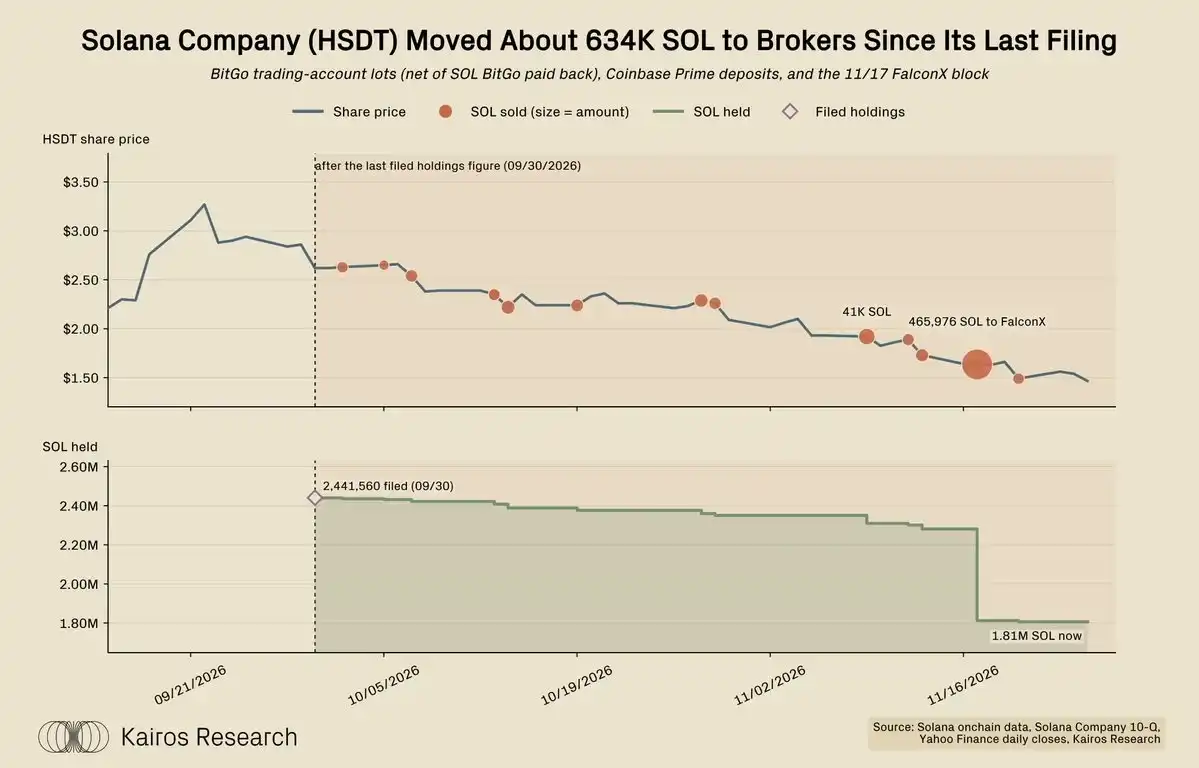
- Solana Company moved about one-quarter of its SOL into brokerage and trading accounts, with none of the assets returning so far.
- Bit Digital sold about 18% of its ETH holdings.
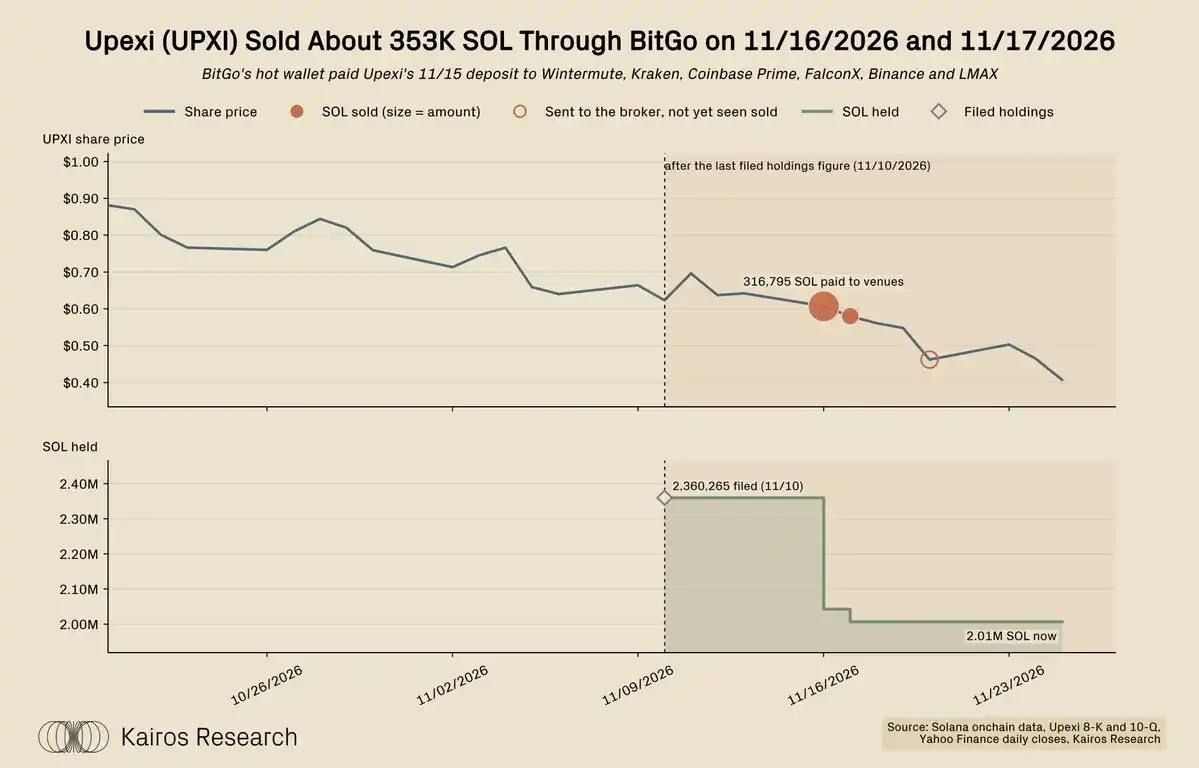
- Upexi sold about 15% of its SOL holdings.
- Silvia sold 410 BTC, the smallest proportion at about 8% of its holdings.
Silvia’s transfers were the most consistent in structure. The company sent the BTC in nine batches of 35 to 80 BTC, all to the same address. That address had previously received every identified Silvia sale, and only Silvia’s wallets had sent funds to it.
None of the five companies appears to have sold directly through exchange order books. The tokens moved through custodians, prime-broker hot wallets and over-the-counter venues, leaving no obvious large block trades on public exchanges.
How the assets moved
- One Silvia transfer was included in a 1,000-BTC payment to a Cumberland DRW wallet.
- On Nov. 15, Upexi sent 329,499 SOL to a shared BitGo hot wallet. During the following 36 hours, that wallet sent 352,530 SOL to trading firms and exchanges including Wintermute, Kraken, Coinbase Prime, FalconX, Binance and LMAX. The wallet normally held about 198,000 SOL. Over the three-day period, Upexi supplied 96% of all assets that flowed into it. None of the funds went to BitGo or another lender, so the transfers could not have been completed without Upexi assets and were not loan collateral.
- Solana Company sent a 465,976-SOL transfer to FalconX, while an equal amount reached OKX and Kraken deposit addresses within one day.
- Galaxy Digital moved about 24,800 ETH from a hot wallet and sent it to Coinbase deposit addresses over three and a half days. Bit Digital later confirmed that it sold this batch.
Transfer timing points to balance-sheet pressure
The timing of the transfers suggests that the sales were more closely connected to balance-sheet pressure than to a change in the companies’ long-term views on the underlying assets.
- BTCS sold assets as ETH fell to about $1,561, using the proceeds to reduce its Aave borrowing.
- Solana Company began unstaking SOL on the same day that its previously sold 390,000-SOL put options expired deep in the money. The options were expected to produce a loss of about $12 million.
- Upexi sold SOL when the token traded near $70, close to Kairos’s estimated $67 level. At that price, the collateral ratio on its $57.3 million BitGo loan would reach 150%, allowing the lender to issue a margin call. The amount Upexi actually sold was less than 1% different from the quantity needed to restore the loan’s collateral ratio to 200%.
- Bit Digital began moving assets after the value of the ETH collateral supporting its $100 million Galaxy loan fell to about 131% of the loan amount. The company has confirmed that the proceeds were used to repay half of the loan.
When a treasury company’s stock trades below the value of its assets, its own crypto holdings become the most accessible source of cash. That is the practical constraint facing a model that previously relied on equity issuance and debt to keep expanding crypto reserves.
Disclosure gaps leave on-chain movements visible first
The timing gap between the transfers and public filings may be more important to investors than the sales themselves.
Silvia, Solana Company and Upexi each filed third-quarter 10-Q reports in November. The reports included subsequent-event disclosures. Silvia and Solana Company mentioned share buybacks, new loans and executive departures, but did not mention crypto sales that had already occurred before the filings. Upexi began selling two days after publishing its financial results and has not addressed the transactions.
Bit Digital offers a different reference point. It filed its 10-Q on Nov. 12, before the sales. The day after the final transfer, it disclosed the transactions in an 8-K. That is a standard the other three companies have not yet met.
Silvia’s disclosures show the issue clearly. The company said it repurchased 6.1 million shares for $24.4 million between Oct. 1 and Nov. 10, but did not disclose that about 375 BTC had left its treasury during the same period to fund the buyback.
Public treasury-tracking platforms also appear to lag. They still show Silvia holding 4,965 BTC, while Kairos’s tracing puts its actual holdings at about 4,625 BTC. Phoenix Group shows a similar difference: public platforms list 559 BTC, while its third-quarter report listed only 331 BTC.
Asset sales and buybacks may not improve mNAV as much as expected
Selling crypto to repurchase shares may have a far smaller effect on mNAV than the headline figures suggest. Kairos used Silvia to examine the arithmetic.
- BTC held per share barely improved. The proportion of BTC sold was almost the same as the proportion of shares retired. BTC per million shares therefore slipped slightly, from about 62.2 at the end of September to about 61.8 on Nov. 10.
- The buyback price was close to net asset value rather than at a meaningful discount. After subtracting $99.6 million in convertible debt, Silvia paid roughly 1 times net asset value for the shares it repurchased.
- The mNAV discount shown by the market may be overstated. Using the same debt adjustment, Silvia’s actual mNAV was about 0.98 times rather than the 0.63 times shown in the first chart. The value created by the buyback was therefore much smaller than the headline data suggested.
- Less BTC is freely available than the headline holdings imply. Under the bond terms, collateralized BTC is valued at only half its actual value. At current prices, about 3,420 of Silvia’s roughly 4,625 BTC must remain pledged. Bondholders also have the right to require repayment at face value of the full $99.6 million bond in June 2027.
Stocks did not show broad signs of an unusual reaction
The companies’ shares did not show clear abnormal trading during the sales, consistent with the transactions not yet being publicly disclosed. Trading volume on most sale dates was normal or below average.
Since Sept. 30, four of the five companies have underperformed the crypto assets they hold by a clear margin. Solana Company’s stock has broadly followed SOL. The transfers did not provide visible support for the shares.
The clearest abnormal window involved Bit Digital. While Galaxy was sending ETH to Coinbase, Bit Digital shares fell 15%, compared with a 4% decline in ETH. The stock also underperformed its closest peers.
About 25 treasury companies and miners have disclosed sales
Since mid-October, about 25 treasury companies and miners have disclosed crypto sales in filings submitted to the U.S. Securities and Exchange Commission.
- Complete exits: KULR, Hyperscale Data and Rumble sold all of their BTC holdings. GameSquare sold most of its ETH to repay an ETH-backed bond.
- Large realized losses: Empery Digital sold 3,170 BTC this year, realizing a loss of $160 million.
- Miner sales: MARA sold 13,597 BTC after the third quarter to repay a $750 million Bitcoin-backed loan. Riot has sold 20,264 BTC this year.
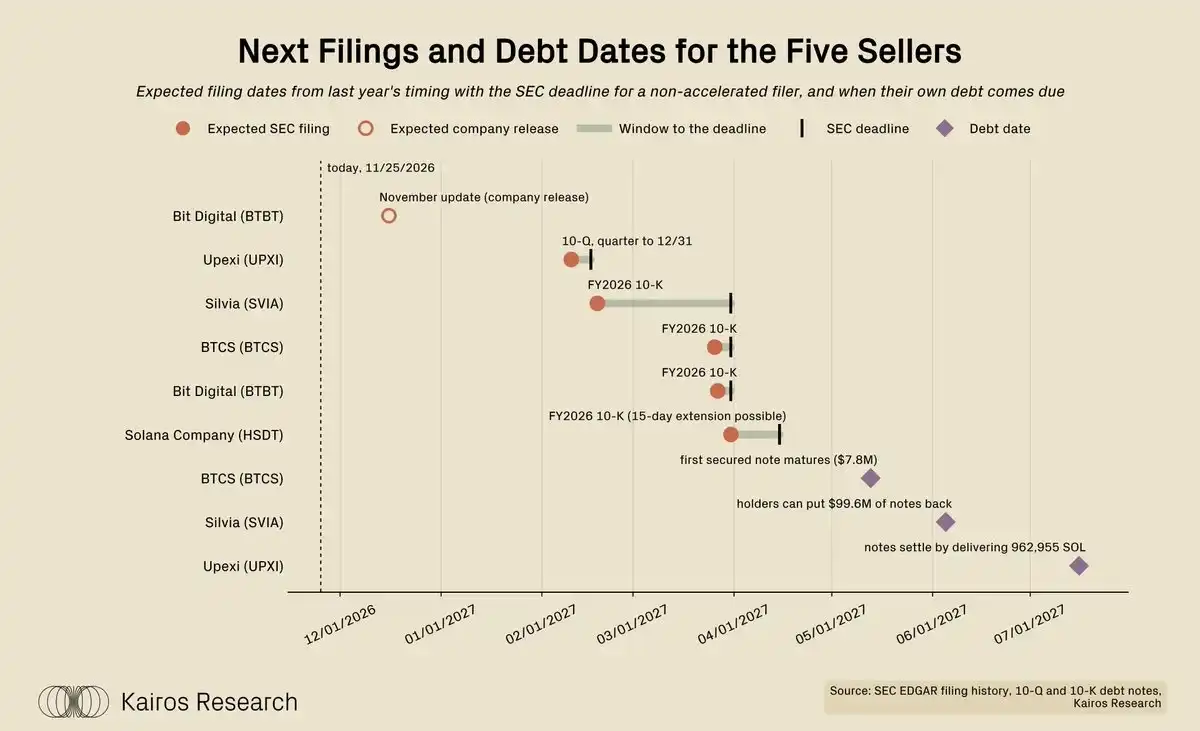
Silvia, Upexi and Solana Company differ from those companies because their post-Sept. 30 sales may not appear in public filings for months. All five firms are non-accelerated filers and can use the longest reporting periods allowed by the SEC.
Expected disclosure dates
- Bit Digital: In mid-December, the company is expected to publish its November holdings update. It will be a company announcement rather than a regulatory filing and may show whether the company sold more after reporting 134,532 ETH-equivalent assets on Nov. 23.
- Upexi: Around Feb. 10, 2027, with a deadline of Feb. 16. Its first required disclosure should be the 10-Q for the period ended Dec. 31, which will report sale proceeds and year-end SOL holdings.
- Silvia: Around mid-February 2027, with a deadline of March 31. The company filed its annual 10-K last year on Feb. 18.
- Bit Digital, BTCS and Solana Company: In late March 2027, with a March 31 deadline. Solana Company has previously used a 15-day extension, which could push its 10-K to around April 15.
On-chain flows may change before those dates.
On Nov. 24, Solana Company began unstaking 218,539 SOL from an Anchorage margin treasury, worth about $14.5 million. The action was identical to the step it took four days before a large SOL transfer to FalconX.
Upexi still had 139,870 unstaked SOL in one wallet, while another 30,000 SOL had remained at BitGo since Nov. 20.
Companies facing lender-driven liquidation pressure may sell next
The next likely sellers may be treasury companies whose lenders can force a decision.
Once a crypto-backed loan triggers a margin call, a price threshold can turn an asset sale from an option into a requirement. A low mNAV also closes the route to cheaper financing through new share issuance.
- Nakamoto (NAKA): It borrowed $165 million in USDT from Kraken against 3,030 BTC. At current prices, the BTC covers the loan by only about 1.07 times. Of the debt, $105 million matures on June 30, 2027.
- Upexi: It owed BitGo $57.3 million at the end of September. The loan can be called with 30 days’ notice and triggers a margin call when the collateral ratio falls to 150%. Upexi also issued a $150 million bond due July 16, 2027, requiring delivery of 962,955 SOL to bondholders.
- Solana Company: It signed a new loan agreement with Maple on Nov. 11 containing margin and liquidation provisions. At the end of September, the company held only about $1.1 million in cash, while its options trading had already generated losses.
- Forward Industries (FWDI): It borrowed $50 million from Erebor Bank on Nov. 16 against SOL held at BitGo, in addition to loans from Galaxy.
- Metaplanet: At the end of September, its borrowings equaled 17.7% of its BTC holdings, above its own 10% guideline. During the third quarter, it sold 10,000 BTC and repurchased 11,000 BTC to demonstrate that financing could raise cash comparable to the amount sold.
Traced sales may be only a lower bound
The research cannot fully confirm every transaction.
The first uncertainty concerns about $33 million of assets moved by Solana Company. The SOL sent through FalconX could theoretically have been collateral or a SOL loan rather than a direct sale. But the company’s own 10-Q said that collateral for its options margin and its new Maple loan was held in custody accounts opened in the company’s name, rather than sent directly to counterparties. No assets returned during the eight days after the transfer. Kairos therefore classified it as a likely sale with medium-to-high confidence.
The second uncertainty concerns BitGo’s shared hot wallet, which serves all BitGo customers. The conclusion that Upexi sold assets is therefore an inference rather than a directly labeled transaction. Still, the data showed that no other customer deposited more than about 14,000 SOL into the wallet that weekend, and the wallet could not have made the observed outflows without Upexi assets. No related assets returned during the following 10 days.
Finally, sales conducted inside custodians cannot be observed directly on-chain. The total identified by the research should therefore be treated as a lower bound; the actual amount may be higher.
The transfers do not necessarily mean the companies violated any rule. Whether selling part of a treasury constitutes a material event outside the ordinary course of business and requires an 8-K filing remains a case-by-case question. The data does show that wallet tracking can identify asset movements weeks or even months before regulatory filings. Kairos said it will continue monitoring the wallets in real time and publish findings when token transfers occur before formal company disclosures.



