
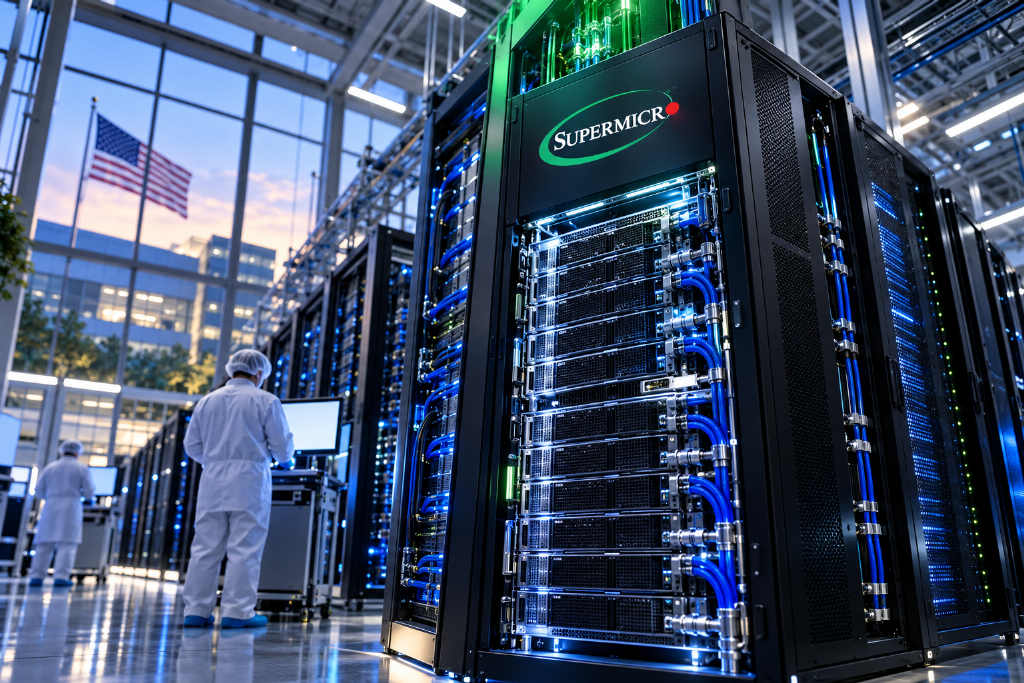
Demand for AI servers is not just about how many systems are sold. The harder question is how much profit remains after those orders are delivered. Super Micro Computer’s latest update gave the market two signals at once: a much higher revenue outlook and a better gross margin forecast.
On Oct. 20 Eastern Time, the company released a preliminary business update for the first quarter of fiscal 2027. It said revenue for the quarter ended Sept. 30, 2026 is expected to reach $18.5 billion to $19.5 billion, above its previous guidance of $14.5 billion to $15.5 billion. Gross margin is now expected at 12.0% to 12.5%, up from the earlier 10.4% to 10.8% range.
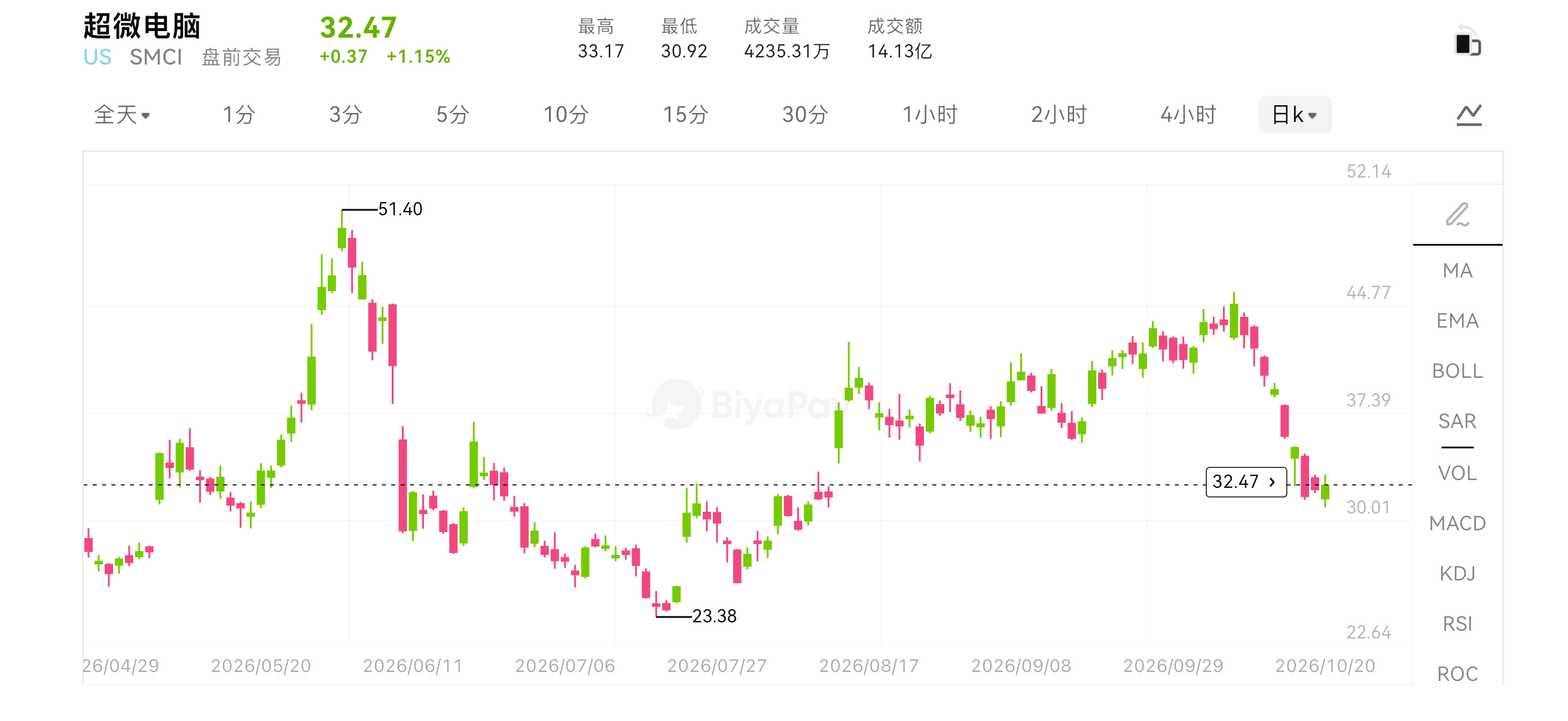
According to BiyaPay market data, SMCI ended regular trading that day at $32.47, up 1.15%. As of 19:59 Eastern Time, the stock was quoted at $37.52 after hours, 15.54% above the regular close.
The market reaction was not only about strong AI demand. For server makers, the central issue has long been whether larger orders actually translate into better profitability. This update at least pointed to a near-term improvement.
That said, the figures released so far are unaudited preliminary estimates. Full results are scheduled for Nov. 3. The positive read on revenue and gross margin still needs to be tested against cash flow, net income and the company’s next set of guidance.
What investors may watch after the after-hours jump
The after-hours rally of more than 10% showed a fast repricing of the higher revenue and margin outlook. For U.S. equity investors tracking SMCI, the next step is to separate after-hours quotes from what happens in the next regular session.
Trading activity, bid-ask spreads and whether the gain can hold once more participants enter the market will all offer clues about how durable this reaction is.
Beyond price action, the funding path into a brokerage account can also shape execution. From market tracking to actual stock trading, some users also focus on how capital moves into the account. For users holding USDT and watching U.S. equities, BiyaPay offers USDT-to-USD conversion and U.S. stock-related trading services, giving them a way to arrange funds from digital assets into stock trading through one account across multiple scenarios.
Higher revenue matters more when margin improves too
Using the midpoint of the ranges, the new revenue estimate comes to $19.0 billion, versus a midpoint of $15.0 billion under the prior guidance. That is a difference of $4.0 billion, or about 26.7%. This comparison is between the company’s updated estimate and its earlier guidance for the same quarter, not a year-over-year growth rate.
The midpoint for gross margin rises from 10.6% to 12.25%, an increase of 1.65 percentage points. For a server company operating at this scale, even a modest shift in margin can materially change gross profit.
If the midpoint revenue figures are multiplied by the midpoint gross margin figures, the new estimate implies gross profit of about $2.328 billion, compared with about $1.590 billion under the prior outlook. This is only a midpoint calculation for illustration. It is not the company’s disclosed final profit and it is not net income. It does, however, help explain why simultaneous improvement in revenue and gross margin can change market expectations more than shipment growth alone.
Viewed across the same supply chain, from chip suppliers to server makers to cloud customers, the distinction becomes clearer. Customers being willing to spend more is one layer. Whether the server maker captures a better share of the profit pool is another.
Higher-priced AI servers do not automatically mean higher profits for assemblers
High-end AI servers include expensive chips, memory, networking and storage components. When the selling price of a full system rises, reported revenue expands as well, but a large part of that amount may simply reflect pass-through procurement costs.
That means a more expensive server does not automatically signal higher technical value capture for the manufacturer. If core components account for most of the cost base, the system maker still has to rely on procurement, delivery and systems integration efficiency to protect a limited profit pool.
The areas that may actually strengthen competitiveness are rack-level integration, liquid cooling, power delivery, network coordination, tuning and ongoing operations support. For large customers, timely deployment, stable operation and lifecycle cost control often matter more than the price of any single component.
Super Micro said the gross margin improvement was driven by customer and product mix. That explanation matters, but it also leaves a follow-up question: did the improvement come from a larger share of higher-value solutions, or from a more favorable delivery mix in a particular batch of orders? If it was mainly a quarterly mix effect, one upward revision should not automatically be treated as a permanent step-up in margin.
Margin improvement still needs to be checked against cash tied up in the business
There is one part of the server business that revenue growth can easily obscure: inventory is often built before cash is collected.
Companies need to buy chips and components first, organize production, then complete delivery and acceptance. Some customers have long payment terms, and some projects are recognized in stages. Revenue may already appear on the income statement while cash remains in accounts receivable. Inventory prepared for the next wave of orders can also continue to absorb capital.
That is why the full earnings report needs to be read by linking revenue, accounts receivable, inventory and operating cash flow together. If collections improve as the business expands and inventory turnover remains normal, the funding burden behind growth is lighter. If receivables and inventory rise much faster than revenue, a company may still need extra financing to sustain delivery even if it looks profitable on paper.
That does not mean a rise in accounts receivable is automatically abnormal. Rapid expansion naturally consumes working capital. The key question is whether payment arrangements are reasonable and whether that capital usage can be released over the following quarters. Rapid expansion naturally consumes working capital. The issue is whether growth is backed by corresponding orders, customer credit quality and a clear collection schedule, and whether the capital tied up can unwind later.
For AI equipment companies, technology transitions also make inventory management more important. Once a new platform is introduced, pricing, demand and delivery timing for older platforms can change. A successful large-volume delivery is not only a sales story. It also reflects procurement and production management capability.
Larger customer orders require a separate look at profit and bargaining power
Large customers can bring scale, but they can also hold stronger negotiating leverage.
When a single order is large enough to materially change quarterly revenue, an earlier or later delivery can alter how the market reads growth. If acceptance is concentrated in one quarter, revenue may come in far above the original expectation. That does not automatically mean the next quarter will expand at the same pace.
For that reason, investors still need to watch order continuity and whether the customer mix becomes more balanced. Demand spread across different customers and delivery cycles is usually more likely to support a steadier operating rhythm than reliance on a small number of large projects. These are variables that should be checked in the business model, not proof that the company already has a collection or order problem.
Customer and product mix can also affect after-sales costs. Higher-spec systems may support higher selling prices, but they can also raise spending on installation, tuning, warranty and on-site support. Whether gross profit improvement ultimately flows through to operating profit depends on those costs as well.
The update points to strong demand, but it does not answer for the whole AI industry
SMCI’s revised outlook shows the company had stronger revenue support in the quarter. But performance at one point in the supply chain should not be mechanically extended to every other segment.
When a server maker recognizes revenue, that may mean equipment has been delivered to cloud service providers. Whether those cloud companies are fully utilizing the systems, and whether they can recover enough revenue from end customers, requires a different set of evidence. Strong infrastructure demand and fully proven end-application monetization can exist at different stages at the same time.
In the same way, better gross margin at Super Micro does not mean every peer will improve in parallel. Customer mix, supplier terms, solution capability and delivery efficiency can all create divergence. One company’s positive update should not be stretched into a single conclusion for the entire industry.
When the full report arrives on Nov. 3, the focus should be on whether the gross margin improvement is sustainable, how operating cash flow looks, how inventory and receivables are moving, and what the company says about demand for the next quarter. If those indicators support one another, this update may be more than a short-term surprise and could become a basis for reassessing the company’s earnings power.
The preannouncement gave the market a clearer look at SMCI’s growth potential in AI servers and helped drive a sharp after-hours move in the stock. But a higher revenue outlook is not the same as a firmly improved profit profile. Whether gross margin can keep recovering and whether working capital can be collected smoothly still need confirmation from the formal earnings release. The full report on Nov. 3 will be the key reference point for judging the quality of this growth cycle.




