
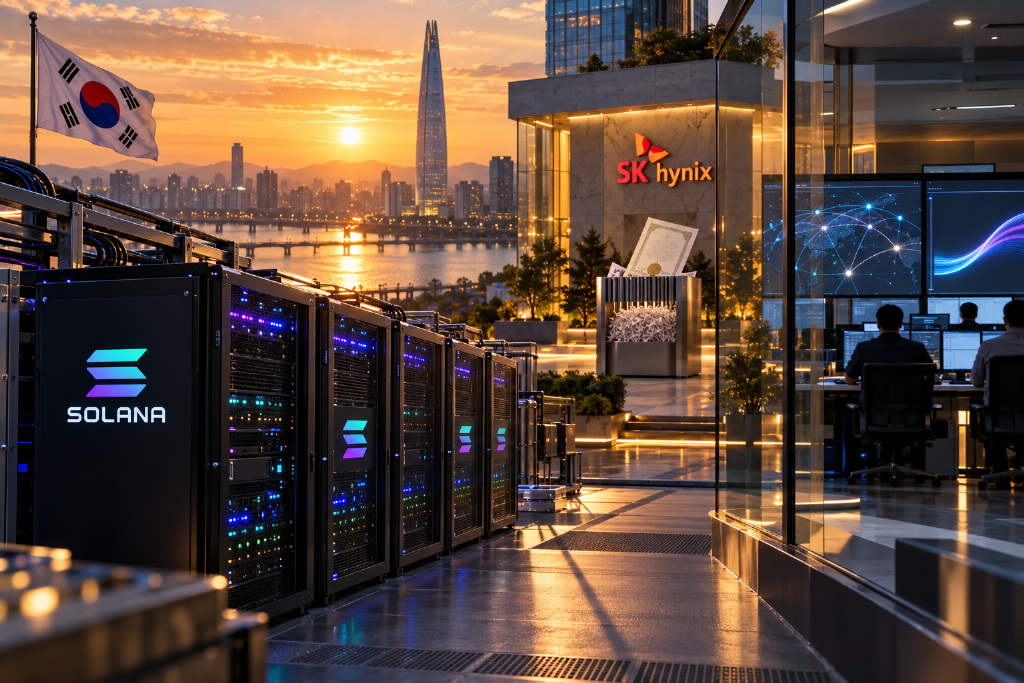
Oct. 21 brought a dense mix of crypto, market, regulatory and technology updates, led by Solana’s planned Alpenglow activation and SK Hynix’s completed 40 trillion won share buyback.
Solana to activate Alpenglow at epoch 1064
Solana is set to activate the Alpenglow upgrade on Wednesday at mainnet epoch 1064. The change is described as the network’s biggest overhaul since 2020. Under the upgrade, validator voting moves off-chain and votes are aggregated into certificates, with the stated goal of reducing transaction finality from about six seconds to roughly 150 milliseconds.
The fee model will also change. Validators currently pay about 2 SOL per day in voting costs. That will shift to an access fee of 0.8 SOL per epoch, or about 24 hours, implying a cost reduction of around 60%.
According to Galaxy Digital, the testnet has restarted six times since early May. One migration failed and was rolled back.
SK Hynix completes 40 trillion won repurchase
SK Hynix completed a two-month share buyback worth 40 trillion won on Oct. 21 on the Korea Exchange. It became another major South Korean company to complete a large-scale repurchase after Samsung Electronics.
The company had previously said it would spend 40.0434 trillion won to buy back 24.07 million shares and retire all of them after the program ended. The repurchased stock accounts for about 3.3% of shares outstanding. The cancellation was described as the largest share retirement by a listed company in South Korea. The original buyback window ran from Aug. 20 to Nov. 19, but the company finished about one month early.
Regulation and macro updates
Finance ministers from APEC member economies released a policy statement on digital infrastructure financing in Hong Kong. The statement encourages the public sector to use project preparation tools, first-loss guarantees and risk-sharing arrangements to mobilize commercial financing. It also encourages the private sector to use financial leasing and asset securitization and to bring in capital from pension funds, insurers and sovereign wealth funds. Multilateral development banks were encouraged to support projects through local-currency hedging tools and dedicated guarantee funds, with the aim of catalyzing rather than crowding out private investment. The statement says the cooperation is voluntary and non-binding.
The U.S. Securities and Exchange Commission said it will continue to accept public comments on its Regulation Crypto Assets, or Reg Crypto, proposal after the formal comment period ended on Oct. 20 local time. An SEC spokesperson said the agency encouraged feedback before the deadline but would still receive public comments afterward. The proposal, formally introduced in August, would create a new fundraising exemption for crypto issuers raising capital in the U.S. Some offerings would not need SEC registration, with limits of up to $5 million over four years or $75 million per year. The proposal also includes a conditional safe harbor.
The U.K. Crown Prosecution Service disclosed in response to a freedom of information request that Hok Seng Ling, an assistant to the so-called “Bitcoin Queen” Qian Zhimin, has paid the full £5,603,305 confiscation order plus £1,990 in interest. Most of the money came from cryptocurrency seized at the time of his arrest. Ling, a Malaysian national, had previously admitted money laundering and was sentenced to four years and 11 months in prison. Separately, a High Court judge in the U.K. ruled last week that claims by victims tied to 61,000 BTC, now valued at about £3.8 billion, should be governed by Chinese law. That ruling increases the possibility that the U.K. government could retain the appreciation in the bitcoin.
China’s e-CNY operating management center also announced a broader upgrade to the digital yuan infrastructure service system, including the launch of the central bank-side Digital Currency Electronic Payment System, or DCEPS, and the e-CNY SMART Contract framework.
Zcash developers propose Nov. 5 activation for NU7
Zcash developer Sean Bowe has submitted a proposal to set the NU7 mainnet activation height at 3,543,405, which is expected to correspond to Nov. 5. The height has already been agreed to in a ZIP editors meeting, though the proposal has not yet been merged and still needs to be incorporated into the upgrade specification and node software.
NU7 would shorten the target block interval from 75 seconds to 25 seconds and temporarily remove 60% of transaction fees from circulation. The upgrade would also disable v4 transactions. Any funds still left in the Sprout shielded pool at that point would become unspendable, so holders would need to migrate in advance.
Binance Alpha details AXIS launch and airdrop
Binance Wallet said Binance Alpha will be the first platform to list Axis Robotics (AXIS), with trading set to open at 19:00 UTC+8 on Oct. 21. Users holding at least 235 Binance Alpha points can claim an airdrop of 250 AXIS on a first-come, first-served basis.
If the reward pool is not fully distributed, the threshold will drop by five points every five minutes. Claiming the airdrop consumes 15 points, and users must confirm on the Alpha Events page within 24 hours or the reward will be forfeited. Binance separately said Binance Alpha will list AXIS on Oct. 21 and eligible users will be able to use Alpha points on the Alpha Events page once trading begins.
On-chain security incidents flagged by ZachXBT
On-chain investigator ZachXBT said an institution had 973,000 MORPHO stolen from two addresses a few hours earlier, with the assets valued at about $2.3 million. The funds were deposited into Tornado Cash. Both thefts involved EIP-7702 delegated account transactions.
According to his tracing, one of the affected entities had also lost about $3.5 million on Oct. 9. Those assets came from claims tied to an old cross-chain bridge, then moved from Ethereum to Zcash through NEAR Intents and entered the Ironwood privacy pool. ZachXBT also said the victim address had an on-chain link to an address suspected to belong to Nima Capital.
ZachXBT separately said another institution may have lost about $2.84 million on BNB Smart Chain on Oct. 8 to SquidSquad, a group he described as linked to North Korea. He said the attacker deposited 1,111.2 ETH into Tornado Cash on Oct. 20, withdrew the funds to three addresses, then bridged them from Ethereum to Tron through USDT0 and consolidated them into two addresses. Those consolidation addresses were said to have fund links to addresses previously attributed to North Korea. The money then moved within minutes through intermediary addresses to Chinese over-the-counter traders. ZachXBT said the move may have been intended to avoid a potential Tether freeze.
Exchange and platform developments
Upbit said it has suspended deposits and withdrawals for GRAM on The Open Network because of wallet maintenance. Trading remains available. Deposit returns and withdrawal address registration are also paused and will be processed in order after services resume.
Binance said it will list five bStocks tokenized equities at 20:00 UTC+8 on Oct. 21: RoboStrategy (BOTB), Berkshire Hathaway (BRKBB), KraneShares SSE STAR Market 50 ETF (KSTRB), Direxion Daily 20+ Year Treasury Bull 3X Shares ETF (TMFB), and Vistra (VSTB). All will trade against USDT in spot markets, and spot strategy trading bots will open at the same time.
Within one hour of listing, the products will be added to Binance Convert with zero conversion fees. Maker fees will be waived from listing until 23:59 UTC on Oct. 31. Users can convert eligible stock holdings into bStocks at a 1:1 ratio with no fee. The product is not available to U.S. users.
Binance Futures also said it will list four U-margined perpetual contracts in stages starting at 17:00 UTC+8 on Oct. 21: CEGUSDT, BACUSDT, IBKRUSDT and MDTUSDT, tied respectively to Constellation Energy, Bank of America, Interactive Brokers and Medtronic shares. The launch times are 17:00, 17:05, 17:10 and 17:20.
OKXICE TSV, the tokenized stock trading platform jointly owned 50-50 by OKX and Intercontinental Exchange, said on Oct. 19 that 16 U.S.-listed companies had filed objections to having their shares traded on the platform, up from nine disclosed on Oct. 15. Newly added names include Microsoft, Alphabet, Goldman Sachs, Qualcomm, Caterpillar, McDonald’s and Western Digital. Earlier objectors included Broadcom, Verizon, UnitedHealth, AppLovin, Rocket Lab, CoreWeave and Cerebras Systems.
The platform uses permissioned AMM pools based on Uniswap v4 on X Layer. Tokenized stocks are paired with USDC, USDG or USDT, trade around the clock, and do not offer leverage or lending.
Technology and corporate updates
Google announced at PyTorch Conference 2026 that it is open-sourcing TorchTPU, a project developed jointly with Meta’s PyTorch team and published on GitHub. The move makes TPU a native PyTorch hardware option alongside GPU and CPU. Existing code can be migrated with limited changes. Frameworks including vLLM, SGLang, TorchTitan, VeRL and Ray have already integrated support. In Hugging Face Transformers v5, passing device_map="tpu" deploys a model to TPU. Tests showed TorchTitan training Qwen 3 8B reached an MFU of as high as 52%, with scaling up to 8,192 Ironwood TPUs.
PHP issued a security notice on Oct. 20 confirming two critical vulnerabilities that could lead to remote code execution, CVE-2026-109618 and CVE-2026-109619, each with a CVSS v4.0 score of 9.2. Official patches had not yet been released. The PHP security team said it expects to publish updates at 22:00 UTC+8 on Oct. 21, or earlier if technical details emerge ahead of time or signs of active exploitation appear. Technical details and affected versions have not been formally confirmed, though a third-party report said PHP 5 and later may be affected. SlowMist advised users to review PHP versions, prioritize internet-facing services, and restrict or isolate exposed PHP services if patching is not immediately possible.
Unitree released a humanoid robot called H2-X Kung Fu Legend with a maximum battery life of about eight hours.
Apple’s China website shows iPhone Duo will go on sale on Oct. 23, with purchases capped at two units per customer. Apple customer service said the limit applies globally and did not give a reason. The China version is priced from 15,999 yuan to 26,499 yuan, with pre-sales having started on Oct. 16. On second-hand platforms, some sellers were offering the 512 GB version for 24,888 yuan, 6,889 yuan above the official price. Supply-chain information said mass-production yield is about 65% and daily output is only a few hundred units. Analysts expect shipments of about 6 million units this year.
Elon Musk said on SpaceX’s third-quarter earnings call that the company aims to split AI compute roughly half for internal use and half for external rental, with the ratio adjusted based on demand. He said SpaceX prefers short-term rental contracts at market prices rather than long-term agreements. Musk also said the company plans to bring online by the end of the second quarter of 2027 a training cluster made up of 440,000 Nvidia Vera Rubin computing devices to strengthen Grok’s competitiveness. He said the main bottleneck in compute expansion has shifted more toward power, cooling and infrastructure rather than chips.
Musk also said Tesla and SpaceX have formed a special committee to discuss a merger.
A company linked to MrBeast, Beast Holdings, has filed two trademark applications in the U.S. covering services including crypto trading.
Funding updates
Personal Agent company Today AI said it has raised more than $200 million from investors including Ant Group, IDG Capital, Tencent, 5Y Capital, Sequoia China, Transsion, Tongge Venture Capital and Shanghai Jiao Tong University Hanyuan Asset. Today AI is building a personalized proactive AI system that serves as an assistant for each user, covering scheduling, daily services, work support, travel planning, note-taking, research, health management, information delivery and study coaching. The product has completed closed testing and has now launched first in China.
Arda, an AI manufacturing software company founded by former OpenAI head of research Bob McGrew, raised $230 million at a $1.5 billion valuation. The round was led by Altimeter Capital, Accel and Khosla Ventures. Arda builds AI agents for manufacturing engineers to speed up production-line setup and modification, and its product has already been deployed at defense technology company Anduril. McGrew said adjusting an automated production line after a design change usually takes three to six months. The company combines in-house, open-source and frontier models and plans to move into robotics next. Other co-founders are Adept co-founder Augustus Odena and former Palantir engineers Alex Mark and Jakob Frick.
New York-based startup Mural raised $15 million in Series A funding led by Tether, with participation from North Island Ventures, bringing total funding to $28 million. The company had previously raised a $5 million seed round in 2022. Mural was co-founded in 2022 by former Palantir engineers Sinclair Toffa, the CEO, and Chris Fernandes. Its platform gives payroll providers, software companies and fintech firms a single account that can hold traditional U.S. dollars, local currencies and stablecoins at the same time, helping simplify cross-border payments and compliance without requiring direct integration with multiple banks and payment providers.
Strive said it completed the initial public offering of SATS perpetual preferred stock, selling 7 million shares at $90 each for gross proceeds of $630 million. The company said the stock began trading on the Nasdaq Global Market around Oct. 20 under the ticker SATS. The preferred shares carry a fixed annual dividend rate of 15% based on a $100 liquidation preference per share, with payments planned on trading days starting Nov. 9, subject to board approval. The preferred stock is not backed by the company’s bitcoin holdings.
Autonomous driving company Neolix said it has completed a new funding round of nearly $400 million. One year ago, it had just completed a Series D round of more than $600 million. Total cumulative financing has now exceeded 10 billion yuan, according to the report. People familiar with the matter said Boyu Capital and the National AI Industry Investment Fund co-led the latest round, with participation from Alibaba AEF NextGen Hong Kong Fund, Monolith, Temasek-backed Vertex Growth and GAC Capital. Existing investors including Leishi Capital, Trustar Capital, SoftBank Asia, Yizhuang State Investment and Gaorong Capital also joined.
Views and market data
Citadel founder Ken Griffin said at the Future of Global Markets Conference in New York that the current AI investment boom has “almost certainly” become a bubble. He compared the surge with the internet bubble while saying a small number of companies could still emerge as long-term winners. S&P Global estimates that six technology companies including Amazon and Microsoft will spend more than $7 trillion on AI-related capital expenditures between 2025 and 2030. CoreWeave has about $50 billion in debt, and the yield on its 2031 bonds at one point rose to about 16%. Gartner estimates that more than $4 trillion in assets could face impairment risk by 2032.
Delphi Digital analyst Jason Pagoulatos said in a report that speculative demand driven by the AI infrastructure boom, housing pressure, debt and employment stress is strengthening at the same time. He argued investors should own the platforms that match trades rather than the assets traded on those platforms. The report said Kalshi and Polymarket posted a combined $53 billion in trading volume in July, about 25 times the level a year earlier. Robinhood generated $156 million in event-contract revenue in the second quarter, above its stock revenue of $129 million and crypto revenue of $100 million. The report named Hyperliquid and Lighter as on-chain platform examples and warned about litigation risk and revenue swings across market cycles.
Industrial and Commercial Bank of China president Liu Jun said at the first digital yuan annual meeting during the 2026 Financial Street Forum that technology can only reinforce trust, not replace it. Whether digital currency can function as money depends not on algorithm design alone but on how credit is supported and honored and how responsibility is assigned. He said a credit system is hard to sustain if algorithms or linked assets lack transparent oversight or if trust rests on an opaque technical black box. Liu added that digital currency creates new possibilities for cross-border settlement, but technology cannot create international monetary status out of thin air. In his view, the influence of a digital anchor currency ultimately depends on overall national strength. On tokenization of real-world assets and related experiments, he said finance should remain focused on serving the real economy and avoiding a drift away from it.
Dragonfly partner Haseeb Qureshi said on X that claims Polymarket CEO Shayne Coplan used company funds for private jet expenses and that the issue was discovered by Peter Thiel’s Founders Fund were false. Qureshi said Dragonfly is one of Polymarket’s largest early investors. He said Coplan was not taking a salary at the time, disclosed all expenses, and that the total was roughly equivalent to the annual pay of a software engineer. He also said the flights were not for personal use. According to Qureshi, Coplan initiated the accounting and repayment process himself, repaid the company in full, and later began drawing a normal salary. Qureshi said the matter was an accounting issue, not an integrity issue.
Binance market data showed SpaceX up about 9% in premarket trading and Tesla up about 2.3%. U.S. AI-related stocks were also higher before the open: Nvidia rose 1.8%, AMD 2.5%, Intel 2.9%, SanDisk 2.9%, Broadcom 1%, Marvell Technology 2.4%, Micron 3%, Western Digital 2.1% and Seagate Technology 2.4%. Nebius rose 4.3% in premarket trading and CoreWeave gained 3%.
South Korea’s KOSPI closed up 182.93 points, or 3.29%, at 5,735.67 on Oct. 21. Samsung Electronics rose 5.67% and SK Hynix gained 5.8%. During the session, the KOSPI’s advance widened to 4.7% and moved above 5,800, while Samsung rose 7.4% and SK Hynix climbed 8.2%.
Data submitted by South Korea’s Financial Supervisory Service to a lawmaker showed that retail investors lost a combined 6.313 trillion won, about $4.8 billion, on single-stock leveraged and inverse exchange-traded products between May 27 and Aug. 14. The figures cover 10 major brokerages. Realized losses totaled 2.3242 trillion won and unrealized losses reached 3.9888 trillion won. Investors aged 40 to 49 posted the largest aggregate loss at 2.053 trillion won. Those aged 40 to 59 accounted for about 62.1% of total losses. Investors aged 70 and above had the highest average loss per account at about 29.94 million won.
On-chain analyst Ember said an address running a maximum-leverage short position in 13,830 ETH, worth about $32.72 million, was fully liquidated, losing $1.11 million over two days. The address opened the short when ETH was at $2,366. A few hours later, ETH rebounded to $2,409 and 2,765 ETH, worth about $6.66 million, was liquidated first. The trader did not cut losses and instead added to the short when ETH pulled back to $2,387. As ETH kept rising, the rest of the position was liquidated, leaving about $140,000 from an initial $1.25 million in capital.
Lookonchain said three newly created wallets received 1,090 BTC worth $90.38 million from market maker Wintermute.
Coinbase said in a report that stablecoins transferred more than $400 million per hour on average in the third quarter, with 73% of transactions taking place outside U.S. banking hours.



