
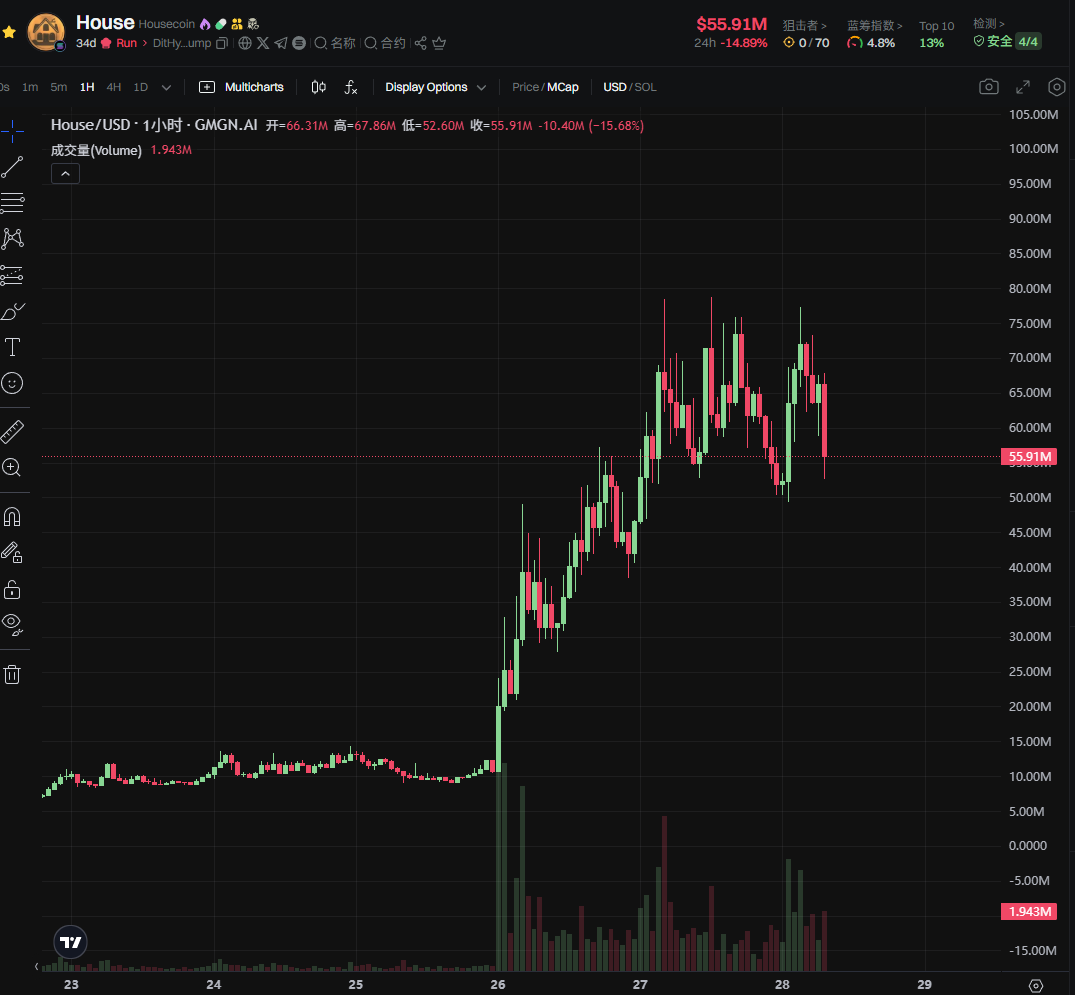
On April 27, 2025, Solana-based meme coin HOUSEcoin reached a record $75 million market capitalization, marking a sharp rise only about a month after its March 25 launch on Pump.fun. The token quickly moved from obscurity to the center of crypto discussion, helped by a slogan on its website, “Flipping the Housing Market, One $HOUSE at a Time,” and by a widely circulated quote attributed to Michael Burry claiming that a housing market collapse would make the coin a hedge.
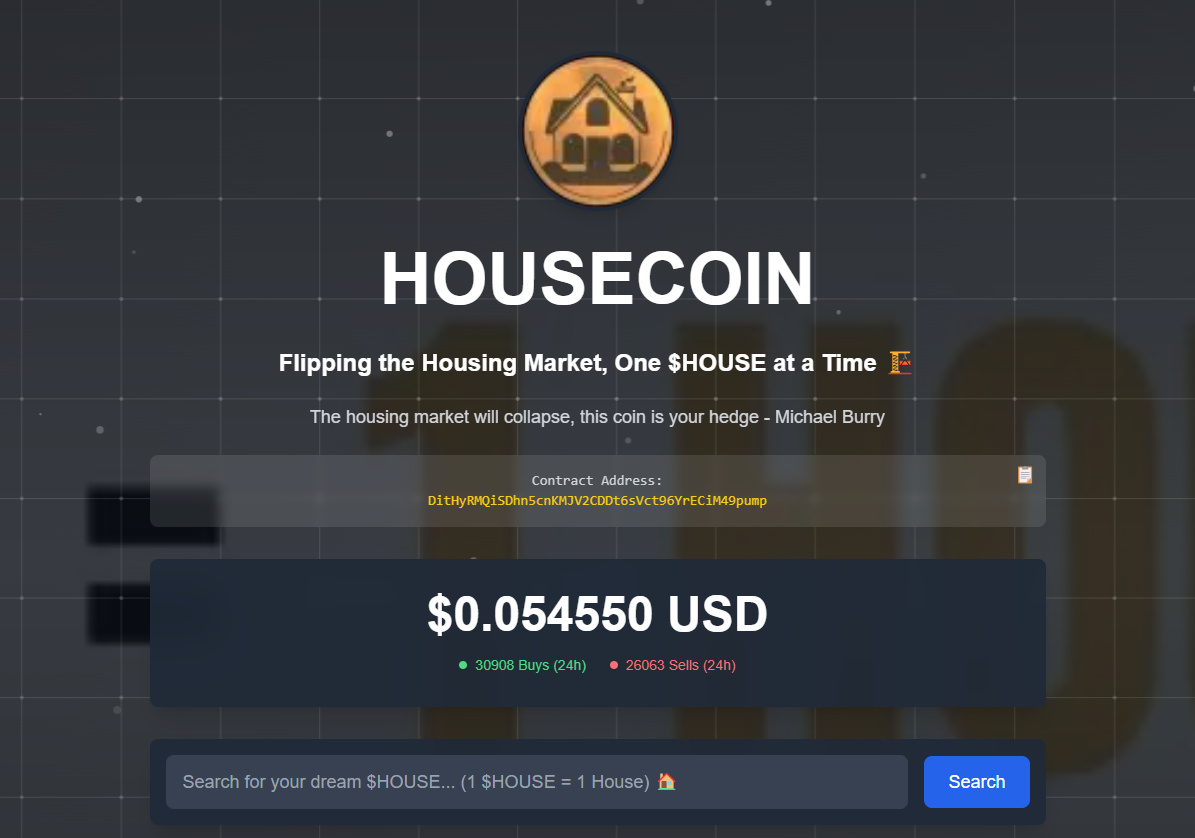
What set HOUSE apart from many meme tokens was not only momentum trading, but the way it translated housing anxiety into crypto-native symbolism. The article frames the project as a response to unaffordable real estate, especially among younger people priced out of ownership, and argues that HOUSE turned that frustration into a decentralized cultural campaign amplified by Solana’s low-cost, high-speed infrastructure.
Token design, supply, and early traction
HOUSEcoin was launched on Solana through Pump.fun and positioned as a satirical attack on the global property market. The reported tokenomics include a total supply of 998.8 million tokens, with 60% allocated to the community, 20% to the liquidity pool, and the remainder reserved for development and marketing. The source also highlights Solana’s throughput of 65,000 transactions per second and an average fee of roughly $0.00025 per transaction as key enablers of rapid distribution and trading.
On-chain and community metrics were used to illustrate the project’s growth. According to the article, HOUSE had already surpassed 18,000 holders and built a Telegram community of more than 35,000 members. Its contract address was listed as DitHyRMQiSDhn5cnKMJV2CDDt6sVct96YrECiM49pump. The branding also played a major role: a pixel-style house logo surrounded by flames, a slogan such as “1 HOUSE = 1 House,” and a broader visual language built around mocking the traditional housing system.
Why the anti-housing message resonated globally
The project’s narrative drew strength from worsening affordability data. Citing 2025 World Bank figures, the article says the price-to-income ratio in major global cities had reached 12:1, while cities including London, Sydney, and San Francisco had exceeded 18:1. In the United States, the average home price reportedly rose to $580,000, and the average age of first-time homebuyers increased to 39, an all-time high. Since 2018, wages for younger people were said to have grown only 6%, far below a 48% increase in housing prices, while student debt and elevated rents further reduced purchasing power.
HOUSE converted those pressures into an emotionally charged market narrative. Although the project described itself as a hedge against a housing crash, the article makes clear that this was more symbolic than financial. On X, posts framing HOUSE as protection against collapsing home values gained traction, helping turn economic despair into speculative participation. In that sense, buying the token became a kind of digital protest as much as a market bet.
The narrative also spread well beyond English-speaking crypto circles. A TikTok video showing a Gen Z renter throwing a mortgage contract into a fire while waving a HOUSE flag reportedly reached 3 million views. Memes on Discord and Reddit compared overpriced homes with a single token, asking which was the real scam. The source adds that Japan’s Telegram community reached 5,000 members, while Spanish artists produced HOUSE-themed street graffiti amid high youth unemployment. Promotional materials were translated into Spanish, Korean, and Chinese, and non-English users reportedly accounted for 40% of the community.
An anonymous team with visible product execution
The project’s founders remained anonymous and primarily communicated through the X account @HousecoinOnSol and Telegram. The article says on-chain analysis linked the developer wallet to other Solana meme coin projects, implying prior experience inside the ecosystem. Although the identities behind the token were not disclosed, the team’s output was presented as one of the main reasons the project moved beyond a simple meme launch.
On April 10, the team released a progressive web app called “Burn the Mortgage.” The app allowed users holding $HOUSE to “buy” and “burn” overpriced virtual homes, extending the project’s satire into an interactive format. The article says the app attracted 10,000 users within 48 hours and helped push market capitalization from $10 million to $25 million. Then on April 20, the team announced a 10,000-unit HOUSE NFT collection that would grant holders governance participation and airdrop rewards. Following that announcement, reported trading volume jumped 200% and market cap moved above $50 million.
The project’s messaging remained consistent with its anti-establishment branding. Statements such as “We don’t build houses, we build revolution” reinforced the idea that HOUSE was less a conventional asset and more a meme-driven insurgent symbol. Community rumors about team members working across three continents from coffee shops and co-working spaces added to that decentralized mythology, even if those stories were not independently confirmed.
Community activation and Solana ecosystem support
HOUSE’s growth was also tied to structured community campaigns. On April 15, the community launched a “Burn the House” airdrop that distributed $150,000 worth of HOUSE to 7,000 wallets. A promotional video featuring a virtual mansion exploding reportedly drew 500,000 views within 24 hours and helped lift trading volume to $30 million. On Reddit, a meme contest attracted 2,000 participants, with the winning entry receiving $5,000 worth of HOUSE tokens.
At the ecosystem level, the timing was favorable. The article notes that meme coins launched on Pump.fun reached a combined market capitalization of more than $2 billion in the first quarter of 2025. Decentralized exchanges including Raydium and Jupiter provided liquidity, while the HOUSE/SOL pair accounted for 70% of total trading volume. That combination of low-friction issuance, immediate exchange access, and strong community virality gave HOUSE a path from niche experiment to global crypto talking point.
Symbolic protest first, financial hedge second
A central point in the article is that HOUSE should not be mistaken for a true financial hedge against falling real estate prices. Unlike instruments such as credit default swaps, the token has no direct mechanism that profits from a decline in housing markets. Its valuation remains dependent on community belief, trading momentum, and the durability of its narrative. In practical terms, that makes it far closer to an emotional asset than a real estate-linked protection vehicle.
Still, the project was described as trying to evolve beyond pure meme status. The community reportedly planned to launch a HOUSE DAO in May, giving token holders a way to vote on future initiatives, including support for low-income housing programs or anti-eviction efforts. If implemented, that would shift HOUSE from narrative speculation toward a more structured on-chain governance experiment tied to social issues.
At the same time, the risks are obvious. The anti-property framing may energize supporters, but it can also alienate others who see it as emotional hype. The Michael Burry quote remains unverified, raising the risk that investors overestimate the token’s economic meaning. And because housing markets are heavily shaped by interest rates, public policy, and government support, any stabilization in prices or progress on housing reform could weaken the emotional conditions that helped HOUSE spread in the first place.
Even so, the article argues that HOUSE has already exceeded the usual boundaries of a Solana meme coin. A UK housing NGO reportedly referenced it in an April 2025 report as a form of digital protest against systemic inequality. Across markets from Tokyo to Toronto, the token, its memes, NFTs, and social campaigns gave expression to a generation increasingly shut out of ownership. Whether that energy will fade as another meme cycle or persist as a wider cultural movement remains unresolved.