
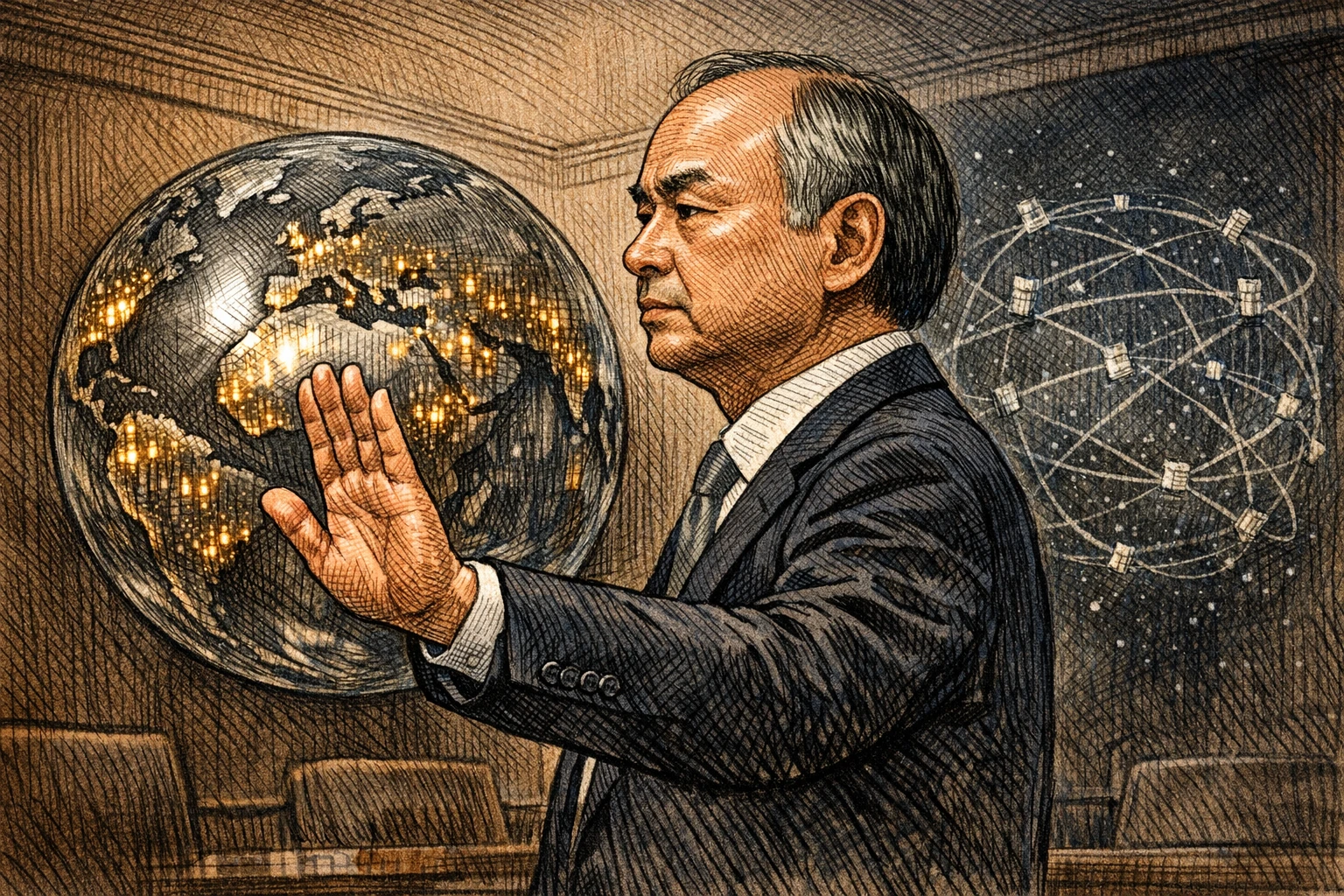
SoftBank founder Son Masayoshi publicly shot down Elon Musk's proposal to build data centers in space during a shareholder meeting of SoftBank Japan's telecom unit on Tuesday. His starting point: cost structure.
The most touted advantage of space data centers is saving electricity bills — no need for terrestrial grids, theoretically unlimited solar power. But Son pointed out that electricity accounts for only a small fraction of total operating costs. The real money goes to hardware like AI chips. Savings on power are nowhere near enough to offset rocket launch expenses, on-orbit maintenance, and the inevitable signal latency between Earth and space. He called Musk a "remarkable change driver" but made it clear this path isn't worth taking — at least not now.
Why 'Now' Matters
Son didn't dismiss space outright; he stressed timing. "In the AI race, the next few years are far more important than what might happen a decade later," he said. Even if space data centers become technically feasible, the timeline is 10-plus years. The battle for AI compute power is being decided here and now. SoftBank's mantra: first-mover wins.
Meanwhile, SoftBank's earthbound bet is massive. The company has committed roughly $65 billion to OpenAI's Stargate project. In May 2026, it announced plans to invest up to €75 billion in France, with an initial €45 billion to build 3.1 GW of data center capacity — sites include Dunkirk, Boskayle, and Bouchain — targeted for completion by 2031. In Ohio, a $500 billion super AI data center park aims for 10 GW. All resources are pinned to Earth; there's no room for a space detour.
Counterforce on Earth
On the same day Son sided with Earth, 40 city mayors — including those of London and Phoenix — formed a coalition to curb data center expansion's strain on power grids, water systems, and communities.
Melbourne Mayor Sally Capp gave stark data: Melbourne has about 50 large data centers operating, which are expected to consume 10% of local electricity demand by 2030 and 20% by 2040. Her analogy was blunt: "Data centers are the biggest shock to the electricity grid since air conditioning became widespread in the 1950s. Air conditioning took decades to become common; data centers happened in just a few years."
Whether compute sits on Earth or in space, it demands energy, cooling, and infrastructure — resources that aren't infinite on this planet. Space advocates might say that's exactly the reason to leave. Son's answer is clear: that's the next race, not this one. Win now, talk about the future later.