
50 minutes and 26 seconds. That time beat Ugandan runner Jacob Kiplimo's human half-marathon world record of 57:20 set in Lisbon by nearly seven minutes. But the record-breaker was not human — it was a humanoid robot.
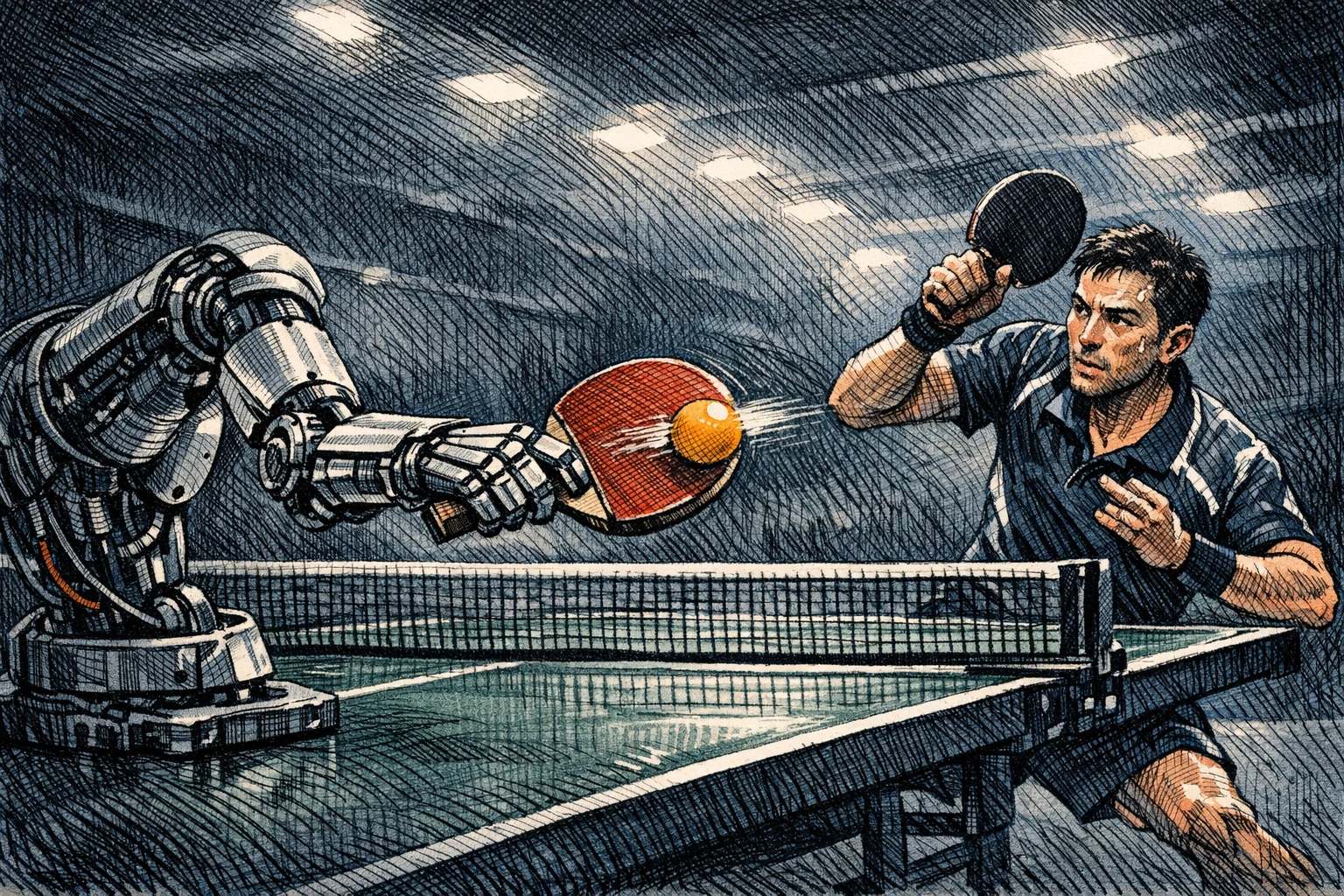
The same week, Sony AI's table tennis robot Ace defeated a professional player in an official match officiated by a licensed referee under International Table Tennis Federation rules. The research was published in Nature.
Two events in the same window highlight how Physical AI — artificial intelligence powering physical machines in real-world environments — is moving from labs into real competitive arenas.
How Ace beat a human
Sony AI's team led by Peter Dürr tackled an extreme engineering problem: table tennis ball speed, spin variation, and flight trajectory demand perception and action coordination within milliseconds. Ace's hardware uses nine synchronized cameras and three vision systems to track ball motion and spin, plus eight joints controlling the paddle — three for positioning, two for angle, three for hitting force and speed. Dürr described the visual processing speed as "fast enough to capture motion that human eyes see only as a blur."
The training method was the key differentiator. Ace learned entirely in a simulated environment without observing human movements. This allowed it to develop hitting strategies distinct from human players, making it hard for opponents to anticipate shots. In April 2025 tests, Ace went 5-3 against elite players; from December 2025 to early 2026, it began recording wins over professionals.
Defeated player Mayuka Hirata described an unprecedented difficulty: "Because you can't read its reactions, you have no idea what shots it dislikes or is weak at." Without emotional cues or body language, opponents lose the psychological information they rely on in competitive sports. Dürr said Ace was originally designed to study how robots can react quickly and accurately in dynamic environments, with the same perception and control technologies applicable to manufacturing and service robotics.
Why Lightning ran under 51 minutes
On April 19, 2026, the Beijing Yizhuang Humanoid Half Marathon was held in Daxing District over a 21km course from Tongminghu Park to Nanhaizi Park. Over 12,000 human runners and more than 100 robots started simultaneously on separated tracks. Honor's "Lightning" finished in 50:26 at an average speed of about 25 km/h. For reference, the human world record is 57:20, a gap of 6 minutes and 54 seconds.
Last year's fastest robot took 2 hours 40 minutes 42 seconds. The record improved by 110 minutes in one year. The race prioritized autonomous navigation; another Honor robot finished in 48 minutes under remote control but was not ranked. Honor engineers said structural reliability and liquid cooling systems validated during Lightning's development are now ready for industrial deployment.
Where Physical AI's frontier is moving
Both breakthroughs share a common underlying architecture: integration of perception speed, physical control precision, and autonomous decision-making. Sony's nine-camera sensing system mirrors Lightning's autonomous navigation; Ace's simulation-based self-training mirrors Lightning's 110-minute improvement curve — capabilities are converging. The next battlefield for Physical AI is not competition but manufacturing, logistics, and services — environments requiring fast perception and precise execution in unstructured conditions. Ace and Lightning provide the first quantifiable external validation that this capability stack is mature enough to compete.