
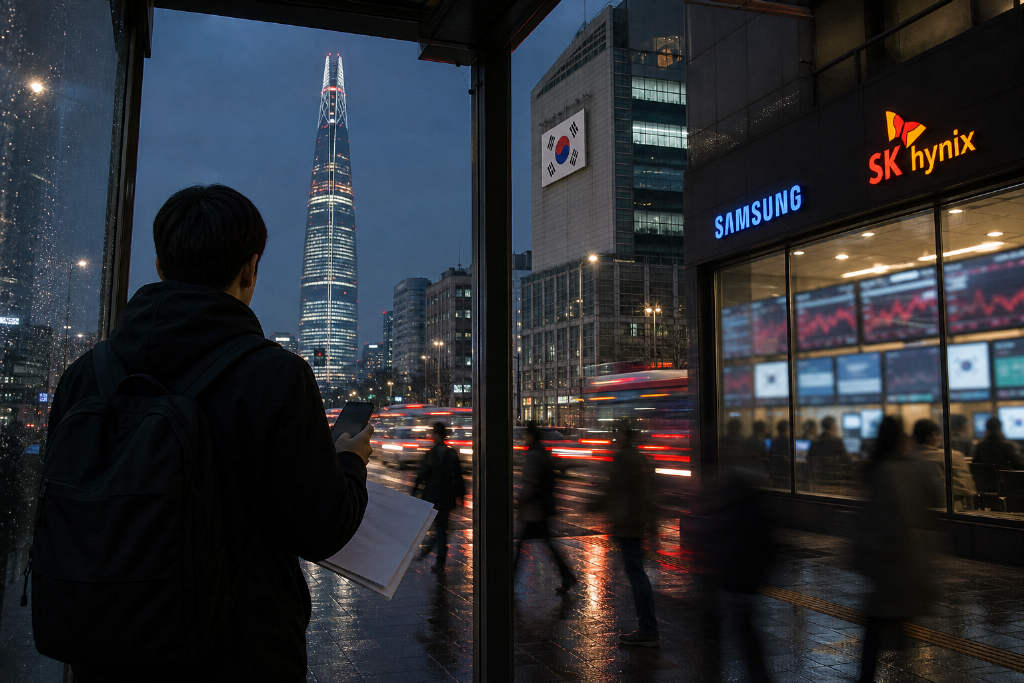
South Korea’s stock market rode a dramatic semiconductor-driven rally over the summer, with SK Hynix surging, Samsung Electronics following, and the Korea Composite Stock Price Index, or KOSPI, repeatedly setting fresh highs. That upswing was later interrupted by a stretch of sharp selloffs, circuit breakers, and violent rebounds.
Against that backdrop, Chinese WeChat account Zhiwei, in a report republished by MarsBit, spoke with two people in South Korea: Park, a section chief in Samsung Electronics’ DS division, which covers semiconductor operations, and Kim, an executive at a Korean medical aesthetics institution. Their comments point to a clear gap between online narratives of a nationwide investing boom and the more restrained mood they say exists in daily life.
Online stories of a “golden age” did not match what people actually showed
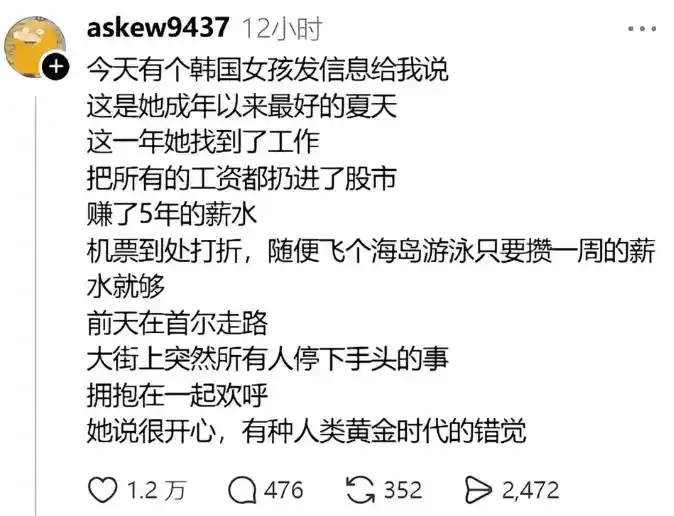
Kim said he found some of the viral descriptions of South Korea’s stock market boom exaggerated, especially depictions of public celebration in Seoul.
“People in the streets of Seoul suddenly stop, hug each other, and cheer in celebration. Honestly, I laughed when I saw that. That kind of description is almost impossible in Korean society. I think it is far too theatrical and does not fit Korean character or social culture. Koreans are not really a society where people openly share with everyone how much money they made,” Kim said.
Even though his own stock investments were at one point up 2x, he said the real shift was mostly emotional. Investors who held stocks did seem more optimistic and upbeat, but they usually did not put that on display. Most of the time, investment came up only in occasional conversations among friends. He added that many people in South Korea’s younger MZ generation do not actively discuss their private lives with superiors at work, let alone publicly talk about investment gains.
Kim said social media and news coverage played a major part in creating the impression that Korean retail investors had become unusually frenzied.
“When people keep seeing stories about someone making a lot of money and stocks continuing to rise, and then occasionally hear that someone around them also made money investing, many naturally start to think, ‘Should I start investing too?’ So the enthusiasm for stocks in Korea in recent years is real. But I think it shows up more in rising account openings and continued inflows into the stock market, rather than in the kind of collective carnival atmosphere portrayed in those viral stories,” he said.
He added that when the market falls, the social mood does soften, but even then the change remains restrained. Most Koreans, in his view, do not show anxiety, losses, or pressure too openly.
Chip upcycle did not translate into broad pay raises for ordinary staff
Another strand of online discussion focused on labor and compensation, including claims that badges from SK Hynix had become highly prized in matchmaking and headlines around Samsung employee union action for higher pay. Park said those stories did not reflect the position of ordinary employees across the company.
“First, unions do not represent all employees. In Korean corporate culture, benefits often go first to a small number of union members, so not all employees necessarily support labor-management negotiations. That is because sharing most of a company’s profits with employees does not necessarily guarantee the company’s development,” Park told Zhiwei.
The report noted that in South Korean public debate, unions are not always viewed as broad representatives of workers. Critics sometimes use the term “aristocratic union” to describe organizations seen more as interest groups than as voices for the wider workforce.
On wages, Park said there had not been an across-the-board rise. “In addition, there has not yet been an overall salary increase. And the wage competition between SK and Samsung actually targets only core employees, such as researchers or management. It generally does not extend to ordinary staff. I do not know much about Hynix, but Samsung has not yet conducted annual salary negotiations this year, and we have not received bonuses either, so there is not much of a real feeling of change,” he said.
He also pushed back on the idea that the 2024-2026 semiconductor cycle, often described externally as an “AI-driven structural recovery,” felt transformative inside the industry. In his view, South Korea’s chip sector had long maintained a growth trend, so another growth phase was not necessarily seen by insiders as a major rupture. Better company performance, he said, mainly meant more hiring rather than redistributing the wages of two people to one. Aside from gradual improvements in benefits and pay, there was little else that materially changed for most workers.
Property long dominated household wealth building, but that pattern began to shift
Kim said the traditional path for many ordinary salaried workers in South Korea had long looked similar: save from wages step by step, buy a home with bank loans, then let rising property values build household assets and support retirement preparation.
That pattern was sustained by a long period of strength in the real estate market and relatively accessible housing credit. For a long time, real estate was therefore seen as the most important investment channel for Koreans, while equities were less favored.
In recent years, he said, that started to change. The South Korean government tightened regulation of the property market, increased the tax burden on owners of multiple homes, and narrowed room for property transactions. At the same time, it introduced policies aimed at supporting capital market development, hoping to keep more money inside the domestic stock market and even encourage some capital invested in overseas equities to flow back into Korea.
Under those conditions, Kim said the Korean stock market entered a highly active phase around 2025. More people began to see stock investing as one of the few realistic opportunities for ordinary individuals to change their financial standing, or even their social class. The constant appearance of online “wealth myths” made that belief stronger.
Loans and leverage magnified the pain after the rally turned
Kim said many investors pursued higher returns through margin loans or leveraged products tied to hot names such as Samsung Electronics and SK Hynix.

“What surprised me a little was that the kinds of cases you see in the news were actually happening around me. One friend did exactly that. He kept feeling that wage growth could not keep up with rising prices and always wanted to catch one chance to get rich quickly. So he borrowed money to invest in leveraged products, hoping to rapidly magnify returns. But after this round of market adjustment, he lost almost most of his funds,” he said.
He added that several people around him had started to cut spending in visible ways. During the bull market, some often treated friends to meals, bought more expensive goods, or even switched to new cars. Now, he said, some have sold their cars, and others have started bringing boxed lunches to work every day in an effort to reduce living costs.
Kim said fear of missing out was a major driver. “I think he was not originally someone who truly loved investing. It was more that after seeing the Korean stock market rise so quickly, he developed the anxious feeling that if he did not get on board now, he would be the only one who became poorer later. Under that emotional pressure, he kept increasing his investment and eventually took on risks far beyond what he could bear,” he said.
A few days after Kim spoke with Zhiwei, the Korean stock market hit another circuit breaker. More repeated circuit breakers followed, and protesting investors placed funeral wreaths outside the National Assembly, according to the report.
Kim said reactions around him became more intense starting in late July. He said his uncle even called him specifically to ask what to do, because stocks that had previously shown strong gains had turned into losses. Some people, he said, were so stressed that they lost their appetite, especially those who had invested with borrowed money or leverage.
“Lately, the things I hear most often from these people are, ‘Sure enough, you can’t make money trading stocks,’ and, ‘Why does it fall every time I buy?’” Kim said.
KOSPI above 3000 was once seen as almost miraculous
Despite seeing a major drawdown in his own gains, Kim said he viewed the turbulence as part of what a mature stock market goes through.
“For a long time, the idea that the KOSPI could break above 3000 was, in the eyes of many Korean investors, almost a miracle,” he said.
He said many Koreans had long believed local companies were not getting valuations that matched their underlying strength. Leading U.S. semiconductor firms could command price-to-earnings multiples in the hundreds, sending market capitalizations to fresh highs. At the same time, some Korean chip companies, despite posting revenue that in some cases exceeded that of certain U.S. peers, had long traded at roughly 10x earnings.
Kim added that the Korean market had also faced another persistent issue: a large number of small- and mid-cap stocks and frequent speculative trading around certain names, including what he called “manipulated stocks.” That led many people to conclude that Korean equities lacked real investment value and that even high-quality companies were not receiving fair valuations.
That view, he said, had existed for years. Only recently, with the property market cooling and capital market policies moving ahead, had more money that once sat in real estate started shifting into stocks. Overseas funds also began paying attention to the Korean market, accelerating the pace of gains.
But as more people with almost no investment experience entered the market during a sustained rise, risks accumulated. Some overseas capital and institutional investors that had already made sizeable gains gradually took profits and exited, and the market moved into an adjustment phase. Many ordinary retail investors, limited in financial strength and exposed through loans and leverage, could not withstand prolonged declines. Some cut losses and left, while others were forced out through liquidation.
One interviewee remains optimistic and is still buying in batches
Even after the adjustment, Kim said he remains optimistic about the future of the Korean stock market and continues to add positions gradually.
“All of those factors together are important reasons behind the recent sharp adjustment. But even so, I remain optimistic about the future of the Korean stock market. Right now, I am still continuing to buy in batches. Whether it is Samsung Electronics, SK Hynix, or many strong companies in the Korean and U.S. markets, I believe there are still many businesses with long-term investment value. I also hope more friends in China can better understand Korea,” he said.
The original report argued that, taken as a whole, the changes brought by South Korea’s latest semiconductor wave were not fundamentally different from what has been seen in China. The bigger gap lay in cultural distance and the tendency to project an idealized filter onto life elsewhere.
The article was originally published by the WeChat account Zhiwei, written by He Bi and edited by Da Bing, and later carried by MarsBit.