
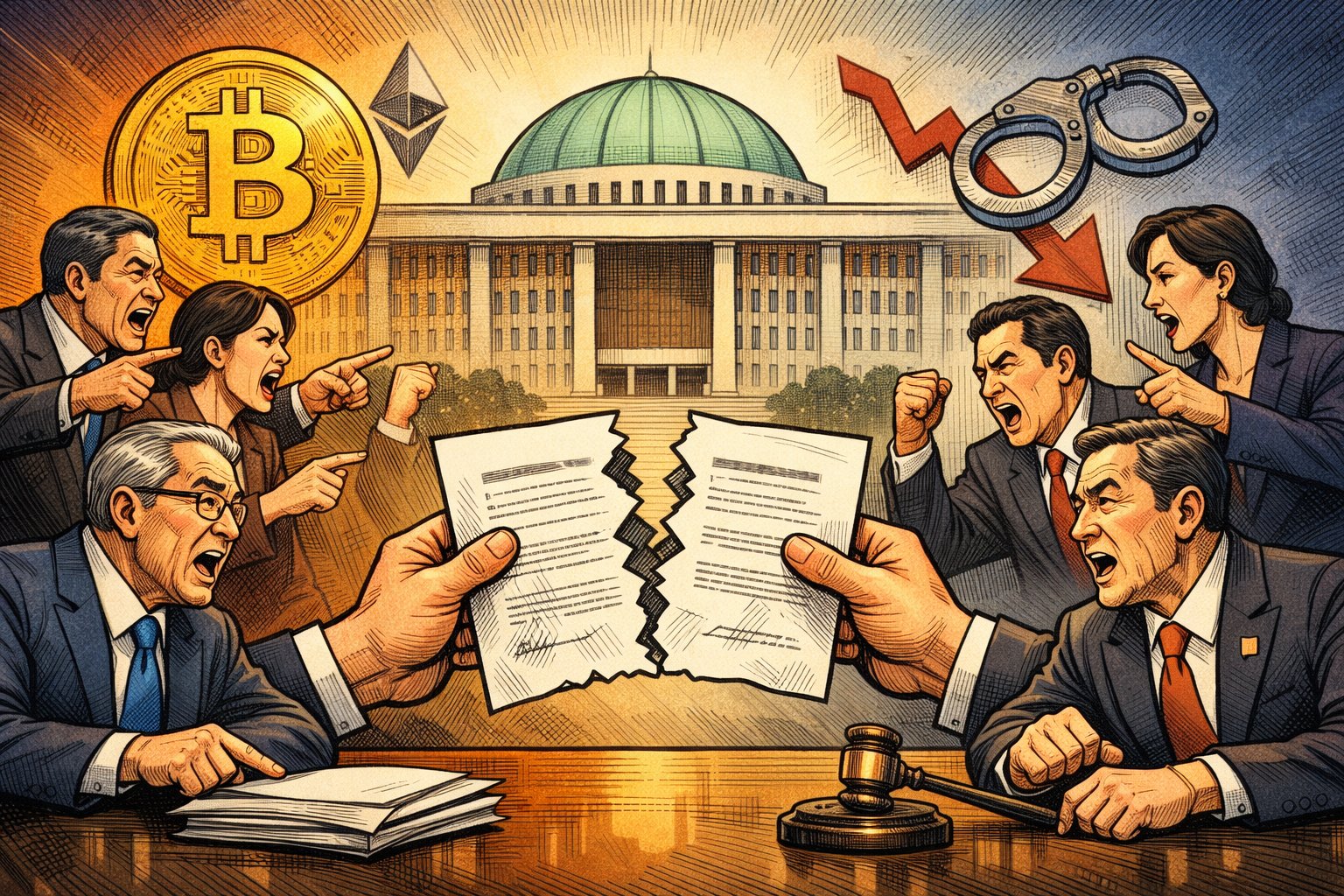
The Financial Services Commission (FSC) formally proposed imposing a 15-20% ownership cap on major shareholders of crypto exchanges, including the provision in the second phase of the Digital Asset Basic Act. FSC Chairman Lee Eog-weon argued that once exchanges obtain licenses under the new regime, they assume quasi-public infrastructure functions and must meet governance standards similar to Alternative Trading Systems (ATS) under the Capital Markets Act, to prevent conflicts of interest and insider trading.
Five major exchanges face forced sell-offs
Under a 20% cap, Coinone founder Cha Myung-hoon, holding about 53%, would need to offload up to 38%; Upbit parent Dunamu's Song Chi-hyung, with roughly 28%, faces an 8-13% excess. Bithumb, Korbit, and Gopax are also affected. South Korea now counts over 11 million crypto users; Upbit alone handles 411 trillion won ($286 billion) per quarter, while Bithumb's volume tripled year-on-year to 128 trillion won.
Lee's campaign promises clash with policy reality
President Lee Jae-myung won June 2025 with 49.42% of the vote on a pro-crypto platform including Bitcoin spot ETFs, a won stablecoin, and public pension fund crypto investments. But his Democratic Party endorsed the ownership cap in Phase 2, citing market fairness and decentralization of power. Opposition People Power Party slammed the move as excessive state intervention, noting that the UK and Singapore rely on behavioral regulation, not ownership limits.
Industry and academia push back
FourPillars research lead @100y_eth questioned Lee's crypto-friendly credentials, calling the ATS analogy flawed and the policy a vote-buying ploy. The Digital Asset Exchange Alliance (DAXA), representing the top five exchanges, warned that forced ownership restructuring would undermine an industry where major shareholders are the ultimate custodians of user assets. KOSPO and KOVA cautioned that retroactive equity restructuring would hurt entrepreneurship. Seoul National University professor Cho Jae-woo argued for transparency over caps, and flagged potential constitutional challenges on property rights.
Naver deal at risk, stablecoin turf war unsettled
The cap threatens Naver Financial's planned 20 trillion won ($14 billion) full acquisition of Dunamu, as it would prevent 100% ownership. Mirae Asset's 100 billion won bid for Korbit also faces collapse. Lawyers expect a 5-10 year transition period if the bill passes, but uncertainty is already chilling deals. Meanwhile, the stablecoin regulatory turf war persists: the Bank of Korea insists bank-led consortia must hold over 51% to issue won stablecoins, while the FSC opposes fixed thresholds to avoid stifling tech firms, pushing the legislation from 2025 into 2026.