
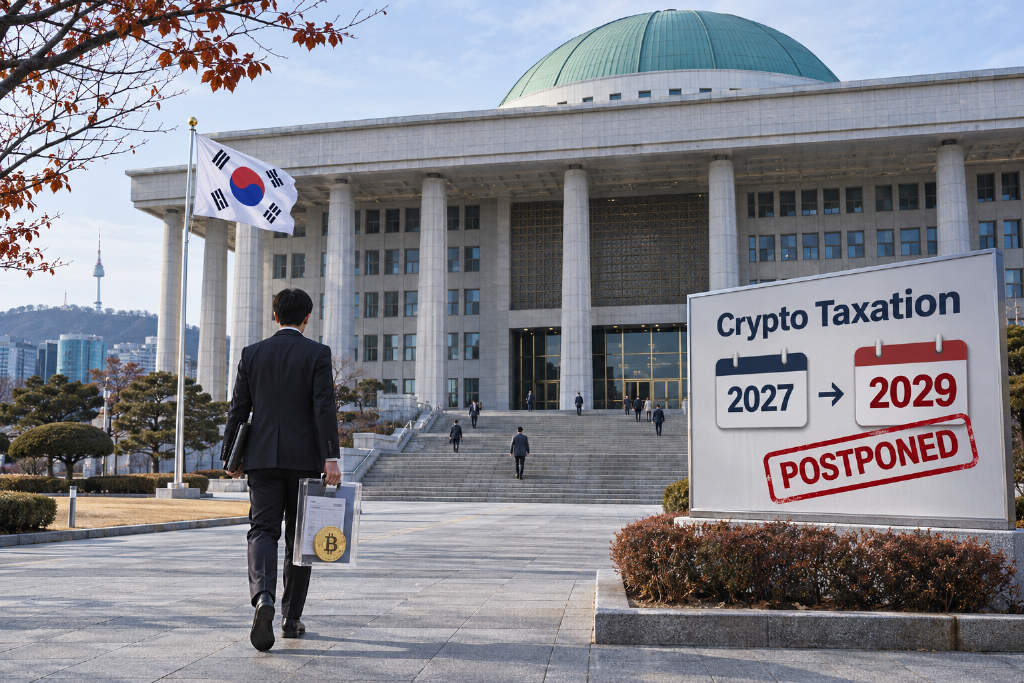
South Korea’s ruling Democratic Party has formally asked the government to delay the country’s crypto income tax again, raising the possibility that the measure could be pushed back from Jan. 1, 2027 to 2029.
The party made the request on Nov. 4, arguing that South Korea should first complete the Digital Asset Basic Act and resolve issues tied to overseas transaction data, tax fairness between domestic and foreign investors, and exchange reporting systems.
If lawmakers eventually amend the Income Tax Act, the move would mark the fourth delay since South Korea first established its crypto tax framework in 2020.
Ruling party puts forward formal delay request
According to Yonhap News Agency, Democratic Party leader Kim Min-seok said at a Supreme Council meeting in the National Assembly on Nov. 4 that the party had officially proposed postponing the crypto asset income tax.
Kim said that after consultations between the party and the government, discussions at the National Assembly’s finance and economy committee, and talks with crypto industry participants, the ruling party concluded that South Korea should first pass the Digital Asset Basic Act, build a fuller regulatory framework, and give companies and investors time to adjust to the new system.
Lawmakers from the Democratic Party had already reached a preliminary consensus on Nov. 3 in favor of a delay. The main option under discussion was a roughly two-year postponement, which would move the planned start of taxation from 2027 to January 2029.
Kim did not formally specify the exact length of the delay in his Nov. 4 remarks, and neither the government nor the National Assembly has made a final decision. At this stage, the plan remains a policy proposal rather than an enacted postponement.
Current rules tax gains above 2.5 million won at a combined 22%
South Korea passed rules on crypto income taxation in 2020. The tax was originally scheduled to take effect in 2022, but was later delayed to 2023, then 2025, and finally 2027 because of gaps in regulatory preparation and tax administration.
Under the current framework, annual income generated from selling or lending crypto assets is taxed after deducting acquisition costs, necessary expenses, and a basic exemption of 2.5 million won. The remaining amount is subject to 20% income tax and 2% local income tax, for a combined 22% rate.
That does not mean all crypto trading volume is taxed at 22%, and it does not mean investors with annual gains below 2.5 million won must pay the tax.
If the ruling party’s latest request wins government support and the National Assembly passes an amendment to the Income Tax Act, South Korea’s crypto income tax would be delayed for a fourth time.
Overseas exchange data and tax fairness are central issues
One of the main points in the latest debate is tax fairness between domestic and overseas exchanges.
Under the Organisation for Economic Co-operation and Development’s Crypto-Asset Reporting Framework, or CARF, South Korea is expected to begin cross-border crypto tax information exchange in 2027. The first exchange timeline for the United States, however, is scheduled for 2029.
Some South Korean lawmakers are concerned that if taxation begins under the current timetable, tax authorities may be able to track gains from users of local platforms such as Upbit and Bithumb more easily, while still struggling to obtain complete records from some overseas exchanges. In their view, that could create unequal enforcement and tax treatment among investors.
For that reason, the ruling party wants to use the delay period to improve access to international transaction data, tax reporting systems, and exchange information verification procedures.
The report also noted that CARF is not starting in 2029 for every country. South Korea and some other jurisdictions are expected to begin exchanging data in 2027. The issue is that implementation timelines differ across jurisdictions.
Digital Asset Basic Act seen as a key condition
Beyond cross-border information exchange, the ruling party also wants to align the launch of crypto income taxation with progress on the Digital Asset Basic Act.
The bill is expected to add rules for crypto asset trading platforms, stablecoin issuance, and the operation of the digital asset industry, supplementing the investor protection framework already in place.
Lawmakers and industry participants who support a delay argue that starting taxation before exchange reporting systems, cost-basis standards, and related regulatory rules are fully in place could increase filing burdens for investors and make enforcement harder.
Opponents of another delay argue that South Korea has already postponed the tax three times, and that another deferral would weaken tax policy stability and could raise fairness questions across different types of asset income. They also point out that any delay would require the National Assembly to complete amendments in time; otherwise, the current statutory start date remains Jan. 1, 2027.
South Korea’s government and ruling party are expected to continue discussions on the length of the delay and the details of amendments to the Income Tax Act. A two-year delay to 2029 is now the main option under discussion, but until the government confirms the plan and the National Assembly passes the necessary revisions, 2029 should be treated as a proposal rather than a fixed launch date.



