
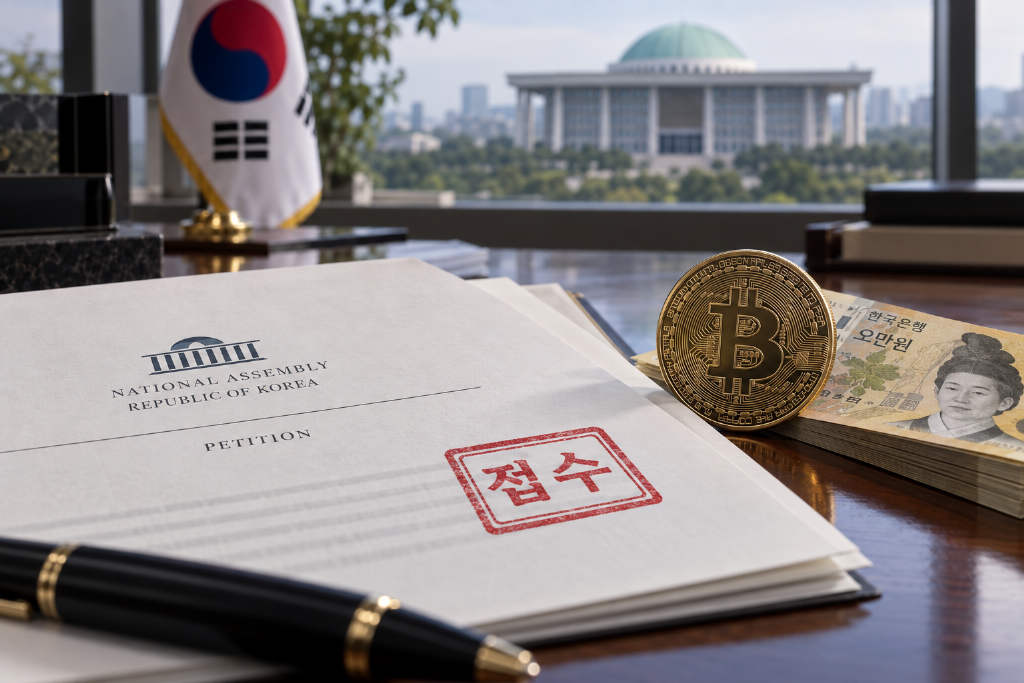
South Korean crypto investors have pushed a fourth petition to delay the country’s crypto income tax past the 50,000-signature threshold, sending it to a relevant standing committee in the National Assembly for formal review under the electronic petition system. On this issue, it is the first time a petition has advanced to that stage.
Petition seeks another two-year delay
South Korea is currently set to begin taxing crypto income on Jan. 1, 2027. The effective tax rate is 22%, combining a 20% base tax with a 2% local tax. The levy would apply to the portion of annual digital-asset gains above 2.5 million won, or about $1,856, and would cover income from selling, transferring, and lending crypto assets.
The plan has already been postponed three times since it was first discussed in 2022. Local investors and industry participants have continued to press for another delay, saying tax infrastructure is still insufficient and the crypto market structure is not mature enough.
The latest petition asks for the tax to be postponed by two more years. Petitioners said most crypto investors are currently carrying heavy losses, major South Korean crypto companies have suffered operating profit declines of as much as 90%, and the broader industry remains loss-making.
One anonymous petitioner said in the statement: 「Taxing now is like taking away the wealth ladder that young people use to move up.」 The petitioner added: 「Implementing the crypto tax immediately is unfair to young people.」
Petitioners also argued that taxation could push investors toward offshore platforms and that, given the market’s volatility, the actual tax revenue collected may be limited.
A May petition also hit the mark but stalled afterward
In May this year, a separate petition calling for the crypto tax to be abolished reached 50,000 signatures in just eight days. It was also forwarded to a committee for review, but no further progress followed.
Whether this latest petition, focused on a two-year delay, can produce a more concrete outcome remains unclear.
Government says the 2027 schedule stands
The government’s position remains firm despite the latest petition drive. Finance Minister nominee Lee Hyoung-Il said over the weekend that the crypto tax plan would move ahead on schedule and that the National Tax Service, or NTS, will release detailed tax standards later this year.
The Block, citing Yonhap, reported that this marked the first formal response from a senior South Korean government official to a petition seeking another delay to the crypto tax. Lee’s remarks sent a direct message to the market: the Jan. 1, 2027 timetable is not being moved.
What the market will watch next
South Korea is often associated with the so-called kimchi premium. Once implemented, the crypto tax would directly affect retail trading behavior and exchange liquidity. From a policy standpoint, the measure is not only about tax revenue; it is also part of South Korea’s effort to bring crypto assets into the formal financial system.
The next points of focus are whether the committee review leads to hearings or amendment procedures, whether the NTS guidance later this year includes changes to the tax-free threshold or loss offsets, how trading volume and user numbers at local exchanges such as Upbit and Bithumb could shift if the tax starts in 2027 as planned, and whether capital moves to offshore platforms as petitioners claim.
The fourth successful petition shows that opposition to the tax inside South Korea’s crypto community has not faded. Even so, after the government has already delayed the measure three times and is now taking a harder line, winning another postponement appears more difficult than in earlier rounds.