

South Korea’s crypto market is trading against the global pattern. In the period cited in the source article, long-tail tokens made up 58% of volume on Upbit and 52% on Bithumb, while Bitcoin accounted for only 9% of trading in the Korean market. On Binance and Coinbase, by comparison, Bitcoin’s share stood at 23% and 47%.
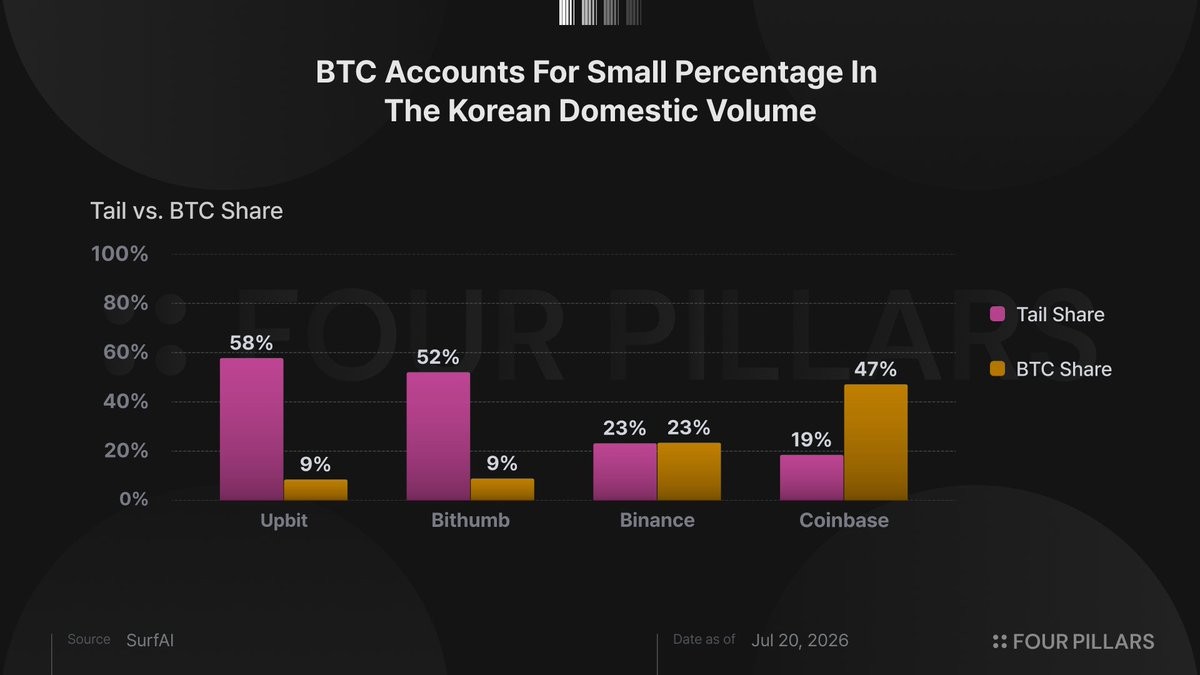
The article, written by Heechang Kang and translated by Luffy for Foresight News, says the KRW spot market is the world’s second largest, averaging about $26 billion in weekly turnover and representing 30% of global spot volume. Despite that scale, most of the money goes to altcoins and newly listed tokens rather than BTC and ETH.
As early as the first quarter of 2024, KRW trading pairs posted $456 billion in quarterly turnover, briefly overtaking the U.S. dollar as the top fiat lane in crypto by trading volume. Yet only 15% of that capital went into Bitcoin and Ether. The remaining 85% flowed into altcoins and fresh listings, creating what the article describes as a unique liquidity premium for newly listed tokens in the KRW market.
A duopoly built on retail participation
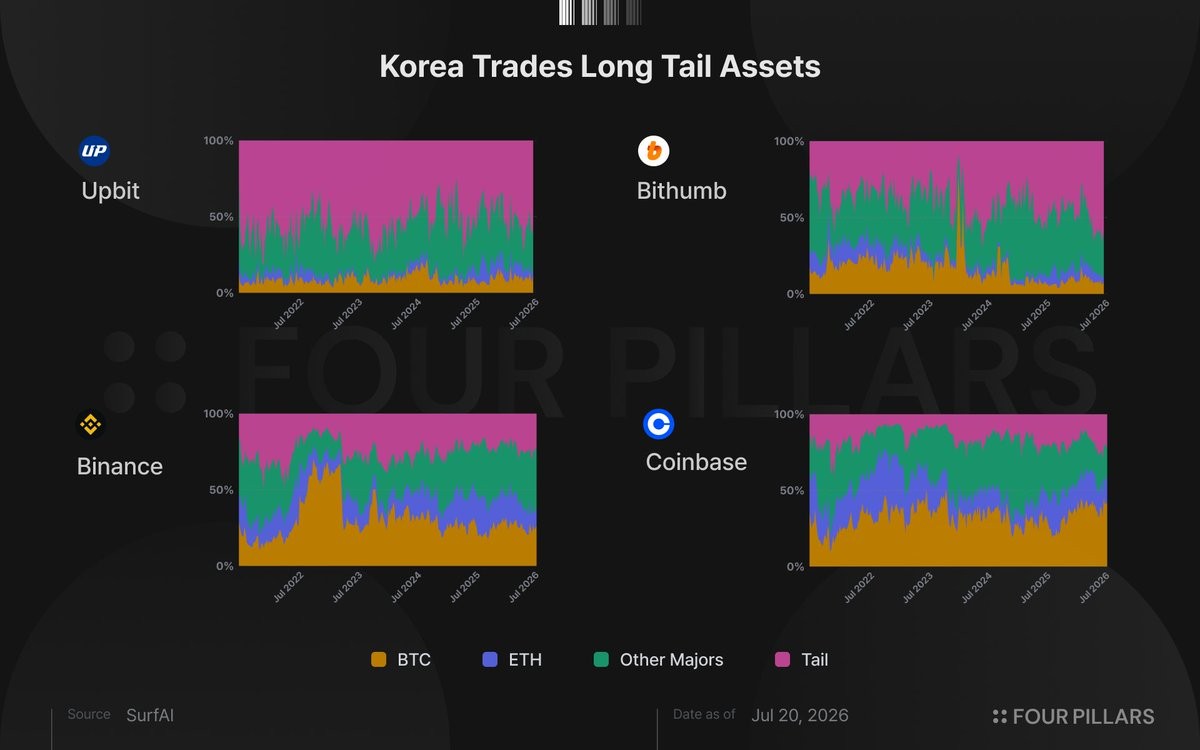
That appetite for long-tail tokens helped build Korea’s two leading domestic exchanges. Upbit rode the trend into the global top five by trading volume and at one point held more than 80% of the local market, before later easing to 72%. Together, Upbit and Bithumb controlled nearly 96% of Korea’s crypto trading volume.
The customer base behind that dominance is large. At the beginning of 2025, registered users at crypto exchanges in South Korea topped 16.2 million, above the 14.5 million people holding stocks in the country. Regulatory data cited in the article showed 9.7 million traders had completed real-name verification by the end of 2024, up 25% in six months, while user crypto holdings doubled to $77.5 billion.
Age and account size matter here. Investors in their 30s made up 29% of the market, and those in their 40s accounted for 27%. Meanwhile, 66% of users held less than KRW 500,000 in crypto assets. The article identifies this large group of active small-balance traders as the core demand base for long-tail token trading.
Why 85% of turnover goes to altcoins
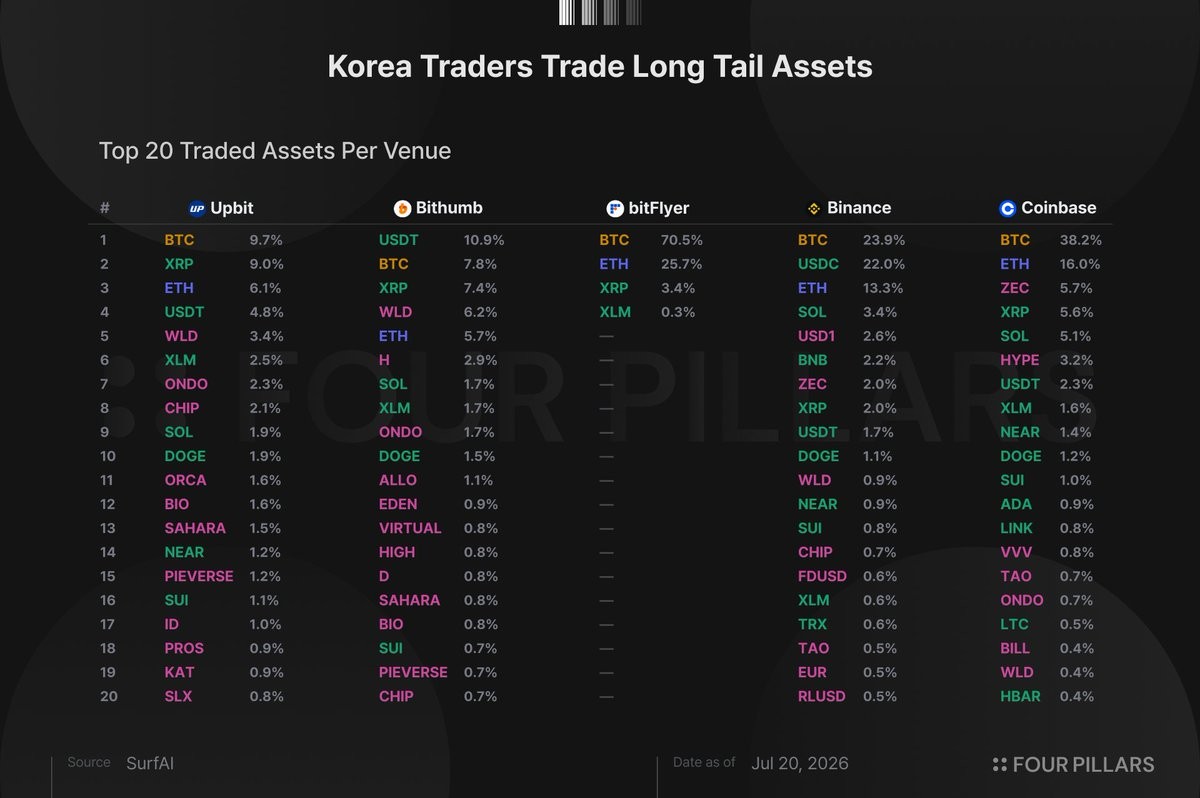
Major global exchanges are centered on BTC and ETH. Korea, the article argues, is effectively the reverse: 85% of local trading volume goes to altcoins, versus 9% for Bitcoin and 6% for Ether. It attributes that pattern to four structural constraints.
- No compliant domestic derivatives. South Korea has no legal onshore crypto futures, options, or leverage products. In other markets, traders can seek amplified returns through derivatives. At home, that demand shifts into more volatile spot altcoins, which in practice become what the article calls a “natural leverage tool” for retail traders.
- Capital controls limit foreign participation. Rules requiring real-name domestic bank accounts and KRW-only deposits and withdrawals keep out overseas market makers and cross-market arbitrage desks. That leaves pricing largely in the hands of local retail traders, with less institutional hedging of sentiment once a trend starts to build.
- A narrower listing pool. Upbit supports only KRW trading and lists about 324 tokens, while Binance and Bitget each list more than 700. With the same local capital spread across fewer assets, every new listing can attract a larger share of attention.
- A retail-driven market culture. The article says institutional participation is limited, digital products spread quickly, and hot narratives can move through the market fast. Funds often crowd into newly popular tokens at the same time. In the United States, by contrast, ETFs and corporate buyers provide a steadier base for BTC and ETH demand.
Listing spikes and a closed-loop liquidity effect
On Upbit and Bithumb, new listings have often been followed by sharp jumps in both price and turnover. The article gives several examples: PRL recorded a 5,500% jump in 24-hour trading volume after listing, SLX doubled in price, HYPER rose more than 100%, AZTEC gained 82%, and SKR saw volume surge 700% while price climbed 62%.
Listings also became a competitive tool between the two exchanges. In September 2025, Bithumb’s market share climbed to 46%. Upbit then answered by listing seven new tokens within 10 days.
The market has also developed what the article calls the “9 a.m. move.” At 9 a.m. Korea Standard Time each day, multiple obscure altcoins can rally at once. Retail traders place bets on which token will become the next local favorite, and the trigger is not necessarily industry news. The move is described instead as a synchronized trading pattern among local investors.
Speculation, the article says, can continue even when fiat rails are disrupted. In November 2025, Upbit suffered a hack and suspended deposits and withdrawals, but traders on the platform still speculated on tokens such as ORCA and RAY. Industry participants referred to the pattern as a “net-style pump,” and the article says the platform generated $340,650 in fee revenue in a single day. Then in February 2026, ZKsync rose nearly 970% during a platform maintenance window, triggering a regulatory probe and reinforcing the article’s argument that Korea’s closed market structure can sustain a self-contained speculation loop.
A key reason these moves can persist, the article says, is that capital controls keep arbitrage capital from stepping in quickly. The clearest sign is the so-called kimchi premium, which averaged 2% to 3% and peaked at 10.88% in March 2024. The effect has not been one-directional, though. By late 2025, the premium had turned negative, and the short-term premium attached to new listings had weakened at the same time.
The listing premium has a shelf life
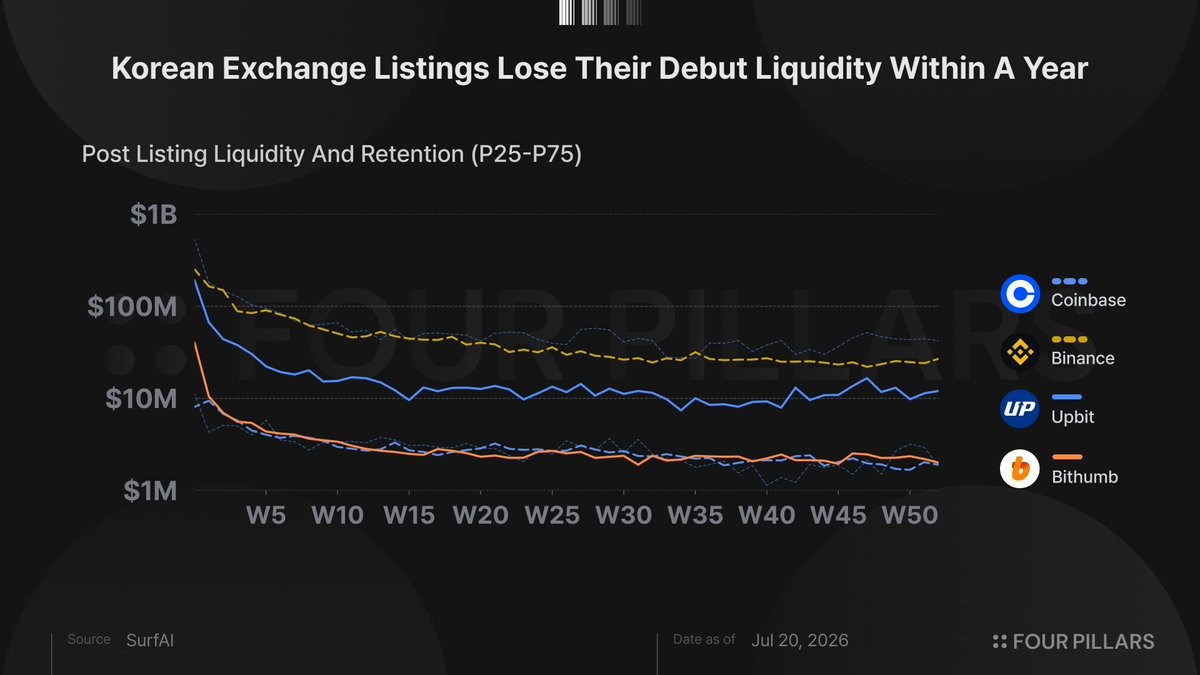
The source also says liquidity for newly listed tokens is concentrated heavily in the early phase after listing. On Upbit, median liquidity for new listings loses most of its strength within 10 to 15 weeks, though it does not fall to zero and instead settles into a more stable floor.
After 51 weeks, the median weekly liquidity of surviving Upbit-listed tokens stands at $11.3 million. That trails Binance at $25.6 million but is roughly five times the level seen on Coinbase at $2.3 million and Bithumb at $2.2 million.
Retention, however, is less impressive. After 51 weeks, only 42.7% of tokens listed on Upbit and 40.5% on Bithumb still maintain trading volume above 10% of their listing peak. The comparable figure is 43.6% on Binance and 63.8% on Coinbase. The article says Coinbase tends to see lower initial listing heat and smoother post-listing trading, making it easier to hold above that 10% threshold. In Korea, new listings often open with extremely high turnover, so even 10% of peak volume can still represent a meaningful absolute amount.
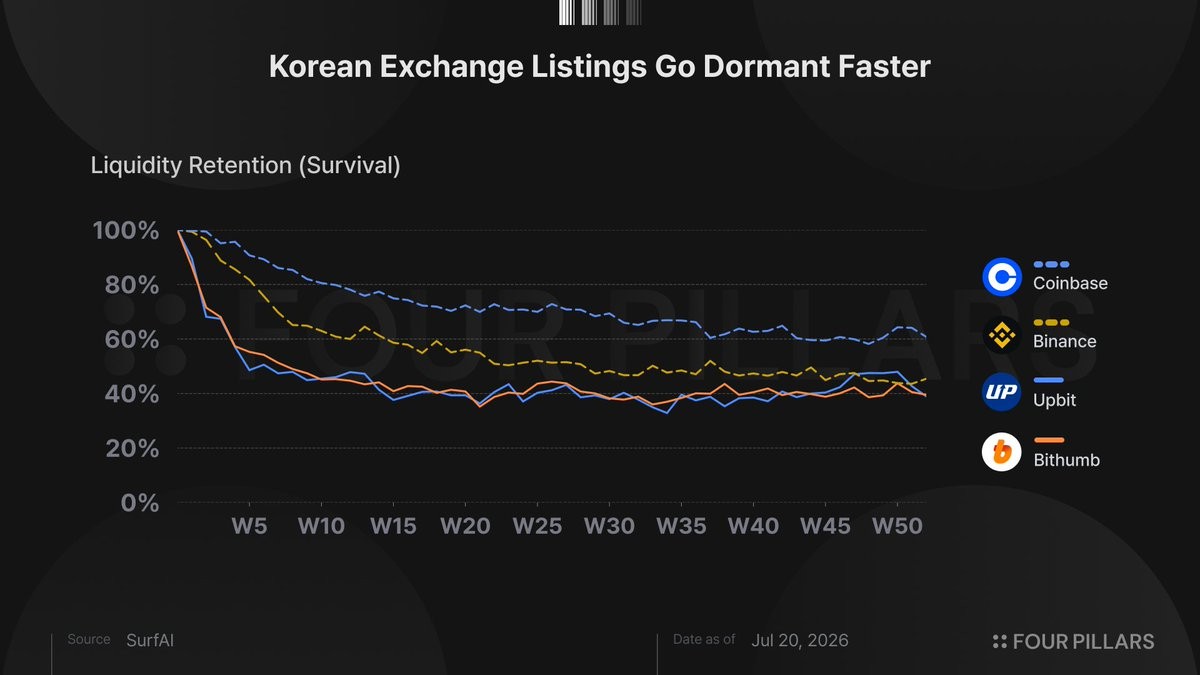
Even so, the broader pattern is clear in the source data: close to 60% of newly listed tokens in Korea lose most of their initial capital within a year.
Not permanent traffic, but a one-year filter
The article’s closing argument is that the Korean market has a strong memory for new listings, but it is selective. The first few months after listing serve as an intense elimination period, and only a small number of tokens go on to build durable, large-scale liquidity.
In that sense, the KRW listing premium is not a permanent source of steady traffic. The article frames it more as a one-year screening process, after which only a limited set of tokens retain stable liquidity in the tens of millions of dollars.