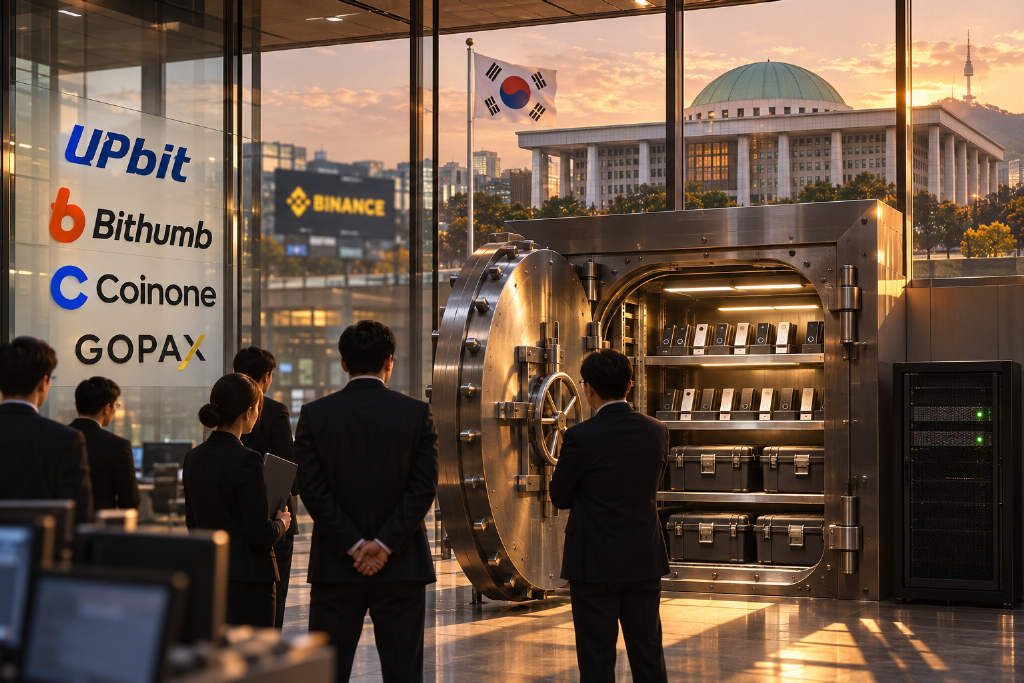
South Korea’s financial authorities are discussing whether to tighten custody rules for crypto exchanges by lifting the required share of user assets held in cold wallets to around 99%, according to a News1 report cited by PANews. The issue was discussed at an emergency security inspection meeting on Nov. 2 involving the Financial Services Commission, major crypto exchanges and custodians, with the Binance theft incident serving as the trigger for the review. Under the current Virtual Asset User Protection Act, exchanges must keep more than 80% of user assets in cold wallets. The proposal under consideration would move that threshold closer to the level already maintained by some larger platforms. Reported cold wallet ratios vary across exchanges, with Upbit above 99%, Bithumb at about 94%, Coinone at 85%, and GOPAX and others just above 80%. Industry participants warned that a higher cold wallet ratio would leave fewer assets in hot wallets for immediate withdrawals, which could slow withdrawals and raise operating pressure on smaller exchanges. In August this year, Bithumb saw withdrawals of some altcoins delayed by about 13 hours because of insufficient hot wallet balances. The proposal is still under discussion and has not been finalized.
South Korea’s Financial Services Commission (FSC) held an emergency security inspection meeting on Nov. 2 with major cryptocurrency exchanges and custodians to discuss raising the share of user assets that exchanges must keep in cold wallets, according to industry sources cited by News1.
The discussion was prompted by the Binance theft incident. One option under review would lift the requirement from the current level of more than 80% under the Virtual Asset User Protection Act to around 99%, a level already maintained by some large exchanges.
Current cold wallet ratios at major exchanges
Upbit is reported to keep more than 99% of user assets in cold wallets. Bithumb is at about 94%, Coinone at 85%, while GOPAX and some other exchanges are only slightly above 80%.
Industry concerns over implementation
Industry participants warned that a higher cold wallet ratio would reduce the amount of assets available in hot wallets for immediate withdrawals. That could lead to withdrawal delays and add to the operating burden on smaller exchanges.
In August this year, Bithumb experienced delays of about 13 hours in withdrawals for some altcoins after hot wallet balances ran short.
The proposal remains under discussion and has not been decided.
This article was originally published by Bit.Fan. For more cryptocurrency news and market insights, visit www.bit.fan. Disclaimer:
The market information, project data, and third-party content displayed on this platform are for industry information sharing only and do not constitute any form of investment advice or return commitment.
Cryptocurrency trading carries high risks. Users should fully assess their risk tolerance and make independent decisions. All profits, losses, and legal responsibilities are borne by the users themselves.