
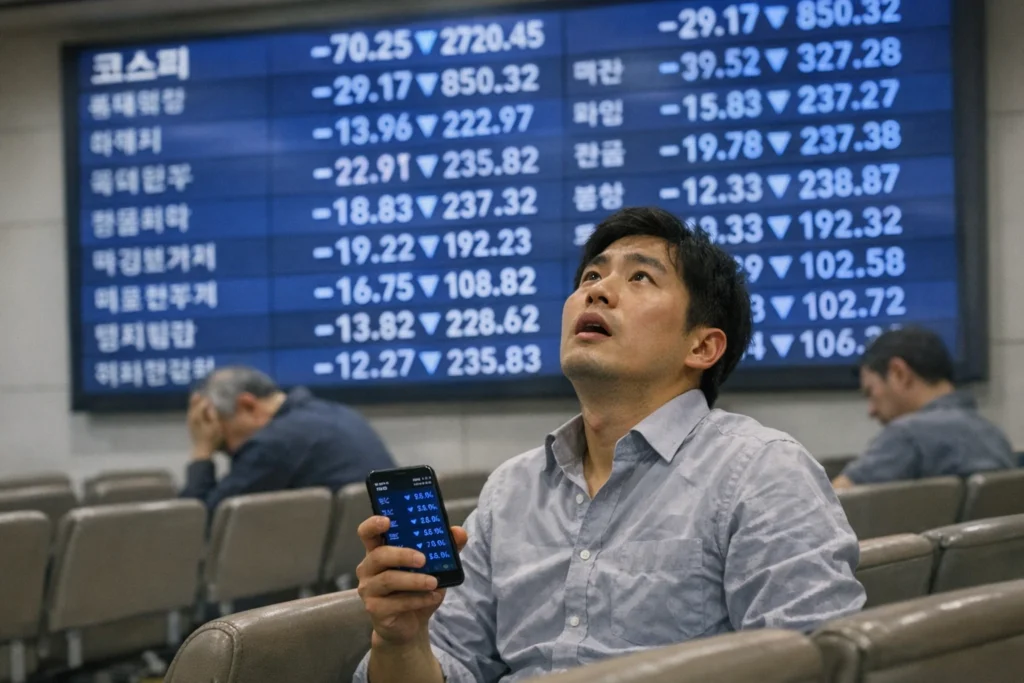
South Korea’s four top financial authorities were set to convene an emergency market review meeting on July 29 after another sharp sell-off pushed the country’s benchmark stock index below 6,000.
The KOSPI closed at 5,663.24 on Wednesday, down 360.42 points, or 5.98%, for the day. The KOSDAQ ended at 662.68, off 6.12%. A day earlier, the KOSDAQ had already fallen 7.72%. Over two trading sessions, the KOSPI slid from 6,755.75 to 5,663.24, a cumulative drop of 16.2%.
During the session, the KOSPI fell as low as 5,637.85. The report said sidecar protections and a 20-minute circuit breaker were both triggered within the two-day sell-off.
F4 meeting set for 6 p.m. local time
The Ministry of Economy and Finance, the Financial Services Commission, the Financial Supervisory Service and the Bank of Korea will hold a market conditions review meeting at 6 p.m. Korea time on July 29. In South Korea’s financial circles, the gathering is commonly known as the F4 meeting.
Attendees are listed as Deputy Prime Minister and Minister of Economy and Finance Koo Yun-cheol, Bank of Korea Governor Shin Hyun-song, Financial Services Commission Chairman Lee Eok-won and Financial Supervisory Service Governor Lee Chan-jin. According to the report, the meeting will focus on the reasons behind the stock market decline and on preparations for reinforcement measures related to leveraged ETFs that are due to take effect.
Morgan Stanley’s bearish 6,000 target was breached
On July 20, Morgan Stanley lowered its bearish-case target for the KOSPI to 6,000, citing signs of trading fatigue in a rally driven by leveraged ETFs. At the time, many viewed that level as too pessimistic. Nine days later, the market had already fallen through it.
The report added that the KOSPI’s decline for the month of July was close to 30%, the biggest monthly drop since 1990. From its June 19 peak, the pullback exceeded one-third.
Retail investors led the selling
Flows on the day showed individual investors were net sellers of KRW 1.51 trillion in the KOSPI. Foreign investors were net buyers of KRW 278 billion, while institutions bought a net KRW 1.48 trillion.
Among major names, SK Hynix fell 9.61% intraday and Samsung Electronics lost 5.23%. South Korean media, according to the report, quoted investors with a blunt question: “Where is the rescue team?”
The only confirmed step is a higher deposit requirement
Kim Yong-beom, head of policy at the presidential office, said leveraged ETFs may make volatility appear more pronounced, but they are not the only reason for the swings. He said financial authorities would examine structural factors that make the South Korean market unusually volatile.
So far, the only confirmed policy action is a rule change effective July 31. The minimum cash deposit for buying leveraged products tied to a single stock will be raised to KRW 30 million, or about $20,000, triple the previous level. The measure had originally been set for August but was moved forward. If demand still does not cool, the next step could be a cap on individual investment. The Financial Services Commission has previously mentioned 20%.
The report said the measures investors are really watching remain only proposals from brokerages. Hana Securities analyst Lee Kyung-soo outlined four possible options:
- a return of foreign passive flows tied to MSCI Emerging Markets index weight adjustments;
- a reduction in single-stock leveraged ETF assets from about KRW 20 trillion now to below the government’s target of KRW 5 trillion;
- a temporary short-selling restriction;
- the launch of a stock market stabilization fund, modeled on the roughly KRW 10.8 trillion “Everyone Together Korea Fund” from 2020.
The report stressed that none of those four items has been formally announced by the government. The July 31 deposit rule is the only measure that is firmly confirmed, and the market appears unwilling to wait for that date.
Crypto trading in South Korea has shrunk about 89% over the past year
For the crypto market, the stock sell-off also highlights a separate trend: retail capital in South Korea had already moved from digital assets into equities over the past year.
Comparing July 2025 with July 2026, average daily trading volume across five South Korean exchanges fell from $2.82 billion to $305 million, a contraction of about 89%. Over the same period, the KOSPI more than doubled.
Exchange earnings reflected the same shift. Dunamu, the parent company of Upbit, reported a 55% year-over-year drop in first-quarter revenue and a 78% fall in operating profit. Bithumb posted a 57.6% revenue decline and a 95.8% drop in operating profit.
Upbit trading mix pointed to demand for shelter
The report said there is still no clear sign that capital is moving back into crypto. Upbit’s 24-hour trading volume on July 28 rose to KRW 1.06 trillion, up 13.28% from the previous day, but local media attributed that increase to sentiment around U.S. technology stocks rather than directly linking it to the South Korean equity rout.
At the same time, Bitcoin fell below KRW 95 million and was quoted at KRW 94.338 million.
The composition of trading was also notable. USDT, not BTC, had the largest share of volume on Upbit at 14.61%. ETH followed at 6.80%, XRP at 6.03%, and BTC at 5.58%, with much of the remaining activity concentrated in newly listed tokens.
That pattern, the report said, looked less like bargain hunting and more like investors shifting into dollar-denominated assets and waiting on the sidelines.
Attention now turns to the F4 meeting
With the F4 meeting scheduled for the evening, market attention is centered on whether the government will move beyond the already announced deposit rule and bring out stronger tools such as a short-selling ban or a stabilization fund. The report said the market may get its answer later that night.