

KOSPI triggers another sidecar as chip stocks fall
South Korea’s stock-market decline continued on July 13, with the KOSPI opening down 63.91 points at 7,412.03. By 10:34 a.m., KOSPI 200 futures had fallen more than 5%, triggering the year’s 18th temporary sell-side trading curb, known as a sidecar. At that moment, the KOSPI was at 7,162.21, down 4.20% from the previous trading day.
Heavyweight stocks led the move lower. Samsung Electronics fell more than 7.72%, SK Hynix dropped over 12%, SK Square slid 15%, and Samsung Electro-Mechanics fell 17%. From its June 19 intraday high of 9,385, the KOSPI has now fallen more than 20%.
The article said volatility on the Korea Exchange in 2026 has already exceeded levels seen during the 2008 financial crisis. Before this session, the exchange had triggered nearly 30 sidecars and multiple circuit breakers this year, surpassing the full-year 2008 record of 26 sidecars.
Samsung Electronics and SK Hynix together account for about half of the KOSPI’s market capitalization. eToro market analyst Zavier Wong previously said the two stocks made up roughly one-quarter of the index at the end of last year and now account for about half, meaning a sharp move in either name can drag the broader index before the rest of the market reacts.
SK Hynix outlook cut after ADR debut
SK Hynix listed its ADR on Nasdaq on July 10. The stock rose 12.8% on its first trading day, and the company raised about $26 billion. Three days later, however, its shares in Seoul came under pressure.
On July 13, Korea Investment Securities analyst Chae Min-sook forecast SK Hynix’s second-quarter operating profit at 60.4 trillion won, about 8% below the market consensus of 65 trillion won. She said the company’s higher sales mix of HBM, or high-bandwidth memory, compared with rivals had slowed growth in average selling prices relative to the industry average.
Daishin Securities analyst Lee Kyung-min said the KOSPI’s forward price-to-earnings ratio had dropped to levels seen during the 2008 global financial crisis because of heavy semiconductor concentration, deleveraging and supply-demand shocks. He also said valuations had moved into an undervalued range and that even a small positive catalyst could trigger a sharp rebound.
The article also cited a more cautious signal: the KOSPI’s Buffett indicator, measured as market capitalization to GDP, reached 221% in June, well above the 70.2% average for 2000 to 2025.
Upbit volume rises 436% as crypto trading returns
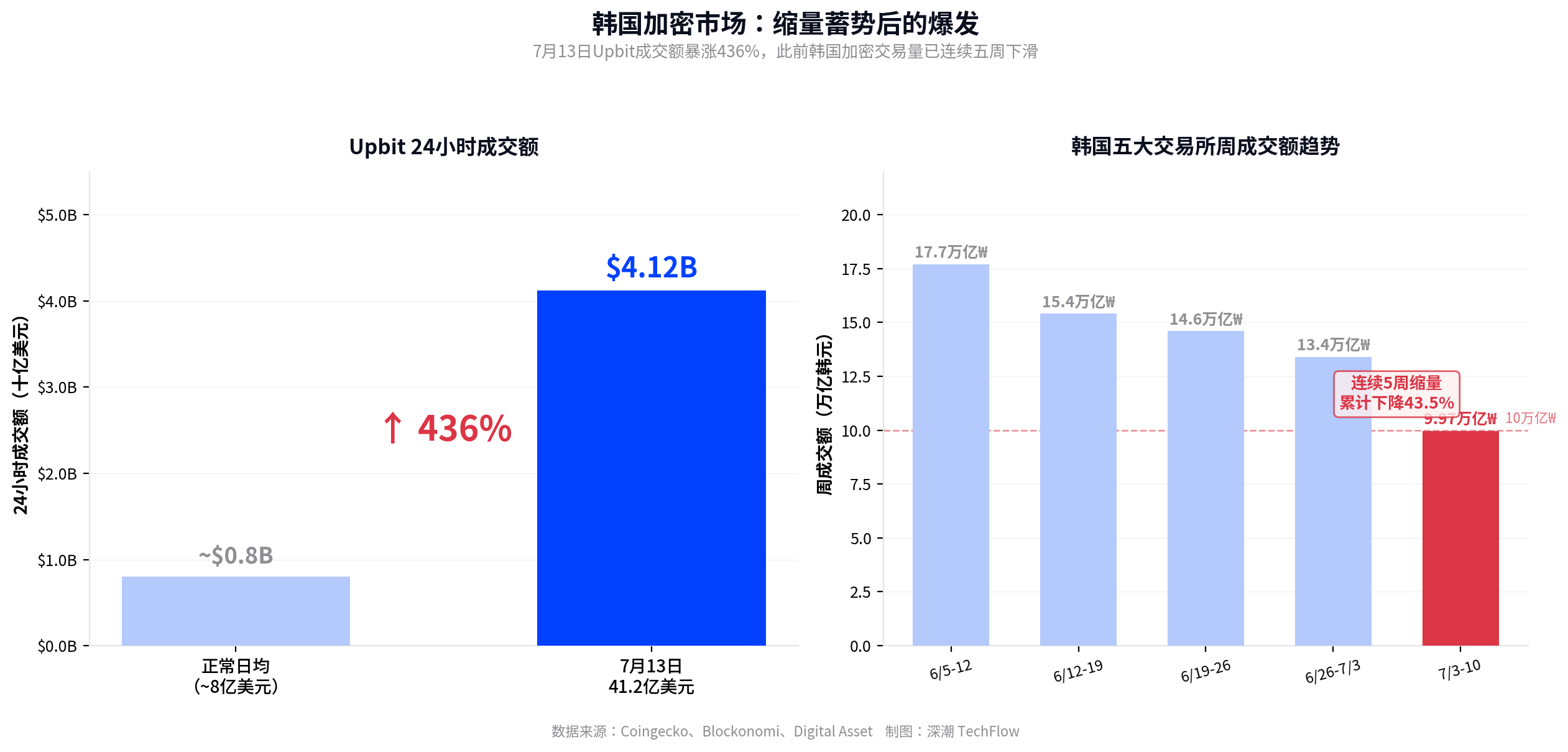
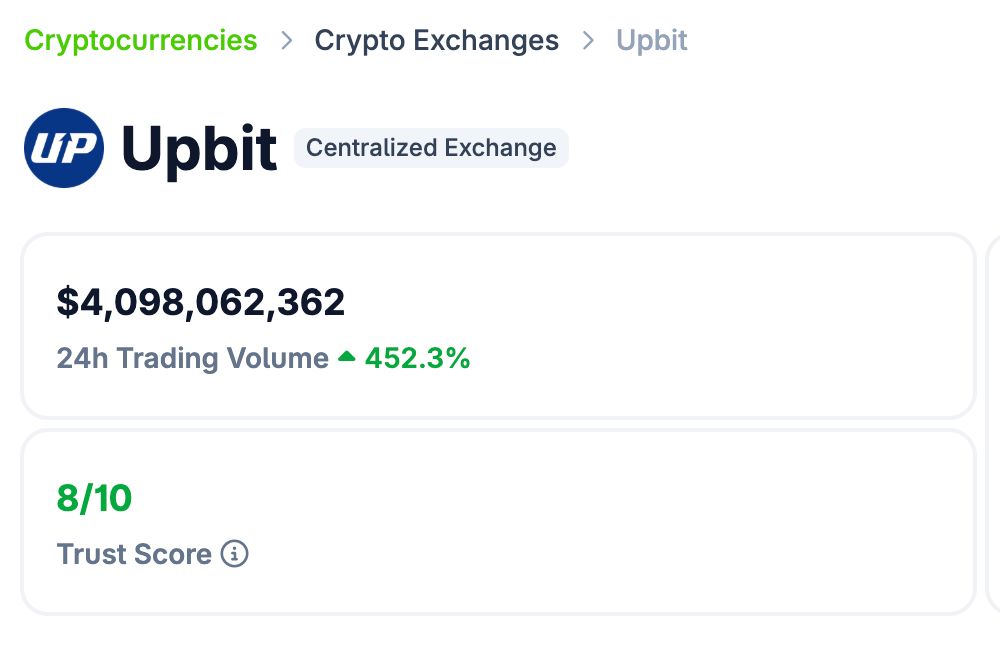
Crypto activity picked up as stocks sold off. According to CoinGecko, Upbit recorded $4.12 billion in trading volume over the past 24 hours, a 436% increase from a day earlier. The top five assets by trading volume were BTC, XRP, ETH, T, the token of Threshold Network, and BLAST.
The report said this shift by South Korean retail traders from equities to crypto is not new. During an earlier KOSPI decline in May, XRP became the most-traded crypto asset on Upbit and Bithumb, with single-day turnover exceeding that of BTC and ETH.
Tiger Research analyst Ryan Yoon linked the move to South Korean retail investors in their 40s and 50s, saying they have been pulling money from domestic equities and U.S. stocks and reallocating it into crypto, with XRP as a preferred target.
Before this jump in activity, South Korea’s crypto market had gone through five straight weeks of lower volume. From July 3 to July 10, total trading across the country’s five won-based exchanges — Upbit, Bithumb, Coinone, Korbit and Gopax — fell 25.75% week over week to 9.9676 trillion won, the first reading below 10 trillion won since September 2023.
The appearance of Threshold and BLAST among the top five most-traded assets also reflected local retail appetite for smaller-cap tokens. Data cited from Bitcoin Sistemi showed T posted $68.27 million in 24-hour trading volume on Upbit and about $76.75 million across South Korean exchanges.
A familiar rotation between stocks and crypto
The article described South Korea as one of the few markets where retail money moves at scale between equities and digital assets. More than 16.2 million people in the country now hold crypto accounts, equal to about 32% of the population, and the number of crypto holders has surpassed the number of stock investors.
Chainalysis data showed South Korea has received more than $722 billion in cumulative crypto asset value, ranking second globally behind the United States. Public data cited in the article also showed that stablecoin trading volume across South Korea’s five major exchanges reached 2.226 trillion won, or about $1.62 billion, between July 13 and July 19.
The report said that, based on prior patterns, aggressive retail buying in crypto usually clusters within one to three trading days after a steep KOSPI drop, then fades as the stock market stabilizes. If the KOSPI finds support at current levels, the spillover funds moving into crypto could also leave quickly.