
South Korea’s F4 coordination body will meet Thursday to discuss how single-stock leveraged exchange-traded funds are affecting the stock market. The topic has now reached the country’s highest-level economic policy platform, bringing together the Ministry of Economy and Finance, the Financial Services Commission, the Bank of Korea and the Financial Supervisory Service.
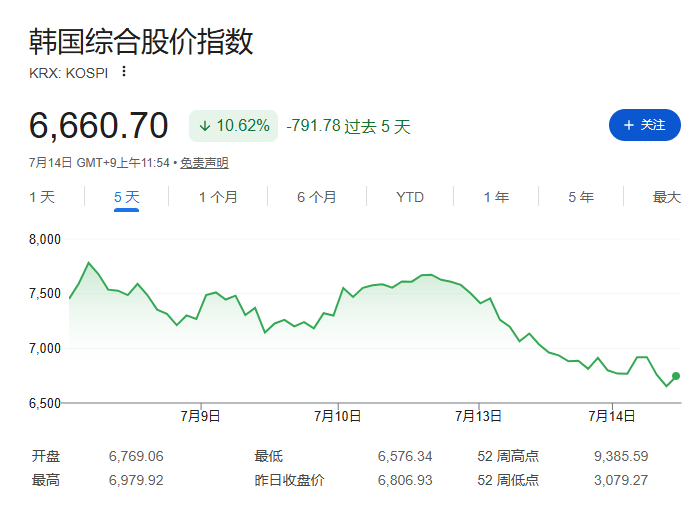
The immediate trigger was a sharp selloff in the KOSPI. The index fell more than 8% in a single session on Monday, setting off the year’s seventh circuit breaker, and the focus quickly turned to single-stock leveraged ETFs.
Product launched on May 27
The products began trading on May 27 and let investors make 2x bets on Samsung Electronics and SK Hynix. Their returns are tied to a multiple of the daily move in the underlying stock. To maintain that exposure, the funds have to buy or sell the underlying shares each day, a mechanism that has drawn scrutiny during periods of heavy volatility.
Before the government meeting, securities firms and asset managers planned to hold an industry meeting on Tuesday to review the leveraged ETF issue and broader market conditions.
Regulators describe the problem as structural
On July 13, Financial Supervisory Service Governor Lee Chan-jin chaired a closed-door meeting at the Korea Financial Investment Association in Yeouido with representatives from 20 asset management firms. He said, “There are structural problems, so it is unlikely that a clear answer can be given.” He added that the issue could not be solved in a single step and would require continued monitoring, revision and refinement.
Lee did not spell out what he meant by “structural problems.” The report said outside observers have pointed to two factors: individual investors have made net purchases of nearly 10 trillion won in these products, making forced liquidation close to impossible, and the ETFs were introduced after related enforcement rules were revised by the presidential office, the Financial Services Commission and the Korea Exchange, so a forced delisting could damage the credibility of the rules behind the launch.
Lee also said, “This does not appear to be an area where one person can make the decision. The authorities (the Financial Services Commission) may also need broad deliberation. We (the Financial Supervisory Service) will do our best, but we are currently in a position where we are taking criticism. Asset management companies should candidly share their practical demands and institutional suggestions, and that will become an important reference for policy decisions.”
At a regular press briefing on the 22nd of last month, Lee said he regretted not doing everything possible to stop the launch of single-stock leveraged ETFs. The day after that remark, the KOSPI fell 10%. From the 22nd of last month to the 13th of this month, the KOSPI dropped more than 25% in cumulative terms. Earlier this month, Lee said regulators were “seriously reviewing the unintended consequences that have appeared since these products were launched.”
Deputy Prime Minister and Minister of Economy and Finance Koo Yun-cheol said at a National Assembly meeting last week that, given the range of concerns raised, authorities were discussing ways to remedy and minimize the related problems. Kim Yong-beom, senior presidential secretary for policy, said at a press conference that the F4 was closely studying how single-stock leveraged ETFs were amplifying volatility and that remedial steps, if needed, would be decided at the F4 market conditions review meeting.
Three policy options under discussion
Regulators are already examining several paths before Thursday’s meeting. According to South Korea’s financial investment industry, authorities have formally asked asset managers to submit concrete proposals on how to address market swings linked to single-stock leveraged ETFs. Those views will be compiled before a formal policy package is drafted.
The main ideas under discussion fall into three buckets:
- raising margin requirements,
- placing limits on daily price swings,
- adjusting the upper cap on leverage ratios.
The Financial Services Commission is set to convene experts from major securities firms and asset managers on the 14th to discuss supplementary measures. Specific proposals include raising the minimum margin requirement, meaning the amount investors must deposit in advance, and strengthening pre-investment education.
Officials have also acknowledged that these steps may amount to temporary fixes rather than a solution to the structural source of market volatility. Any decision reached on Thursday may therefore be revised later.
Volatility data have worsened since launch
Data cited in the report show a sharp shift in market behavior after the products were introduced. NH Investment & Securities said that in the 96 trading days before the launch, the KOSPI moved more than 3% in either direction on 26 days, or 27% of the time. In the 33 trading days after the launch through the 13th, that share rose to 52%, or 17 days.
For comparison, the report said the S&P 500 has not recorded a daily move of 3% or more so far this year.
Korea Exchange data show the securities market had triggered 35 sidecar trading curbs this year as of the 13th, including 17 buyer-side triggers and 18 seller-side triggers. That is far above the three recorded in all of last year, and it has already surpassed the previous record of 26 set during the 2008 global financial crisis. Full market circuit breakers have been triggered seven times this year, more than half of the cumulative 13 times since the mechanism was introduced in 2000.
The Wall Street Journal also said, “Volatility in the South Korean stock market has been amplified further by leveraged products tied to Samsung Electronics and SK Hynix.”
Thursday meeting now in focus
Kim Yong-beom said the products have been operating for about a month and a half, and the F4 will carefully assess their actual impact on the market.
Expectations are building that the products could face tighter restrictions, including lower leverage, higher investor entry thresholds or other structural limits. The next policy steps will depend on the conclusions reached at Thursday’s F4 meeting.