
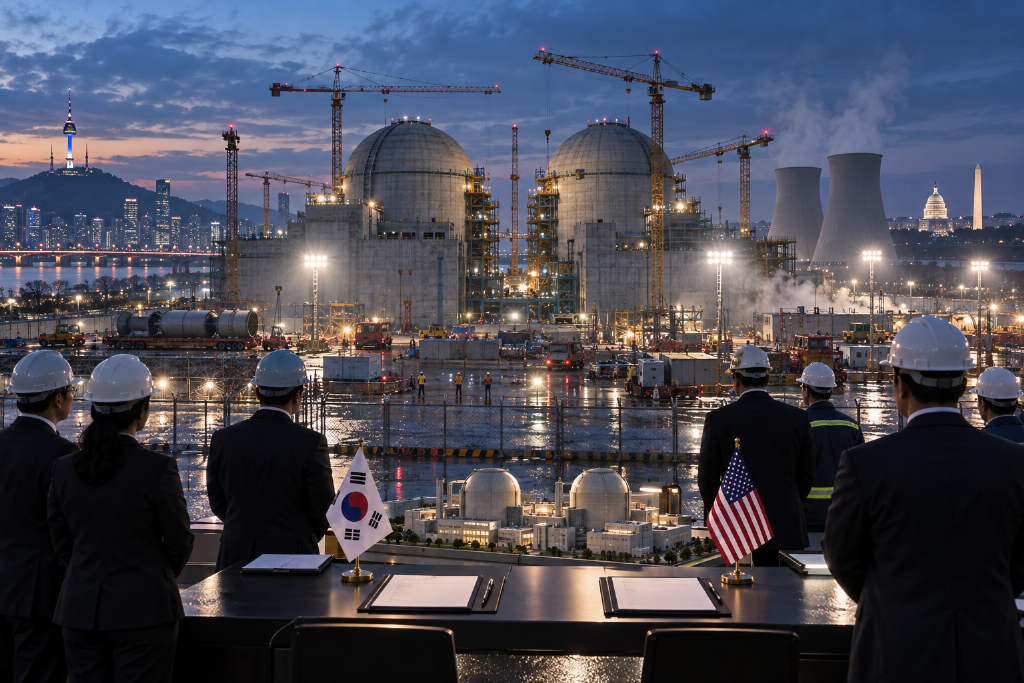
South Korea and the United States are discussing a revised nuclear cooperation plan under which the first four reactors would be split evenly, with each side building two. The proposal also includes the possibility that the two units built by South Korea could later be sold back into the U.S. domestic market. The overall package is valued at $120 billion and covers eight nuclear reactors, with a memorandum of understanding, or MOU, potentially ready as soon as Sept. 18.
If completed as outlined, the eight-reactor project would account for nearly 60% of South Korea’s pledged investment into the United States, according to the report. In practical terms, that would mean close to $6 out of every $10 of South Korean investment committed to the U.S. would be directed toward nuclear reactor construction. The article describes nuclear power as moving from a basic infrastructure issue to one of the heaviest bargaining chips in tariff talks.
First four reactors would be divided equally
The order was originally expected to be led by the United States. Washington’s timetable called for completion before 2030, with specifications centered on 10 models in the 1.1GW class and Westinghouse Electric, the long-established U.S. nuclear company, taking the main construction role.
Under that earlier design, South Korean companies were expected to play a supporting role by supplying peripheral parts and equipment for the reactors, using the AP1000 model preferred by the U.S. side. Seoul, however, was not satisfied with a role limited to contract manufacturing for Westinghouse. South Korea has its own APR1400 reactor design, with generating capacity of 1,400MW, and officials want to bring that technology directly into the U.S. market.
The compromise now described would have South Korea and the U.S. build two reactors each in the first batch of four. The report says the remaining four reactors are still under discussion, including how they would be divided and whose reactor model would be chosen.
$120 billion proposal may be folded into a $350 billion investment MOU
Last month, the United States proposed what the report called a "comprehensive framework," an idea that would direct South Korea’s investment fund in the U.S. toward nuclear power plant construction. In this context, the term refers to setting a binding overall direction first and leaving detailed negotiations for later. Korea JoongAng Daily first reported details of the proposal, according to the article.
The U.S. side is said to be seeking $120 billion. South Korea is considering incorporating the nuclear project into a $350 billion investment MOU with the United States that was signed in October last year. That earlier agreement specified that $200 billion of the total had to be delivered as cash investment. If the nuclear plan is added, it would take up a substantial share of that cash portion.
South Korea’s Ministry of Trade, Industry and Energy briefed the ruling party on the latest progress of the proposal at a closed-door meeting on the 7th. Using an average construction cost of $15 billion per reactor, the total for eight reactors comes to roughly $120 billion, matching the figure sought by the U.S. side.
Sept. 18 seen as the earliest date for a joint announcement
Negotiations remain at the MOU stage, and the operational process for actual construction has not yet moved into detailed talks. People within the ruling camp said South Korea and the U.S. may be able to announce both the broader U.S.-bound investment agreement and the outline of nuclear cooperation as soon as Sept. 18.
The report also stresses that what is currently on the table is still a political commitment at the MOU level. It is not yet the same as breaking ground on the project.
AI-driven power demand has pushed nuclear energy into negotiations
The article ties the deal to a wider structural issue: electricity demand from AI data centers. As power consumption rises, governments are treating electricity supply as a strategic national asset, and nuclear power is being pulled into industrial and tariff negotiations between major economies.
For South Korea, using nuclear cooperation as leverage in tariff discussions serves two goals in the report’s framing. It could help the U.S. address electricity shortages linked to AI demand, while also opening overseas market opportunities for South Korea’s domestically developed APR1400.
Even so, an MOU does not mean construction is ready to begin. Funding sources, reactor model selection and the allocation of the remaining four reactors all remain unsettled. Sept. 18 is shaping up as the first key test of whether the $120 billion commitment moves beyond political language.