
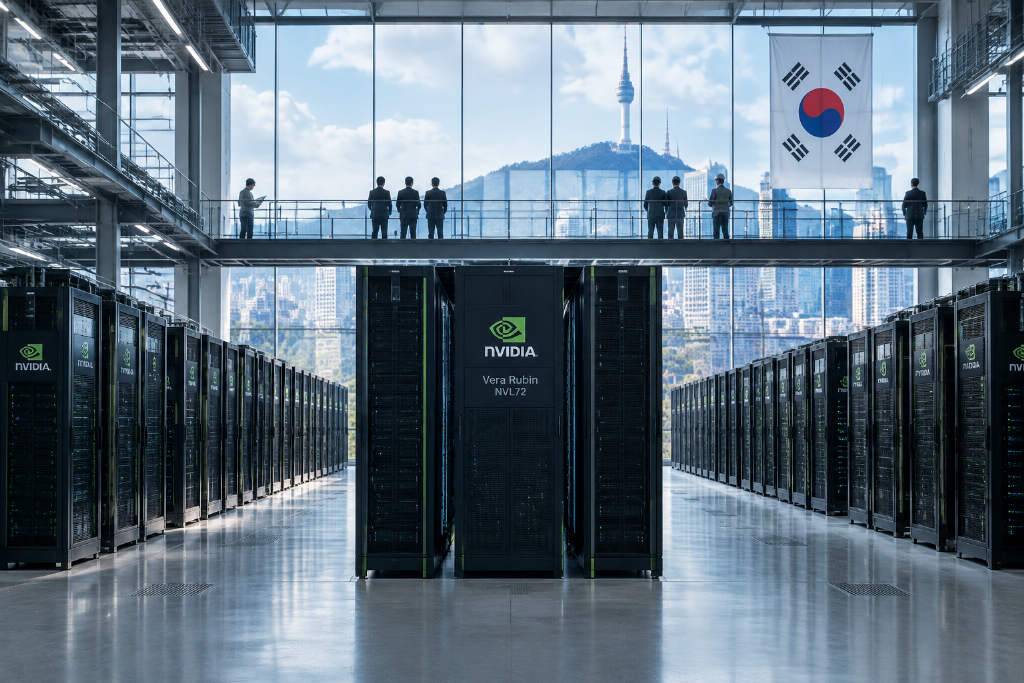
South Korea’s next-generation AI compute procurement plan has come under scrutiny after the government confirmed a budget that implies a much higher price for NVIDIA’s Vera Rubin NVL72 systems than estimates published by Wall Street firms.
The Ministry of Science and ICT said next year’s GPU server expansion budget totals 3.85 trillion won. The full amount is allocated to the purchase of 140 NVIDIA Vera Rubin NVL72 server racks, implying an average budget of 27.5 billion won, or about $20.7 million, per rack.
3.85 trillion won plan covers 140 NVL72 racks
Money Today, citing a "Global AI Frontier Lab" project document obtained by the office of Democratic Party lawmaker Lee Jeong-heon, reported that the entire 3.85 trillion won budget is set aside for 140 Vera Rubin NVL72 server racks.
Each rack includes 72 Rubin GPUs and 36 Vera CPUs. Across 140 racks, that would amount to 10,080 Rubin GPUs in total. The report said the final procurement volume may still change depending on NVIDIA’s supply conditions.
The ministry said the 27.5 billion won budget per rack already factors in possible price increases caused by constrained GPU supply, as well as installation work, infrastructure and related costs.
Government links the purchase to frontier-model ambitions
The policy goal behind the purchase has also been stated publicly. In June, Deputy Prime Minister and Science Minister Bae Kyung-hoon said, 「To develop a model at the level of Anthropic Mythos, about 10,000 Vera Rubin are needed.」
In that context, the procurement is being framed not only as a compute expansion project, but also as part of South Korea’s effort to join the top tier of countries pursuing frontier AI models.
Budget figure stands far above outside estimates
The 27.5 billion won, or roughly $20.7 million, implied price per rack differs sharply from estimates released by foreign financial institutions.
Bernstein said in a report published in June that a Vera Rubin NVL72 rack would cost about $9.1 million. Morgan Stanley’s estimate was about $7.8 million. On that basis, South Korea’s budget figure is 127% above Bernstein’s estimate and 165% above Morgan Stanley’s.
The report added, however, that the comparison is not straightforward because the methodologies are different.
It said Morgan Stanley’s earlier bill-of-materials analysis used the market purchase price paid by cloud providers to NVIDIA, including roughly a 75% gross margin markup, rather than NVIDIA’s manufacturing cost. The South Korean government’s budget, by contrast, also includes a shortage premium and infrastructure buildout expenses.
Public estimates for Vera Rubin have moved higher over recent months
Based on public information from the past six months, market estimates for the Vera Rubin NVL72 rack have been trending upward.
In May, Morgan Stanley first published a $7.8 million teardown estimate. That was already close to double the $3.99 million estimate for the previous-generation GB300 NVL72 rack, while memory costs were said to be up 435%. In June, Bernstein raised its estimate to $9.1 million.
In July, research firm Futurum estimated the BOM cost of NVIDIA’s second-generation Vera Rubin rack, which was not the NVL72 discussed above, at $3.5 million to $4 million. AMD’s competing Helios rack system was priced at $5 million to $5.5 million, about 40% higher.
Actual NVL72 transaction price remains unknown
The report stressed that current Vera Rubin pricing figures from outside institutions are still analyst estimates based on public information, not official NVIDIA quotes. The actual market transaction price for the NVL72 remains unknown.
With governments and large technology companies continuing to buy AI chips aggressively, South Korea’s budgeted figure of about $20.7 million per rack has put fresh attention on how supply constraints and infrastructure spending may shape the total cost of high-end AI compute systems.