
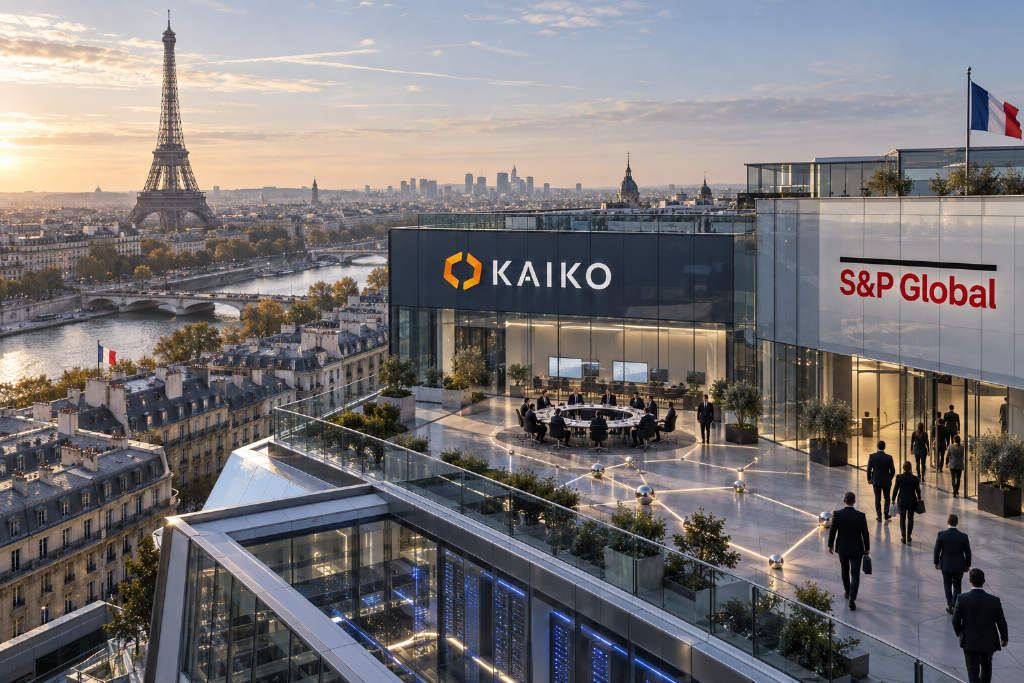
Crypto market data provider Kaiko said on Sept. 14 that it had raised an extension to its Series B round, taking total funding to $110 million, with S&P Global leading the financing. The round included BNP Paribas, Bpifrance, Broadridge, Canton Foundation, Coinbase Ventures, DRW Venture Capital, Nasdaq Ventures, RBC, Stellar and Susquehanna Private Equity Investments. Existing investors Anthemis, Point Nine and Revaia also participated.
Kaiko said S&P Global invested through S&P Global Ventures and framed the deal as an expansion of an existing strategic relationship rather than a purely financial position. Alongside the financing, the company also announced a Strategic Industry Working Group chaired by Kaiko and joined by all strategic investors. The group is intended to develop data standards and infrastructure norms needed for tokenized markets.
From Challenger Deep to institutional crypto data
Kaiko was founded in Paris in 2014 by French serial entrepreneur Pascal Gauthier. The company was first named Challenger Deep, a reference to the deepest point of the Mariana Trench. It later adopted the name Kaiko, which the report said comes from the Japanese word for trench and from the name of the JAMSTEC submersible that reached Challenger Deep in 1995. Its legal entity remains registered as Challenger Deep SAS.
The company struggled to find a market in its early years. In 2017, Gauthier shifted his focus to Ledger and handed operating control of Kaiko to Ambre Soubiran, now the company’s chief executive officer and chairwoman.
Soubiran studied applied mathematics and computer science at Paris Dauphine University. From 2008 to 2016, she worked in equity derivatives and financing structuring at HSBC Global Markets. The report said she bought her first BTC at a Bitcoin meetup in London in 2012 and was later known inside the bank as “the Bitcoin person.”
When she took over Kaiko, the company had two engineers left and a database with few institutional clients. Kaiko then rebuilt its product line, pushed ahead with EU-BMR certification and expanded into New York, London and Singapore.
The report also highlighted the backgrounds of other senior executives. Chief Product and Technology Officer Karamvir Singh spent more than a decade in trading and systems roles at TP ICAP and SMBC Capital Markets. Chief Operating Officer Elodie de Marchi-Chouard speaks four languages and was selected for Bloomberg New Voices. Chief Revenue Officer Bediss Cherif led product from 2020 before shifting to global commercialization.
Why S&P Global led the round
The equity investment followed several projects between Kaiko and S&P businesses. On March 31, S&P Dow Jones Indices and Kaiko put the iBoxx U.S. Treasuries Index on Canton Network in NFT form, embedding distribution and licensing rights. The two companies described it as the first time a major index provider turned a mainstream financial benchmark into a native on-chain digital asset.
On Sept. 1, they launched the co-branded S&P Kaiko Digital Asset Indices, covering more than 4,000 rates and indices. Two weeks later, that commercial cooperation turned into an equity link, with S&P becoming a shareholder in Kaiko.
Cathy Clay, chief executive officer of S&P DJI, said: 「Kaiko transforms complex trade and on-chain activity into reliable, decision-ready intelligence, building a bridge between traditional finance and decentralized finance and giving institutions the trust they need to deploy capital on-chain with confidence.」
A working group spanning exchanges, banks, market makers and settlement channels
The Strategic Industry Working Group adds another layer to the deal. According to the report, Nasdaq and BNP Paribas bring exchange and banking infrastructure, DRW and Susquehanna represent market makers, Broadridge covers securities clearing channels, and Canton Foundation is tied to a compliance-focused privacy blockchain network backed by institutions including Goldman Sachs. Coinbase Ventures and Stellar represent the crypto-native side.
Those institutions will work together on data rules tied to 24/7 pricing, on-chain valuation and oracle feeds, according to the report. It said the arrangement shows major financial infrastructure players moving to secure a position in the market for on-chain data.
Twelve years of building, compliance work and acquisitions
Kaiko’s path was not smooth. The company generated almost no revenue in its first years after launch. It raised about $24 million in a Series A round in 2021 and $53 million in a Series B round in June 2022. The report said those two rounds, totaling about $77 million, helped Kaiko complete EU-BMR certification, ESMA registration and SOC 1/2 Type 2 audits.
In the institutional crypto data market, the report said Kaiko’s main rivals were not retail-facing platforms such as CoinGecko, but peers chasing the same institutional client base. It identified U.S.-based Coin Metrics and UK-based CCData as direct competitors in exchange market data.
Amberdata, a San Francisco company focused on on-chain data and DeFi analytics, was initially more complementary. As Wall Street demand for deeper on-chain transparency grew, however, the two firms’ client bases increasingly overlapped, turning Amberdata into one of Kaiko’s most serious competitors in the on-chain segment.
The report said Kaiko accelerated in 2026. In February, Bloomberg and Kaiko worked together to bring Data License data on-chain to address reconciliation losses in tokenization workflows caused by inconsistent source standards and timestamp mismatches. In May, Kaiko acquired French DeFi infrastructure company Cometh, adding a MiCA CASP compliance license and strengthening its qualifications for on-chain business under the European Union framework. In June, it acquired Amberdata, bringing in capabilities across DeFi protocol data, on-chain wallet tracking and MEV monitoring, while also expanding its North American institutional client network.
More than 150 exchanges and protocols, more than 250 institutions and regulators
By the time the new financing was announced, Kaiko said it covered more than 150 exchanges and protocols and served more than 250 financial institutions and regulators. The report described the company’s twelve-year journey as a rise from a Paris startup that nearly failed into an on-chain financial data infrastructure provider backed or used by S&P, Nasdaq, BNP Paribas and Bloomberg.
The original article also included a disclaimer that markets carry risk and that the piece does not constitute investment advice.
