
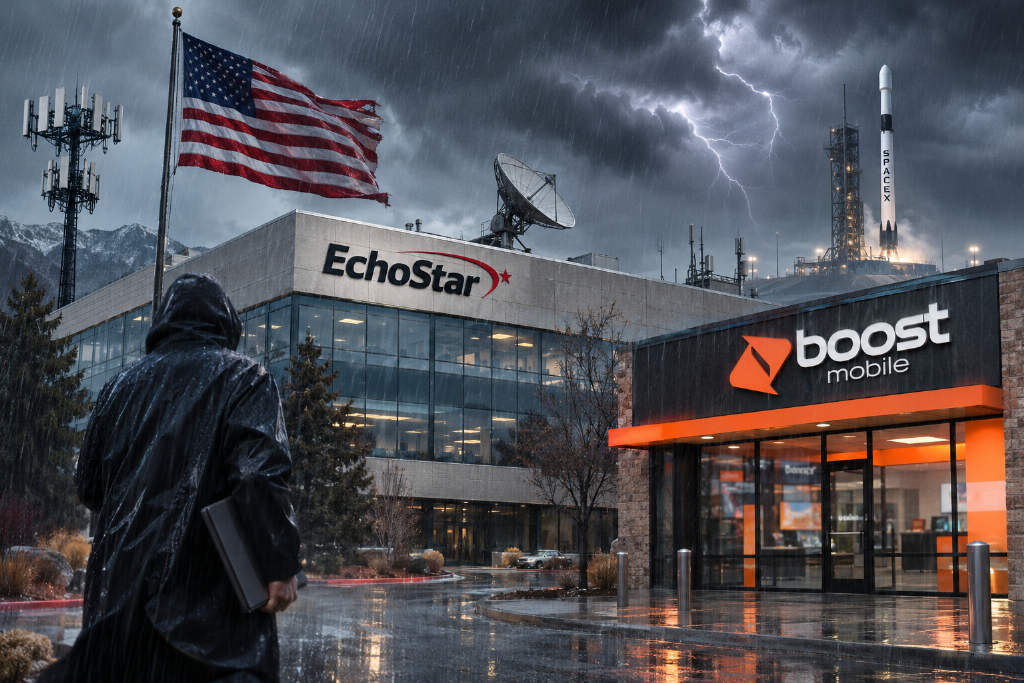
After failing to win network access from major U.S. telecom operators, Elon Musk’s SpaceX has shifted to talks with EchoStar, exploring either an acquisition of Boost Mobile or a deal to use its network as a way into the U.S. wireless market.
According to The Washington Post, the move targets a U.S. wireless sector that MoffettNathanson estimates at roughly $235 billion. The report said this route could redraw the competitive line between space companies and terrestrial telecom carriers.
SpaceX pivots after Verizon, T-Mobile and AT&T say no
The report said Musk had approached senior executives at major U.S. carriers, including Verizon, in recent months, asking them to open their networks to support a SpaceX-branded phone service. Verizon, T-Mobile and AT&T all declined.
SpaceX then turned to EchoStar, the parent company of Boost Mobile. People familiar with the matter told The Washington Post that Musk met EchoStar chairman Charlie Ergen last month. The discussions are centered on Boost Mobile. SpaceX wants its own branded mobile service, while Boost already has an established brand and an existing subscriber base.
That does not remove the large carriers from the equation. Boost leases network capacity from AT&T and T-Mobile, so any transfer arrangement or network access deal for SpaceX would typically still require consent from those two companies. In other words, even if SpaceX reaches a deal to buy Boost or use Boost’s network, it would not automatically bypass the biggest telecom operators.
Verizon and EchoStar declined to comment publicly. AT&T, T-Mobile, SpaceX and Musk did not respond to The Washington Post’s requests for comment.
Spectrum purchase adds to SpaceX’s mobile push
Earlier this month, SpaceX agreed to spend about $8 billion on wireless spectrum licenses suited for places where satellite coverage does not reach effectively. Musk wrote on X that the purchase was “the final piece of the spectrum puzzle needed for complete phone coverage in America.”
SpaceX now has more than 12,000 satellites in orbit. On a recent earnings call, CFO Bret Johnsen said the company’s goal is to become a “major mobile carrier” in the United States.
Musk has also estimated that SpaceX’s businesses could reach an annualized revenue run rate of $1 trillion as early as 2027. That estimate was presented as Musk’s own view.
Satellite-to-phone service still faces limits on the ground
For SpaceX, the EchoStar talks are not just about adding another SIM option. The company is also looking for a terrestrial entry point that could reach urban users more quickly, alongside its direct-to-cell satellite efforts.
Tim Farrar, an analyst at TMF Associates, said current satellite signal strength is still not enough to support everyday usage indoors and in dense urban areas. A partnership with an operator such as Boost could let SpaceX rely on traditional cell towers for coverage while continuing to improve direct satellite connectivity.
A Verizon chief executive previously said SpaceX would need about four to six years to build out a full terrestrial infrastructure if it chose to do so itself. Musk replied that it would take about half that time. The Washington Post noted in its report that Musk’s timeline estimates have often been optimistic.
Drew Cupps, a portfolio manager at Polen Capital, said the telecom industry should take the pressure seriously. He compared the situation to Tesla’s Supercharger network, which he said has deployed about 80,000 charging stalls globally. In his view, the first operator to form a real alliance with SpaceX could gain an early advantage.
A new pressure point in the U.S. telecom market
If the talks lead to a deal, the significance would go beyond adding one more mobile virtual network operator. The report describes a broader plan in which SpaceX combines its satellite constellation, spectrum licenses and a possible Boost distribution channel into one commercial blueprint.
For Verizon, AT&T and T-Mobile, refusing wholesale access did not make the challenger disappear. It may instead have pushed SpaceX toward a smaller player that can be acquired or used as a network partner. For U.S. consumers, whether a space-branded mobile option appears in the next few years will depend on how spectrum, tower infrastructure and carrier approvals come together.




