
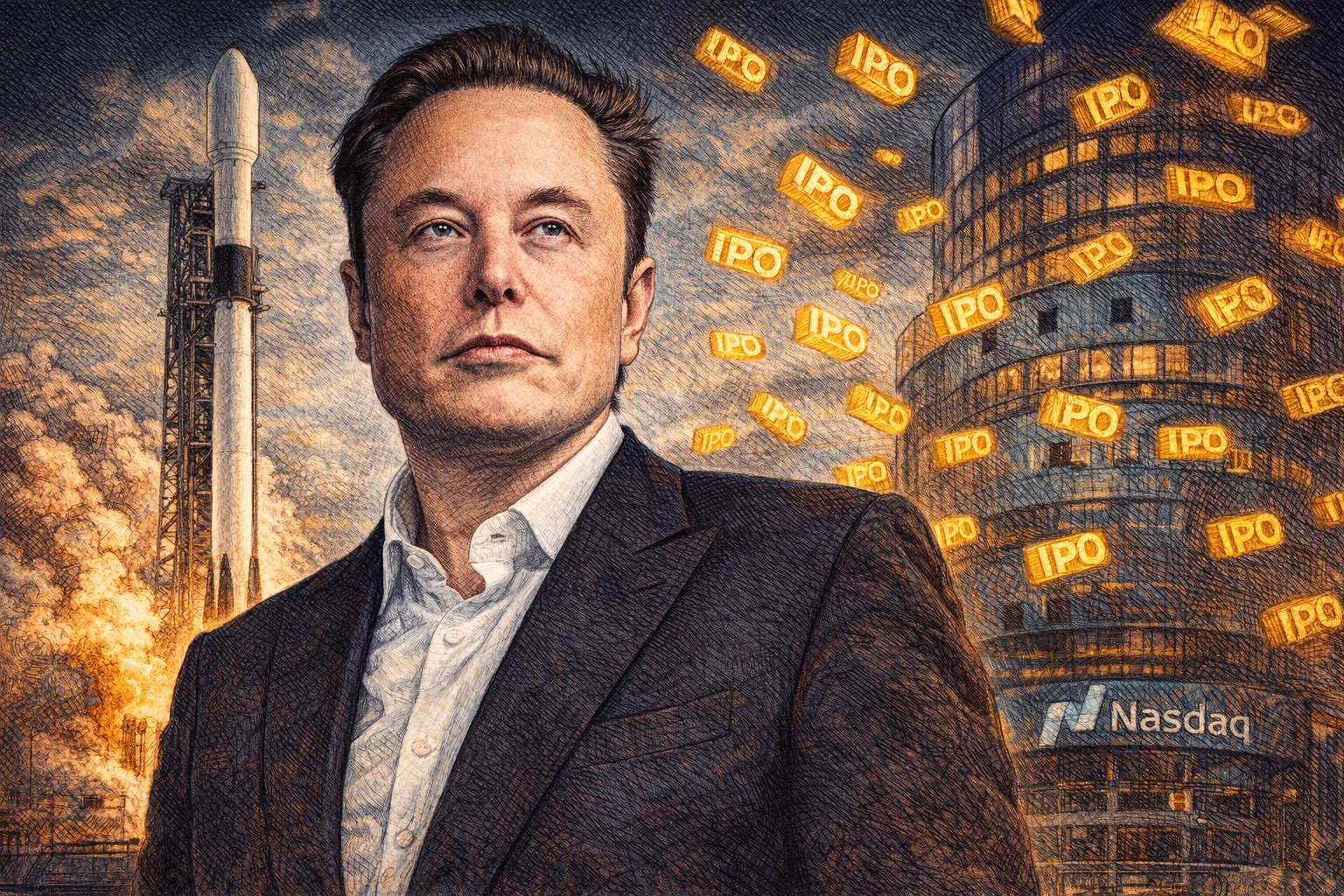
SpaceX is days away from its long-awaited public debut. The rocket and satellite company founded by Elon Musk in 2002 has operated privately for 24 years, barring most investors from owning its shares. That changes on June 12, 2026, when SPCX begins trading on the Nasdaq at a fixed IPO price of $135 per share. The company plans to sell 555,555,555 Class A shares, targeting a record $75 billion raise — more than double the $29.4 billion raised by Saudi Aramco in 2019.
SpaceX IPO Timeline: June 12 Listing, $135 Fixed Price
SpaceX filed a confidential draft registration with the SEC on April 1, 2026, publicly released its S-1 on May 20, and kicked off its roadshow on June 4. Final pricing is set for June 11 after market close, with trading to begin June 12. Goldman Sachs is the lead underwriter, with Morgan Stanley, Bank of America, Citigroup, and JPMorgan Chase as joint bookrunners. The roadshow deck has been made publicly available — an unusual move for a deal of this size.
$135 Per Share Implies $1.75 Trillion Valuation
At the fixed price, SpaceX's implied market cap stands at roughly $1.75 trillion, placing it among the top 10 U.S. public companies by market value — ahead of Meta Platforms, Berkshire Hathaway, and Tesla. The underwriters hold a greenshoe option to sell up to 83.3 million additional shares, potentially boosting total proceeds above $86 billion. The offering is all-primary; every dollar goes to SpaceX's treasury, with no existing shareholders cashing out.
Retail Investors Get 30% Allocation via Five Brokers
In a rare move, SpaceX has reserved up to 30% of IPO shares for retail investors — about three times the typical proportion for a deal this size. Eligible platforms include Fidelity (min. $2,000 account balance), Charles Schwab (min. $100,000 in eligible assets), Robinhood (no minimum, pro-rata allocation), SoFi, and E*TRADE. Submitting an indication of interest does not guarantee an allocation. Unallocated investors can buy SPCX on the open market from June 12. Separately, MEXC lists the SPACEX(PRE) token, which mirrors SpaceX's valuation but carries no voting or dividend rights.
S-1 Financials: $18.7B Revenue, $4.9B Net Loss in 2025
SpaceX reported $18.67 billion in revenue for 2025, up 33% year-over-year, but a net loss of $4.94 billion — a sharp reversal from a $791 million profit in 2024. The losses stem largely from the merger with xAI in February 2026, adding significant AI-related expenses. Starlink remains the core business driver. The $1.75 trillion valuation represents roughly 93.7 times annualized revenue, reflecting high growth expectations rather than current profitability.
Musk Controls 82.4% Voting Power via Dual-Class Structure
Post-IPO, Elon Musk will hold about 82.4% of total voting power through Class B shares (10 votes each), while public Class A shares carry one vote. This dual-class structure allows Musk to control strategic decisions without majority support from public shareholders — a risk explicitly highlighted in the S-1. Investors should weigh this governance factor when evaluating SPCX.