
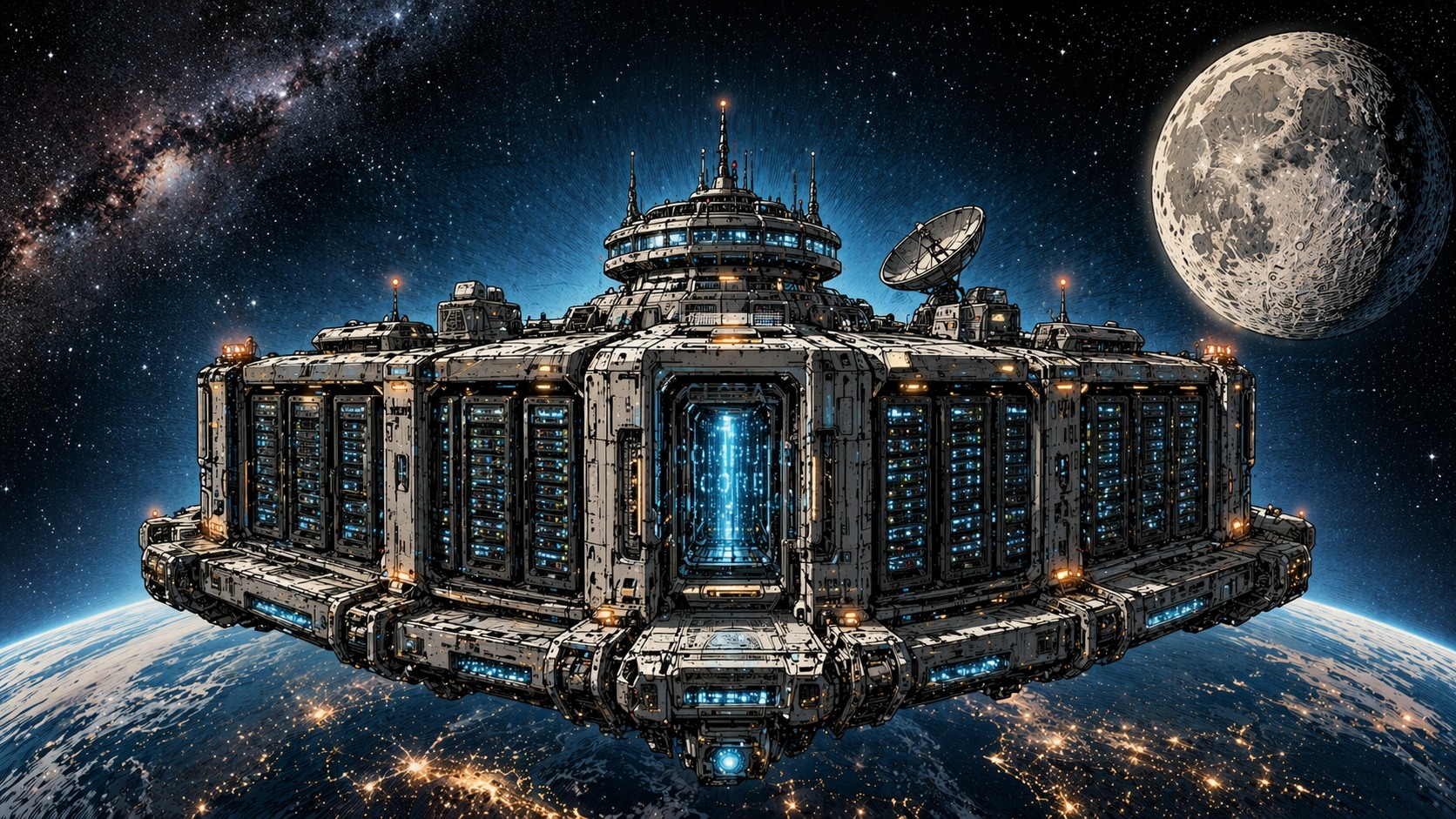
SpaceX's IPO filing explicitly warns that its orbital AI computing plans involve significant technical complexity and unproven technology, potentially making them not commercially viable. This stands in stark contrast to CEO Elon Musk's public statements at the World Economic Forum, where he claimed space data centers are "obviously the only path for expansion."
The previously unreported S-1 filing, obtained and confirmed by Reuters, emphasizes that space data centers would operate under "the harsh and unpredictable conditions of the space environment, exposed to unique and wide-ranging space-related risks that could result in failure or malfunction." The filing serves as a legal commitment to investors, while Musk's speeches aim to communicate a vision to the public — two distinct narratives serving different purposes.
Musk's Vision vs. Legal Caution
In January 2026, Musk stated at Davos that space AI data centers would become the "cheapest option" within two to three years, citing near-orbit solar power costs of just $0.005/kWh, roughly 1/15th of terrestrial wholesale rates, and the elimination of cooling water needs in vacuum. He later called space AI "the only path for expansion." However, SpaceX's lawyers and CFO wrote in the S-1: "Our plans for orbital AI computing and related industrialization are in an early stage, involve significant technical complexity and unproven technology, and may not achieve commercial viability."
Technical Hurdles: Heat, Bandwidth, and Maintenance
SpaceX has applied with the FCC to deploy up to 1 million solar-powered data center satellites in low Earth orbit, but the engineering challenges are widely discussed. Heat dissipation is a core issue: GPUs in vacuum cannot rely on convection cooling, only radiative cooling, a problem not yet solved at commercial scale. Network bandwidth is another bottleneck — latency and throughput between orbit and ground via Starlink remain constraints for large model training. Maintenance and upgrade costs far exceed terrestrial data centers. A former NASA engineer publicly called putting data centers in space "the worst idea I've ever heard." The filing's language aligns more with this assessment than Musk's optimism.
Two Narratives Behind a $1.75 Trillion Valuation
SpaceX is preparing for an IPO at an estimated $1.75 trillion valuation. If the $75 billion fundraising materializes, it would surpass Saudi Aramco's record as the largest IPO in history. The space AI data center narrative is a key marketing element, representing a story of computing growth without earthly limits. The S-1's risk disclosure does not erase that story, but it legally requires SpaceX to inform investors that the technological dream has not yet been proven profitable.